
Oral Cavity, Oropharyngeal, Hypopharyngeal, and Laryngeal Cancers Prevention (PDQ®)–Patient Version
What is prevention?
Cancer prevention is action taken to lower the chance of getting cancer. By preventing cancer, the number of new cases of cancer in a group or population is lowered. Hopefully, this will lower the number of deaths caused by cancer.
To prevent new cancers from starting, scientists look at risk factors and protective factors. Anything that increases your chance of developing cancer is called a cancer risk factor; anything that decreases your chance of developing cancer is called a cancer protective factor.
Some risk factors for cancer can be avoided, but many cannot. For example, both smoking and inheriting certain genes are risk factors for some types of cancer, but only smoking can be avoided. Regular exercise and a healthy diet may be protective factors for some types of cancer. Avoiding risk factors and increasing protective factors may lower your risk but it does not mean that you will not get cancer.
Different ways to prevent cancer are being studied, including:
- Changing lifestyle or eating habits.
- Avoiding things known to cause cancer.
- Taking medicines to treat a precancerous condition or to keep cancer from starting.
For information about screening, diagnosis, and treatment of oral cavity, oropharyngeal, hypopharyngeal, and laryngeal cancer, see the following:
General Information About Oral Cavity, Oropharyngeal, Hypopharyngeal, and Laryngeal Cancers
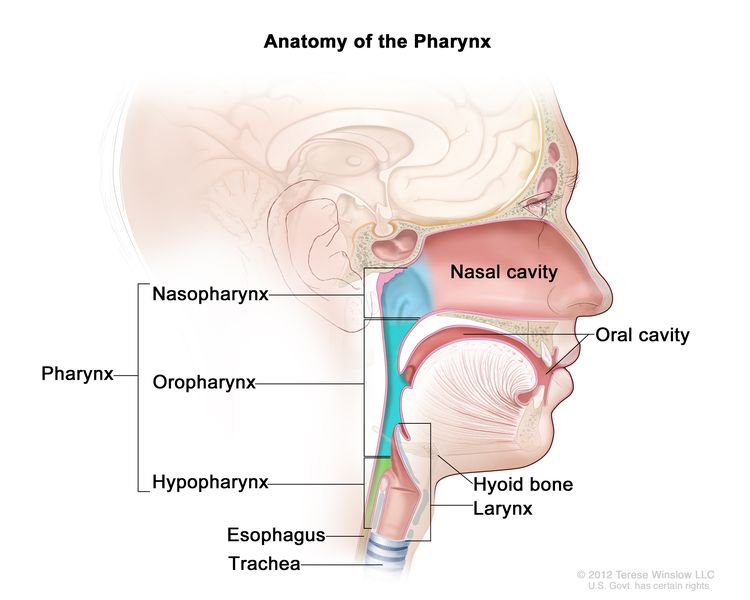
Oral cavity, pharyngeal, and laryngeal cancers usually form in the squamous cells (thin, flat cells lining the inside of the oral cavity, pharynx, and larynx).
Oral cavity cancer forms in any of these tissues of the oral cavity:
- The lips.
- The front two thirds of the tongue.
- The gingiva (gums).
- The buccal mucosa (the lining of the inside of the cheeks).
- The floor (bottom) of the mouth under the tongue.
- The hard palate (the front, bony part of the roof of the mouth).
- The retromolar trigone (the small area behind the wisdom teeth).

Pharyngeal cancer forms in any of these tissues of the pharynx (throat):
- The nasopharynx (the upper part of the throat behind the nose).
- The oropharynx, which includes the following tissues:
- The middle part of the throat behind the mouth.
- The back one third of the tongue.
- The soft palate (the back of the roof of the mouth), including the uvula.
- The side and back walls of the throat.
- The tonsils.
- The hypopharynx (the bottom part of the throat).
Cancers of the nasopharynx have causes, screening, risk factors, and treatment approaches which are distinct from other cancers of the pharynx. For more information, see Nasopharyngeal Cancer Treatment and Oral Cavity and Nasopharyngeal Cancers Screening.
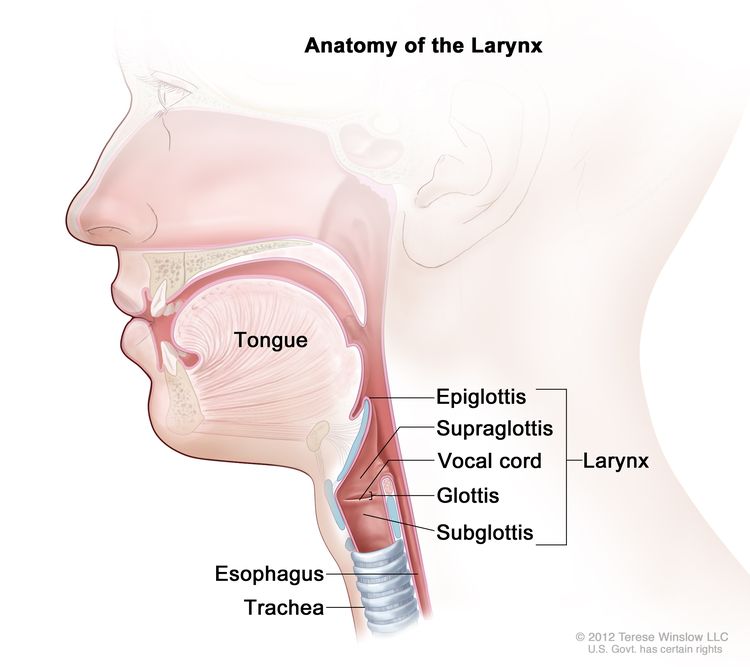
Laryngeal cancer forms in any of these tissues of the larynx (voice box):
- The supraglottis (the area above the vocal cords, including the epiglottis).
- The vocal cords (two small bands of muscle within the larynx that vibrate to produce the voice).
- The glottis (the middle part of the larynx, including the vocal cords).
- The subglottis (the lowest part of the larynx, from just below the vocal cords to the top of the trachea).
Oral cavity cancer and oropharyngeal cancer: Men are more than twice as likely as women to have oral cavity cancer or oropharyngeal cancer and die from it.
Hypopharyngeal cancer: Hypopharyngeal cancer is rare. The number of new cases of hypopharyngeal cancer has slightly decreased over the past twenty years. The decrease in new cases is likely because of a decrease in cigarette smoking.
Nasopharyngeal cancer: Nasopharyngeal cancer is rare in the United States. It is more common in parts of Asia, the Arctic region, North Africa, and the Middle East.
Laryngeal cancer: Laryngeal cancer is less common than oral cavity and oropharyngeal cancers. The number of new cases of laryngeal cancer has slightly decreased over the past ten years. The decrease in new cases is likely because of a decrease in cigarette smoking.
Oral Cavity, Oropharyngeal, Hypopharyngeal, and Laryngeal Cancers Prevention
Key Points
- Avoiding risk factors and increasing protective factors may help prevent cancer.
- The following are risk factors for oral cavity, oropharyngeal, hypopharyngeal, and laryngeal cancers:
- Tobacco use
- Alcohol use
- Tobacco and alcohol use
- Betel quid chewing
- Personal history of head and neck cancer
- The following is a risk factor for oral cavity cancer and oropharyngeal cancer:
- Human papillomavirus (HPV) infection
- The following is a protective factor for oral cavity, oropharyngeal, hypopharyngeal, and laryngeal cancers:
- Quitting smoking
- It is not clear whether avoiding certain risk factors will decrease the risk of oral cavity, oropharyngeal, hypopharyngeal, and laryngeal cancers.
- Cancer prevention clinical trials are used to study ways to prevent cancer.
- New ways to prevent oral cavity, oropharyngeal, hypopharyngeal, and laryngeal cancers are being studied in clinical trials.
Avoiding risk factors and increasing protective factors may help prevent cancer.
Avoiding cancer risk factors may help prevent certain cancers. Risk factors include smoking, having overweight, and not getting enough exercise. Increasing protective factors such as quitting smoking and exercising may also help prevent some cancers. Talk to your doctor or other health care professional about how you might lower your risk of cancer.
Oral cavity, oropharyngeal, hypopharyngeal, and laryngeal cancers have common risk factors.
The following are risk factors for oral cavity, oropharyngeal, hypopharyngeal, and laryngeal cancers:
Tobacco use
Using tobacco is the most common cause of oral cavity, oropharyngeal, hypopharyngeal, and laryngeal cancers. The risk of these cancers is about 5 to 10 times higher for current smokers than for people who have never smoked, and is linked to how much and how long the person has smoked.
The use of all types of tobacco, including cigarettes, pipes, cigars, and smokeless tobacco (snuff and chewing tobacco) can cause cancers of the oral cavity, oropharynx, hypopharynx, and larynx.
Alcohol use
Using alcohol is also an important risk factor for oral cavity, oropharyngeal, hypopharyngeal, and laryngeal cancers.
The risk of oral cavity, oropharyngeal, hypopharyngeal, and laryngeal cancers increases with the number of alcoholic drinks consumed per day. The risk of these cancers is 2 to 6 times higher in people who have 2 or more alcoholic drinks per day compared with those who don't drink alcohol.
Tobacco and alcohol use
The risk of oral cavity, oropharyngeal, hypopharyngeal, and laryngeal cancers is higher in people who use both tobacco and alcohol than it is in people who use only tobacco or only alcohol. The risk of oral cavity cancer and oropharyngeal cancer is about 5 to 14 times higher in people who both smoke and drink heavily than it is in people who never smoke cigarettes or consume alcohol.
Betel quid chewing
Chewing betel quid alone or with added tobacco has been shown to increase the risk of oral cavity, oropharyngeal, hypopharyngeal, and laryngeal cancers. Betel quid contains areca nut, which is a cancer-causing substance. The risk of these cancers increases with how long and how often betel quid is chewed. The risk is higher when chewing betel quid with tobacco than when chewing betel quid alone. Betel quid chewing is common in many countries in South Asia and Southeast Asia, including China and India.
Personal history of head and neck cancer
A personal history of head and neck cancer increases the risk of oral cavity, oropharyngeal, hypopharyngeal, and laryngeal cancers.
The following is a risk factor for oral cavity cancer and oropharyngeal cancer:
Human papillomavirus (HPV) infection
Being infected with certain types of human papillomavirus (HPV), especially HPV-16, increases the risk of oropharyngeal cancers. HPV infection may also increase the risk of some oral cavity cancers. HPV infection is spread mainly through sexual contact.
The risk of oropharyngeal cancer is about 15 times higher in people who have oral HPV-16 infection compared with people who do not have oral HPV-16 infection.
The following is a protective factor for oral cavity, oropharyngeal, hypopharyngeal, and laryngeal cancers:
Quitting smoking
Studies have shown that when people stop smoking cigarettes, their risk of oral cavity, oropharyngeal, hypopharyngeal, and laryngeal cancers decreases by one half (50%) within 5 to 9 years. Within 20 years of quitting, their risk of these cancers is the same as for a person who never smoked cigarettes.
It is not clear whether avoiding certain risk factors will decrease the risk of oral cavity, oropharyngeal, hypopharyngeal, and laryngeal cancers.
Some studies show that when people stop drinking alcohol, their risk of oral cavity and laryngeal cancers decreases within about 20 years.
Getting an HPV vaccination greatly lessens the risk of oral HPV infection. It is not yet known whether getting an HPV vaccination at any age will decrease the risk of oropharyngeal cancer from HPV infection. For information about the use of HPV vaccination to prevent cervical cancer, see Cervical Cancer Causes, Risk Factors, and Prevention.
Cancer prevention clinical trials are used to study ways to prevent cancer.
Cancer prevention clinical trials are used to study ways to lower the risk of certain types of cancer. Some cancer prevention trials are done with healthy people who have not had cancer but who have an increased risk for cancer. Other prevention trials are done with people who have had cancer and are trying to prevent another cancer of the same type or to lower their chance of developing a new type of cancer. Other trials are done with healthy volunteers who are not known to have any risk factors for cancer.
The purpose of some cancer prevention clinical trials is to find out whether actions people take can prevent cancer. These may include eating fruits and vegetables, exercising, quitting smoking, or taking certain medicines, vitamins, minerals, or food supplements.
New ways to prevent oral cavity, oropharyngeal, hypopharyngeal, and laryngeal cancers are being studied in clinical trials.
Information about clinical trials supported by NCI can be found on NCI’s clinical trials search webpage. Clinical trials supported by other organizations can be found on the ClinicalTrials.gov website.
About This PDQ Summary
About PDQ
Physician Data Query (PDQ) is the National Cancer Institute's (NCI's) comprehensive cancer information database. The PDQ database contains summaries of the latest published information on cancer prevention, detection, genetics, treatment, supportive care, and complementary and alternative medicine. Most summaries come in two versions. The health professional versions have detailed information written in technical language. The patient versions are written in easy-to-understand, nontechnical language. Both versions have cancer information that is accurate and up to date and most versions are also available in Spanish.
PDQ is a service of the NCI. The NCI is part of the National Institutes of Health (NIH). NIH is the federal government’s center of biomedical research. The PDQ summaries are based on an independent review of the medical literature. They are not policy statements of the NCI or the NIH.
Purpose of This Summary
This PDQ cancer information summary has current information about oral cavity, oropharyngeal, hypopharyngeal, and laryngeal cancers prevention. It is meant to inform and help patients, families, and caregivers. It does not give formal guidelines or recommendations for making decisions about health care.
Reviewers and Updates
Editorial Boards write the PDQ cancer information summaries and keep them up to date. These Boards are made up of experts in cancer treatment and other specialties related to cancer. The summaries are reviewed regularly and changes are made when there is new information. The date on each summary ("Updated") is the date of the most recent change.
The information in this patient summary was taken from the health professional version, which is reviewed regularly and updated as needed, by the PDQ Screening and Prevention Editorial Board.
Clinical Trial Information
A clinical trial is a study to answer a scientific question, such as whether one treatment is better than another. Trials are based on past studies and what has been learned in the laboratory. Each trial answers certain scientific questions in order to find new and better ways to help cancer patients. During treatment clinical trials, information is collected about the effects of a new treatment and how well it works. If a clinical trial shows that a new treatment is better than one currently being used, the new treatment may become "standard." Patients may want to think about taking part in a clinical trial. Some clinical trials are open only to patients who have not started treatment.
Clinical trials can be found online at NCI's website. For more information, call the Cancer Information Service (CIS), NCI's contact center, at 1-800-4-CANCER (1-800-422-6237).
Permission to Use This Summary
PDQ is a registered trademark. The content of PDQ documents can be used freely as text. It cannot be identified as an NCI PDQ cancer information summary unless the whole summary is shown and it is updated regularly. However, a user would be allowed to write a sentence such as “NCI’s PDQ cancer information summary about breast cancer prevention states the risks in the following way: [include excerpt from the summary].”
The best way to cite this PDQ summary is:
PDQ® Screening and Prevention Editorial Board. PDQ Oral Cavity, Oropharyngeal, Hypopharyngeal, and Laryngeal Cancers Prevention. Bethesda, MD: National Cancer Institute. Updated <MM/DD/YYYY>. Available at: https://www.cancer.gov/types/head-and-neck/patient/oral-prevention-pdq. Accessed <MM/DD/YYYY>. [PMID: 26389257]
Images in this summary are used with permission of the author(s), artist, and/or publisher for use in the PDQ summaries only. If you want to use an image from a PDQ summary and you are not using the whole summary, you must get permission from the owner. It cannot be given by the National Cancer Institute. Information about using the images in this summary, along with many other images related to cancer can be found in Visuals Online. Visuals Online is a collection of more than 3,000 scientific images.
Disclaimer
The information in these summaries should not be used to make decisions about insurance reimbursement. More information on insurance coverage is available on Cancer.gov on the Managing Cancer Care page.
Contact Us
More information about contacting us or receiving help with the Cancer.gov website can be found on our Contact Us for Help page. Questions can also be submitted to Cancer.gov through the website’s E-mail Us.