
National Cancer Institute National Cancer Institute
U.S. National Institutes of Health National Cancer Institute
Send to Printer
Bladder and Other Urothelial Cancers Screening (PDQ®)     
Last Modified: 06/08/2009
Patient Version
Screening for Bladder and Other Urothelial Cancers

Key Points for This Section


Tests are used to screen for different types of cancer.

Some screening tests are used because they have been shown to be helpful both in finding cancers early and in decreasing the chance of dying from these cancers. Other tests are used because they have been shown to find cancer in some people; however, it has not been proven in clinical trials that use of these tests will decrease the risk of dying from cancer.

Scientists study screening tests to find those with the fewest risks and most benefits. Cancer screening trials also are meant to show whether early detection (finding cancer before it causes symptoms) decreases a person's chance of dying from the disease. For some types of cancer, finding and treating the disease at an early stage may result in a better chance of recovery.

There is no standard or routine screening test for bladder cancer.

Screening for bladder cancer is under study and there are screening clinical trials taking place in many parts of the country. Information about ongoing clinical trials is available from the NCI Web site 1.

Two tests may be used to screen for bladder cancer in patients who have had bladder cancer in the past:

Cystoscopy

Cystoscopy is a procedure to look inside the bladder and urethra to check for abnormal areas. A cystoscope (a thin, lighted tube) is inserted through the urethra into the bladder. Tissue samples may be taken for biopsy.
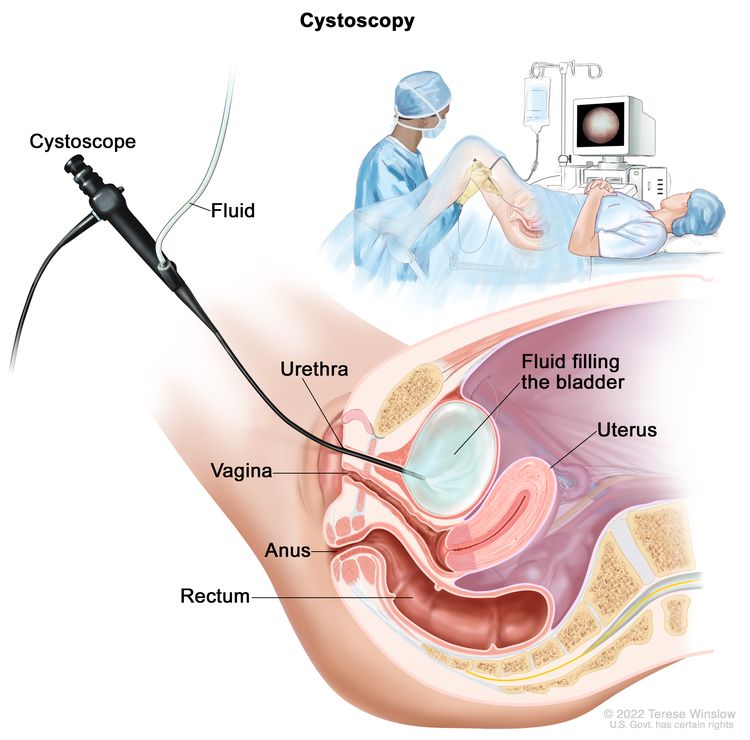
Urine cytology

Urine cytology is the examination of urine under a microscope to check for abnormal cells.

Hematuria tests may also be used to screen for bladder cancer.

Hematuria (red blood cells in the urine) may be caused by cancer or by other conditions. A hematuria test is used to check for blood in a sample of urine by viewing it under a microscope or using a special test strip. The test may be repeated over time.


Glossary Terms

abnormal
Not normal. An abnormal lesion or growth may be cancer, premalignant (likely to become cancer), or benign (not cancer).
biopsy (BY-op-see)
The removal of cells or tissues for examination by a pathologist. The pathologist may study the tissue under a microscope or perform other tests on the cells or tissue. There are many different types of biopsy procedures. The most common types include: (1) incisional biopsy, in which only a sample of tissue is removed; (2) excisional biopsy, in which an entire lump or suspicious area is removed; and (3) needle biopsy, in which a sample of tissue or fluid is removed with a needle. When a wide needle is used, the procedure is called a core biopsy. When a thin needle is used, the procedure is called a fine-needle aspiration biopsy.
bladder (BLA-der)
The organ that stores urine.
bladder cancer (BLA-der KAN-ser)
Cancer that forms in tissues of the bladder (the organ that stores urine). Most bladder cancers are transitional cell carcinomas (cancer that begins in cells that normally make up the inner lining of the bladder). Other types include squamous cell carcinoma (cancer that begins in thin, flat cells) and adenocarcinoma (cancer that begins in cells that make and release mucus and other fluids). The cells that form squamous cell carcinoma and adenocarcinoma develop in the inner lining of the bladder as a result of chronic irritation and inflammation.
blood
A tissue with red blood cells, white blood cells, platelets, and other substances suspended in fluid called plasma. Blood takes oxygen and nutrients to the tissues, and carries away wastes.
cancer (KAN-ser)
A term for diseases in which abnormal cells divide without control and can invade nearby tissues. Cancer cells can also spread to other parts of the body through the blood and lymph systems. There are several main types of cancer. Carcinoma is a cancer that begins in the skin or in tissues that line or cover internal organs. Sarcoma is a cancer that begins in bone, cartilage, fat, muscle, blood vessels, or other connective or supportive tissue. Leukemia is a cancer that starts in blood-forming tissue such as the bone marrow, and causes large numbers of abnormal blood cells to be produced and enter the blood. Lymphoma and multiple myeloma are cancers that begin in the cells of the immune system. Central nervous system cancers are cancers that begin in the tissues of the brain and spinal cord. Also called malignancy.
cell (sel)
The individual unit that makes up the tissues of the body. All living things are made up of one or more cells.
clinical trial (KLIH-nih-kul TRY-ul)
A type of research study that tests how well new medical approaches work in people. These studies test new methods of screening, prevention, diagnosis, or treatment of a disease. Also called clinical study.
cystoscope (SISS-toh-SKOPE)
A thin, tube-like instrument used to look inside the bladder and urethra. A cystoscope has a light and a lens for viewing and may have a tool to remove tissue.
cystoscopy (siss-TOSS-koh-pee)
Examination of the bladder and urethra using a cystoscope, inserted into the urethra. A cystoscope is a thin, tube-like instrument with a light and a lens for viewing. It may also have a tool to remove tissue to be checked under a microscope for signs of disease.
hematuria (HEE-muh-TOOR-ee-uh)
Blood in the urine.
red blood cell
A cell that carries oxygen to all parts of the body. Also called erythrocyte and RBC.
screening (SKREEN-ing)
Checking for disease when there are no symptoms. Since screening may find diseases at an early stage, there may be a better chance of curing the disease. Examples of cancer screening tests are the mammogram (breast), colonoscopy (colon), Pap smear (cervix), and PSA blood level and digital rectal exam (prostate). Screening can also include checking for a person’s risk of developing an inherited disease by doing a genetic test.
stage
The extent of a cancer in the body. Staging is usually based on the size of the tumor, whether lymph nodes contain cancer, and whether the cancer has spread from the original site to other parts of the body.
symptom
An indication that a person has a condition or disease. Some examples of symptoms are headache, fever, fatigue, nausea, vomiting, and pain.
tissue (TISH-oo)
A group or layer of cells that work together to perform a specific function.
urethra (yoo-REE-thruh)
The tube through which urine leaves the body. It empties urine from the bladder.
urine (YOOR-in)
Fluid containing water and waste products. Urine is made by the kidneys, stored in the bladder, and leaves the body through the urethra.
urine cytology (YOOR-in sy-TAH-loh-jee)
Tests performed on cells in urine to detect disease.


Table of Links

1http://cancer.gov/clinicaltrials