
Questions About Cancer? 1-800-4-CANCER

Stomach (Gastric) Cancer Screening (PDQ®)

Patient Version
Last Modified: 08/13/2010

What is screening?

Screening is looking for cancer before a person has any symptoms. This can help find cancer at an early stage. When abnormal tissue or cancer is found early, it may be easier to treat. By the time symptoms appear, cancer may have begun to spread.

Scientists are trying to better understand which people are more likely to get certain types of cancer. They also study the things we do and the things around us to see if they cause cancer. This information helps doctors recommend who should be screened for cancer, which screening tests should be used, and how often the tests should be done.

It is important to remember that your doctor does not necessarily think you have cancer if he or she suggests a screening test. Screening tests are given when you have no cancer symptoms.

If a screening test result is abnormal, you may need to have more tests done to find out if you have cancer. These are called diagnostic tests.

General Information About Stomach (Gastric) Cancer

Key Points for This Section


Stomach cancer is a disease in which malignant (cancer) cells form in the lining of the stomach.

The stomach is a J-shaped organ in the upper abdomen. It is part of the digestive system, which processes nutrients (vitamins, minerals, carbohydrates, fats, proteins, and water) in foods that are eaten and helps pass waste material out of the body. Food moves from the throat to the stomach through a hollow, muscular tube called the esophagus. After leaving the stomach, partly-digested food passes into the small intestine and then into the large intestine.

Enlarge 1
Gastrointestinal (digestive) system anatomy; shows esophagus, liver, stomach, large intestine, and small intestine. 1
The stomach and esophagus are part of the upper digestive system.


The wall of the stomach is made up of 3 layers of tissue: the mucosal (innermost) layer, the muscularis (middle) layer, and the serosal (outermost) layer. Stomach cancer begins in the cells lining the mucosal layer and spreads through the outer layers as it grows.

See the following PDQ summaries for more information about stomach cancer:

Stomach cancer is less common in the United States than in the developing world.

Stomach cancer is much more common in many parts of Europe, Asia, and Central and South America, and is a major cause of death in the developing world.

Stomach cancer rates in the United States have greatly decreased since 1930. The reasons for this are not known, but may have to do with better food storage or changes in the diet, such as lower salt intake.

Older age and certain chronic conditions increase the risk of developing stomach cancer.

Anything that increases the chance of getting a disease is called a risk factor. Having a risk factor does not mean that you will get cancer; not having risk factors doesn't mean that you will not get cancer. People who think they may be at risk should discuss this with their doctor. Risk factors for stomach cancer include the following:

Stomach (Gastric) Cancer Screening

Key Points for This Section


Tests are used to screen for different types of cancer.

Some screening tests are used because they have been shown to be helpful both in finding cancers early and in decreasing the chance of dying from these cancers. Other tests are used because they have been shown to find cancer in some people; however, it has not been proven in clinical trials that use of these tests will decrease the risk of dying from cancer.

Scientists study screening tests to find those with the fewest risks and most benefits. Cancer screening trials also are meant to show whether early detection (finding cancer before it causes symptoms) decreases a person's chance of dying from the disease. For some types of cancer, the chance of recovery is better if the disease is found and treated at an early stage.

Clinical trials that study cancer screening methods are taking place in many parts of the country. Information about ongoing clinical trials is available from the NCI Web site 4.

There is no standard or routine screening test for stomach cancer.

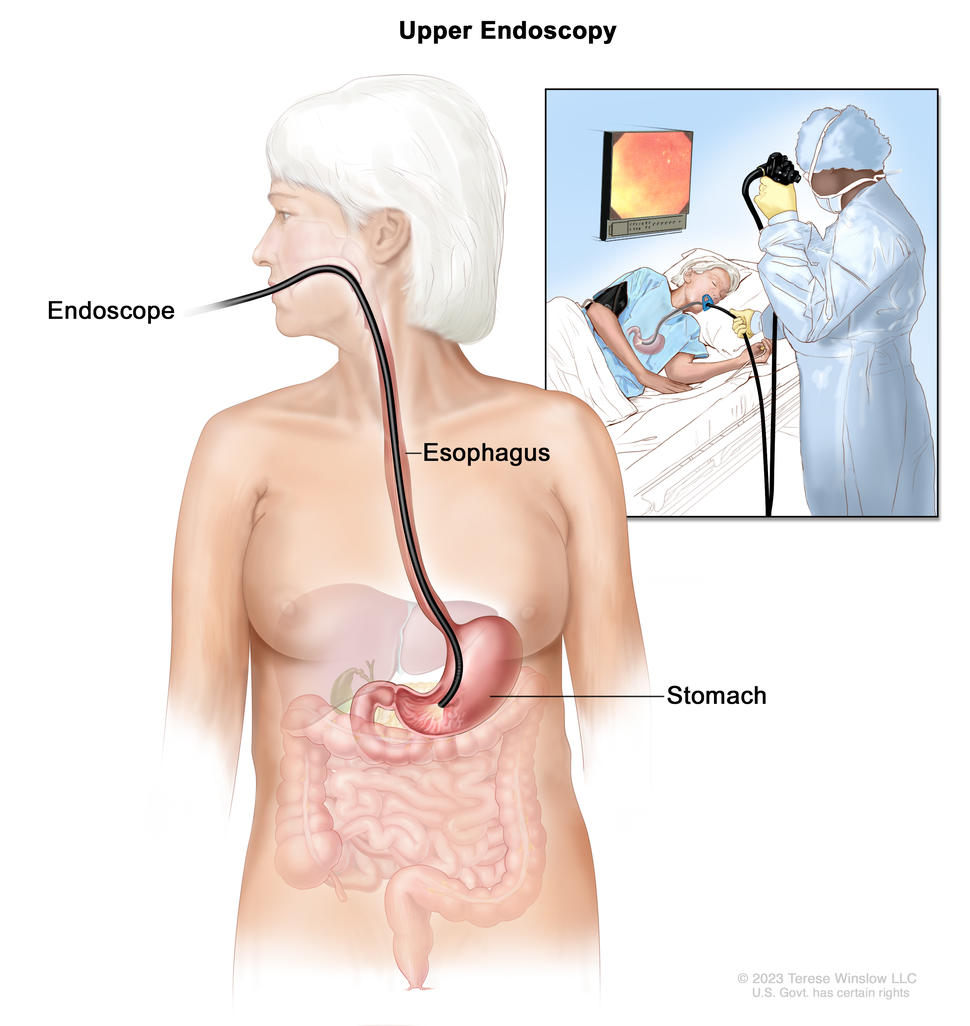
Upper endoscopy has been studied as a screening test to find stomach cancer at an early stage. Upper endoscopy is a procedure to look inside the esophagus, stomach, and duodenum (first part of the small intestine) to check for abnormal areas. An endoscope, a thin, tube-like instrument with a light and a lens for viewing, is passed through the mouth and down the throat into the esophagus. It may also have a tool to remove tissue to be checked under a microscope for signs of disease.

Enlarge 5
Upper endoscopy; shows endoscope inserted through the mouth and esophagus and into the stomach. Inset shows patient on table having an upper endoscopy. 5
Upper endoscopy. A thin, lighted tube is inserted through the mouth to look for abnormal areas in the esophagus, stomach, and first part of the small intestine.


Some studies show that screening tests for stomach cancer, such as upper endoscopy, would not result in a lower death rate. More research is needed to decide if it would be worthwhile to screen people in the United States who have a high risk for the disease. High risk groups that may benefit from stomach cancer screening include:

Risks of Stomach (Gastric) Cancer Screening

Key Points for This Section


Screening tests have risks.

Decisions about screening tests can be difficult. Not all screening tests are helpful and most have risks. Before having any screening test, you may want to discuss the test with your doctor. It is important to know the risks of the test and whether it has been proven to reduce the risk of dying from cancer.

The risks of stomach cancer screening include the following:

Finding stomach cancer may not improve health or help you live longer.

Screening may not improve your health or help you live longer if you have advanced stomach cancer or if it has already spread to other places in your body.

Some cancers never cause symptoms or become life-threatening, but if found by a screening test, the cancer may be treated. It is not known if treatment of these cancers would help you live longer than if no treatment were given, and treatments for cancer may have serious side effects.

False-negative test results can occur.

Screening test results may appear to be normal even though stomach cancer is present. A person who receives a false-negative result (one that shows there is no cancer when there really is) may delay seeking medical care even if there are symptoms.

False-positive test results can occur.

Screening test results may appear to be abnormal even though no cancer is present. A false-positive test result (one that shows there is cancer when there really isn't) can cause anxiety and is usually followed by more tests and procedures which also have risks.

Side effects may be caused by the screening test itself.

Upper endoscopy may cause the following rare, but serious, side effects:

  • A small hole (puncture) in the esophagus or stomach.
  • Heart problems.
  • Breathing problems.
  • Lung infection from inhaling food, fluid, or stomach acid into the lung.
  • Severe bleeding that needs to be treated at a hospital.

Changes to This Summary (08/13/2010)

The PDQ cancer information summaries are reviewed regularly and updated as new information becomes available. This section describes the latest changes made to this summary as of the date above.

Changes were made to this summary to match those made to the health professional version.

Questions or Comments About This Summary

If you have questions or comments about this summary, please send them to Cancer.gov through the Web site’s Contact Form 6. We can respond only to email messages written in English.

Get More Information From NCI

Call 1-800-4-CANCER

For more information, U.S. residents may call the National Cancer Institute's (NCI's) Cancer Information Service toll-free at 1-800-4-CANCER (1-800-422-6237) Monday through Friday from 8:00 a.m. to 8:00 p.m., Eastern Time. A trained Cancer Information Specialist is available to answer your questions.

Chat online

The NCI's LiveHelp® 7 online chat service provides Internet users with the ability to chat online with an Information Specialist. The service is available from 8:00 a.m. to 11:00 p.m. Eastern time, Monday through Friday. Information Specialists can help Internet users find information on NCI Web sites and answer questions about cancer.

Write to us

For more information from the NCI, please write to this address:

NCI Public Inquiries Office
Suite 3036A
6116 Executive Boulevard, MSC8322
Bethesda, MD 20892-8322

Search the NCI Web site

The NCI Web site 8 provides online access to information on cancer, clinical trials, and other Web sites and organizations that offer support and resources for cancer patients and their families. For a quick search, use the search box in the upper right corner of each Web page. The results for a wide range of search terms will include a list of "Best Bets," editorially chosen Web pages that are most closely related to the search term entered.

There are also many other places to get materials and information about cancer treatment and services. Hospitals in your area may have information about local and regional agencies that have information on finances, getting to and from treatment, receiving care at home, and dealing with problems related to cancer treatment.

Find Publications

The NCI has booklets and other materials for patients, health professionals, and the public. These publications discuss types of cancer, methods of cancer treatment, coping with cancer, and clinical trials. Some publications provide information on tests for cancer, cancer causes and prevention, cancer statistics, and NCI research activities. NCI materials on these and other topics may be ordered online or printed directly from the NCI Publications Locator 9. These materials can also be ordered by telephone from the Cancer Information Service toll-free at 1-800-4-CANCER (1-800-422-6237).

About PDQ

PDQ is a comprehensive cancer database available on NCI's Web site.

PDQ is the National Cancer Institute's (NCI's) comprehensive cancer information database. Most of the information contained in PDQ is available online at NCI's Web site 8. PDQ is provided as a service of the NCI. The NCI is part of the National Institutes of Health, the federal government's focal point for biomedical research.

PDQ contains cancer information summaries.

The PDQ database contains summaries of the latest published information on cancer prevention, detection, genetics, treatment, supportive care, and complementary and alternative medicine. Most summaries are available in two versions. The health professional versions provide detailed information written in technical language. The patient versions are written in easy-to-understand, nontechnical language. Both versions provide current and accurate cancer information.

The PDQ cancer information summaries are developed by cancer experts and reviewed regularly.

Editorial Boards made up of experts in oncology and related specialties are responsible for writing and maintaining the cancer information summaries. The summaries are reviewed regularly and changes are made as new information becomes available. The date on each summary ("Date Last Modified") indicates the time of the most recent change.

PDQ also contains information on clinical trials.

A clinical trial is a study to answer a scientific question, such as whether a method of finding cancer earlier can help people to live longer. Trials are based on past studies and what has been learned in the laboratory. Each trial answers certain scientific questions in order to find new and better ways to help cancer patients and those who are at risk for cancer. During screening clinical trials, information is collected about the effects of a new screening method and how well it works. If a clinical trial shows that a new method is better than one currently being used, the new method may become "standard." People who are at high risk for a certain type of cancer may want to think about taking part in a clinical trial.

Listings of clinical trials are included in PDQ and are available online at NCI's Web site 10. Descriptions of the trials are available in health professional and patient versions. Many cancer doctors who take part in clinical trials are also listed in PDQ. For more information, call the Cancer Information Service 1-800-4-CANCER (1-800-422-6237).


Glossary Terms

abnormal (ab-NOR-mul)
Not normal. An abnormal lesion or growth may be cancer, premalignant (likely to become cancer), or benign (not cancer).
cancer (KAN-ser)
A term for diseases in which abnormal cells divide without control and can invade nearby tissues. Cancer cells can also spread to other parts of the body through the blood and lymph systems. There are several main types of cancer. Carcinoma is a cancer that begins in the skin or in tissues that line or cover internal organs. Sarcoma is a cancer that begins in bone, cartilage, fat, muscle, blood vessels, or other connective or supportive tissue. Leukemia is a cancer that starts in blood-forming tissue such as the bone marrow, and causes large numbers of abnormal blood cells to be produced and enter the blood. Lymphoma and multiple myeloma are cancers that begin in the cells of the immune system. Central nervous system cancers are cancers that begin in the tissues of the brain and spinal cord. Also called malignancy.
diagnostic procedure (DY-ug-NAH-stik proh-SEE-jer)
A type of test used to help diagnose a disease or condition. Mammograms and colonoscopies are examples of diagnostic procedures. Also called diagnostic test.
PDQ
PDQ is an online database developed and maintained by the National Cancer Institute. Designed to make the most current, credible, and accurate cancer information available to health professionals and the public, PDQ contains peer-reviewed summaries on cancer treatment, screening, prevention, genetics, complementary and alternative medicine, and supportive care; a registry of cancer clinical trials from around the world; and directories of physicians, professionals who provide genetics services, and organizations that provide cancer care. Most of this information, and more specific information about PDQ, can be found on the NCI's Web site at http://www.cancer.gov/cancertopics/pdq. Also called Physician Data Query.
screening (SKREE-ning)
Checking for disease when there are no symptoms. Since screening may find diseases at an early stage, there may be a better chance of curing the disease. Examples of cancer screening tests are the mammogram (breast), colonoscopy (colon), and the Pap test and HPV test (cervix). Screening can also include checking for a person’s risk of developing an inherited disease by doing a genetic test.
stage (stayj)
The extent of a cancer in the body. Staging is usually based on the size of the tumor, whether lymph nodes contain cancer, and whether the cancer has spread from the original site to other parts of the body.
symptom (SIMP-tum)
An indication that a person has a condition or disease. Some examples of symptoms are headache, fever, fatigue, nausea, vomiting, and pain.
tissue (TIH-shoo)
A group or layer of cells that work together to perform a specific function.

Table of Links

1http://www.cancer.gov/PublishedContent/MediaLinks/292249.html
2http://www.cancer.gov/cancertopics/pdq/prevention/gastric/Patient
3http://www.cancer.gov/cancertopics/pdq/treatment/gastric/Patient
4http://cancer.gov/clinicaltrials
5http://www.cancer.gov/PublishedContent/MediaLinks/292250.html
6http://www.cancer.gov/contact
7https://livehelp.cancer.gov
8http://cancer.gov
9https://pubs.cancer.gov/ncipl
10http://www.cancer.gov/clinicaltrials