Questions About Cancer? 1-800-4-CANCER

Pituitary Tumors Treatment (PDQ®)

Patient Version
Last Modified: 03/16/2012

General Information About Pituitary Tumors

Key Points for This Section


A pituitary tumor is a growth of abnormal cells in the tissues of the pituitary gland.

Pituitary tumors form in the pituitary gland, a pea-sized organ in the center of the brain, just above the back of the nose. The pituitary gland is sometimes called the "master endocrine gland" because it makes hormones that affect the way many parts of the body work. It also controls hormones made by many other glands in the body.

Enlarge 1
Drawing of the inside of the brain showing ventricles (fluid-filled spaces), choroid plexus, hypothalamus, pineal gland, pituitary gland, optic nerve, brain stem, cerebellum, cerebrum, medulla, pons, and spinal cord. 1
Anatomy of the inside of the brain, showing the pineal and pituitary glands, optic nerve, ventricles (with cerebrospinal fluid shown in blue), and other parts of the brain.


Pituitary tumors are divided into three groups:

  • Benign pituitary adenomas: Tumors that are not cancer. These tumors grow very slowly and do not spread from the pituitary gland to other parts of the body.
  • Invasive pituitary adenomas: Benign tumors that may spread to bones of the skull or the sinus cavity below the pituitary gland.
  • Pituitary carcinomas: Tumors that are malignant (cancer). These pituitary tumors spread into other areas of the central nervous system (brain and spinal cord) or outside of the central nervous system. Very few pituitary tumors are malignant.

Pituitary tumors may be either non-functioning or functioning.

  • Non-functioning pituitary tumors do not make hormones.
  • Functioning pituitary tumors make more than the normal amount of one or more hormones. Most pituitary tumors are functioning tumors. The extra hormones made by pituitary tumors may cause certain signs or symptoms of disease.

The pituitary gland hormones control many other glands in the body.

Hormones made by the pituitary gland include:

Having certain genetic conditions increases the risk of developing a pituitary tumor.

Anything that increases your risk of getting a disease is called a risk factor. Having a risk factor does not mean that you will get cancer; not having risk factors doesn’t mean that you will not get cancer. People who think they may be at risk should discuss this with their doctor. Risk factors for pituitary tumors include having the following hereditary diseases:

Possible signs of a pituitary tumor include problems with vision and certain physical changes.

Symptoms can be caused by the growth of the tumor and/or by hormones the tumor makes. Some tumors may not cause symptoms. Conditions other than pituitary tumors can cause the symptoms listed below. A doctor should be consulted if any of these problems occur.

Signs and symptoms of a non-functioning pituitary tumor

Sometimes, a pituitary tumor may press on or damage parts of the pituitary gland, causing it to stop making one or more hormones. Too little of a certain hormone will affect the work of the gland or organ that the hormone controls. The following symptoms may occur:

  • Headache.
  • Some loss of vision.
  • Loss of body hair.
  • In women, less frequent or no menstrual periods or no milk from the breasts.
  • In men, loss of facial hair, growth of breast tissue, and impotence.
  • In women and men, lower sex drive.
  • In children, slowed growth and sexual development.

Most of the tumors that make LH and FSH do not make enough extra hormone to cause symptoms. These tumors are considered to be non-functioning tumors.

Signs and symptoms of a functioning pituitary tumor

When a functioning pituitary tumor makes extra hormones, the symptoms will depend on the type of hormone being made.

Too much prolactin may cause:

  • Headache.
  • Some loss of vision.
  • Less frequent or no menstrual periods or menstrual periods with a very light flow.
  • Trouble becoming pregnant or an inability to become pregnant.
  • Impotence in men.
  • Lower sex drive.
  • Flow of breast milk in a woman who is not pregnant or breast-feeding.

Too much ACTH may cause:

  • Headache.
  • Some loss of vision.
  • Weight gain in the face, neck, and trunk of the body, and thin arms and legs.
  • A lump of fat on the back of the neck.
  • Thin skin that may have purple or pink stretch marks on the chest or abdomen.
  • Easy bruising.
  • Growth of fine hair on the face, upper back, or arms.
  • Bones that break easily.
  • Anxiety, irritability, and depression.

Too much growth hormone may cause:

  • Headache.
  • Some loss of vision.
  • In adults, acromegaly (growth of the bones in the face, hands, and feet). In children, the whole body may grow much taller and larger than normal.
  • Tingling or numbness in the hands and fingers.
  • Snoring or pauses in breathing during sleep.
  • Joint pain.
  • Sweating more than usual.
  • Dysmorphophobia (extreme dislike of or concern about one or more parts of the body).

Too much thyroid-stimulating hormone may cause:

  • Irregular heartbeat.
  • Shakiness.
  • Weight loss.
  • Trouble sleeping.
  • Frequent bowel movements.
  • Sweating.

Other general signs and symptoms of pituitary tumors:

Imaging studies and tests that examine the blood and urine are used to detect (find) and diagnose a pituitary tumor.

The following tests and procedures may be used:

  • Physical exam and history: An exam of the body to check general signs of health, including checking for signs of disease, such as lumps or anything else that seems unusual. A history of the patient’s health habits and past illnesses and treatments will also be taken.

  • Eye exam: An exam to check vision and the general health of the eyes.

  • Visual field exam: An exam to check a person’s field of vision (the total area in which objects can be seen). This test measures both central vision (how much a person can see when looking straight ahead) and peripheral vision (how much a person can see in all other directions while staring straight ahead). The eyes are tested one at a time. The eye not being tested is covered.

  • Neurological exam: A series of questions and tests to check the brain, spinal cord, and nerve function. The exam checks a person’s mental status, coordination, and ability to walk normally, and how well the muscles, senses, and reflexes work. This may also be called a neuro exam or a neurologic exam.

  • MRI (magnetic resonance imaging) with gadolinium: A procedure that uses a magnet, radio waves, and a computer to make a series of detailed pictures of areas inside the brain and spinal cord. A substance called gadolinium is injected into a vein. The gadolinium collects around the cancer cells so they show up brighter in the picture. This procedure is also called nuclear magnetic resonance imaging (NMRI).

  • CT scan (CAT scan): A procedure that makes a series of detailed pictures of areas inside the brain, taken from different angles. The pictures are made by a computer linked to an x-ray machine. A dye may be injected into a vein or swallowed to help the organs or tissues show up more clearly. This procedure is also called computed tomography, computerized tomography, or computerized axial tomography.

  • Blood chemistry study: A procedure in which a blood sample is checked to measure the amounts of certain substances, such as glucose (sugar), released into the blood by organs and tissues in the body. An unusual (higher or lower than normal) amount of a substance can be a sign of disease in the organ or tissue that makes it.

  • Blood tests: Tests to measure the levels of testosterone or estrogen in the blood. A higher or lower than normal amount of these hormones may be a sign of pituitary tumor.

  • Twenty-four-hour urine test: A test in which urine is collected for 24 hours to measure the amounts of certain substances. An unusual (higher or lower than normal) amount of a substance can be a sign of disease in the organ or tissue that makes it. A higher than normal amount of the hormone cortisol may be a sign of a pituitary tumor.

  • High-dose dexamethasone suppression test: A test in which one or more high doses of dexamethasone are given. The level of cortisol is checked from a sample of blood or from urine that is collected for three days.

  • Low-dose dexamethasone suppression test: A test in which one or more small doses of dexamethasone are given. The level of cortisol is checked from a sample of blood or from urine that is collected for three days.

  • Venous sampling for pituitary tumors: A procedure in which a sample of blood is taken from veins coming from the pituitary gland. The sample is checked to measure the amount of ACTH released into the blood by the gland. Venous sampling may be done if blood tests show there is a tumor making ACTH, but the pituitary gland looks normal in the imaging tests.

  • Biopsy: The removal of cells or tissues so they can be viewed under a microscope by a pathologist to check for signs of cancer.

  • Immunohistochemistry study: A laboratory test in which a substance such as an antibody, dye, or radioisotope is added to a sample of cancer tissue to test for certain antigens. This type of study is used to tell the difference between different types of cancer.

  • Immunocytochemistry study: A laboratory test in which a substance such as an antibody, dye, or radioisotope is added to a sample of cancer cells to test for certain antigens. This type of study is used to tell the difference between different types of cancer.

  • Light and electron microscopy: A laboratory test in which cells in a sample of tissue are viewed under regular and high-powered microscopes to look for certain changes in the cells.

Certain factors affect prognosis (chance of recovery) and treatment options.

The prognosis (chance of recovery) depends on the type of tumor and whether the tumor has spread into other areas of the central nervous system (brain and spinal cord) or outside of the central nervous system to other parts of the body.

Treatment options depend on the following:

  • The type and size of the tumor.
  • Whether the tumor is making hormones.
  • Whether the tumor is causing problems with vision or other symptoms.
  • Whether the tumor has spread into the brain around the pituitary gland or to other parts of the body.
  • Whether the tumor has just been diagnosed or has recurred (come back).

Stages of Pituitary Tumors

Key Points for This Section


Once a pituitary tumor has been diagnosed, tests are done to find out if it has spread within the central nervous system (brain and spinal cord) or to other parts of the body.

The extent or spread of cancer is usually described as stages. There is no standard staging system for pituitary tumors. Once a pituitary tumor is found, tests are done to find out if the tumor has spread into the brain or to other parts of the body. The following tests and procedures may be used:

  • MRI (magnetic resonance imaging): A procedure that uses a magnet, radio waves, and a computer to make a series of detailed pictures of areas inside the body. This procedure is also called nuclear magnetic resonance imaging (NMRI).
  • CT scan (CAT scan): A procedure that makes a series of detailed pictures of areas inside the body, taken from different angles. The pictures are made by a computer linked to an x-ray machine. A dye may be injected into a vein or swallowed to help the organs or tissues show up more clearly. This procedure is also called computed tomography, computerized tomography, or computerized axial tomography.

Pituitary tumors are described in several ways.

Enlarge 2
Tumor size compared to everyday objects; shows various measurements of a tumor compared to a pea, peanut, walnut, and lime 2
Pea, peanut, walnut, and lime show tumor sizes.

Pituitary tumors are described by their size and grade, whether or not they make extra hormones, and whether the tumor has spread to other parts of the body.

The following sizes are used:

  • Microadenoma: The tumor is smaller than 1 centimeter.
  • Macroadenoma: The tumor is 1 centimeter or larger.

Most pituitary adenomas are microadenomas.

The grade of a pituitary tumor is based on how far it has grown into the surrounding area of the brain, including the sella (the bone at the base of the skull, where the pituitary gland sits).

Recurrent Pituitary Tumors

A recurrent pituitary tumor is cancer that has recurred (come back) after it has been treated. The cancer may come back in the pituitary gland or in other parts of the body.

Treatment Option Overview

Key Points for This Section


There are different types of treatment for patients with pituitary tumors.

Different types of treatments are available for patients with pituitary tumors. Some treatments are standard (the currently used treatment), and some are being tested in clinical trials. A treatment clinical trial is a research study meant to help improve current treatments or obtain information on new treatments for patients with cancer. When clinical trials show that a new treatment is better than the standard treatment, the new treatment may become the standard treatment. Patients may want to think about taking part in a clinical trial. Some clinical trials are open only to patients who have not started treatment.

Four types of standard treatment are used:

Surgery

Many pituitary tumors can be removed by surgery using one of the following operations:

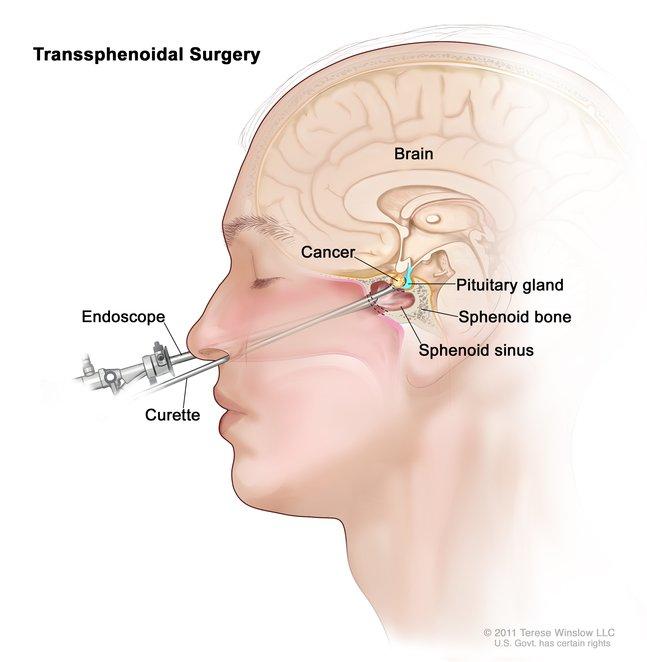
  • Transsphenoidal surgery: A type of surgery in which the instruments are inserted into part of the brain by going through an incision (cut) made under the upper lip or at the bottom of the nose between the nostrils and then through the sphenoid bone (a butterfly-shaped bone at the base of the skull) to reach the pituitary gland. The pituitary gland lies just above the sphenoid bone.
    Enlarge 3
    Transsphenoidal surgery; drawing shows an endoscope and a curette inserted through the nose and sphenoid sinus to remove cancer from the pituitary gland. The sphenoid bone is also shown. 3
    Transsphenoidal surgery. An endoscope and a curette are inserted through the nose and sphenoid sinus to remove cancer from the pituitary gland.
  • Endoscopic transsphenoidal surgery: A type of surgery in which an endoscope is inserted through an incision (cut) made at the back of the inside of the nose and then through the sphenoid bone to reach the pituitary gland. An endoscope is a thin, tube-like instrument with a light, a lens for viewing, and a tool for removing tumor tissue.
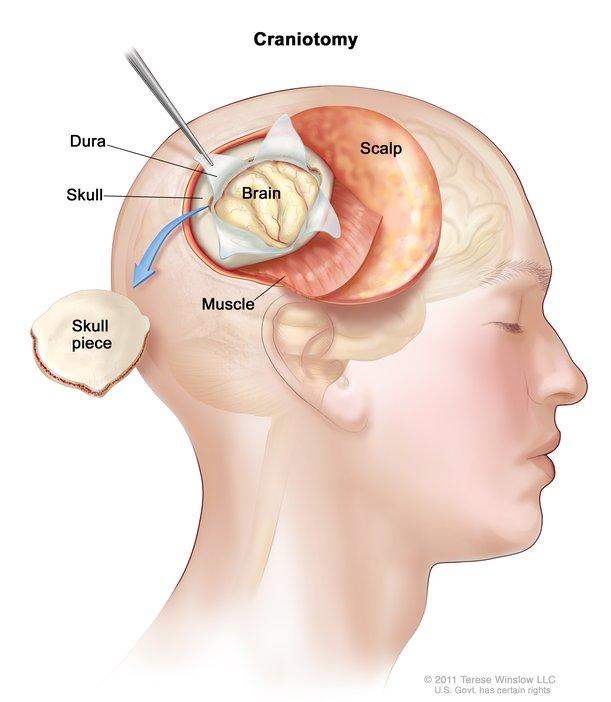
  • Craniotomy: Surgery to remove the tumor through an opening made in the skull.
    Enlarge 4
    Drawing of a craniotomy showing a section of the scalp that has been pulled back to remove a piece of the skull; the dura covering the brain has been opened to expose the brain. The layer of muscle under the scalp is also shown. 4
    Craniotomy: An opening is made in the skull and a piece of the skull is removed to show part of the brain.

Even if the doctor removes all the cancer that can be seen at the time of the surgery, some patients may be given chemotherapy or radiation therapy after surgery to kill any cancer cells that are left. Treatment given after the surgery, to lower the risk that the cancer will come back, is called adjuvant therapy.
Radiation therapy

Radiation therapy is a cancer treatment that uses high-energy x-rays or other types of radiation to kill cancer cells or keep them from growing. There are two types of radiation therapy. External radiation therapy uses a machine outside the body to send radiation toward the cancer. Internal radiation therapy uses a radioactive substance sealed in needles, seeds, wires, or catheters that are placed directly into or near the cancer.

Stereotactic radiation surgery uses a rigid head frame attached to the skull to aim a single large dose of radiation directly to a tumor, causing less damage to nearby healthy tissue. It is also called stereotaxic radiosurgery, radiosurgery, and radiation surgery. This procedure does not involve surgery.

The way the radiation therapy is given depends on the type of the cancer being treated.

Drug therapy

Drugs may be given to stop a functioning pituitary tumor from making too many hormones.

Chemotherapy

Chemotherapy may be used as palliative treatment for pituitary carcinomas, to relieve symptoms and improve the patient's quality of life. Chemotherapy uses drugs to stop the growth of cancer cells, either by killing the cells or by stopping them from dividing. When chemotherapy is taken by mouth or injected into a vein or muscle, the drugs enter the bloodstream and can reach cancer cells throughout the body (systemic chemotherapy). When chemotherapy is placed directly into the cerebrospinal fluid, an organ, or a body cavity such as the abdomen, the drugs mainly affect cancer cells in those areas (regional chemotherapy). The way the chemotherapy is given depends on the type of the cancer being treated.

New types of treatment are being tested in clinical trials.

Information about clinical trials is available from the NCI Web site 5.

Patients may want to think about taking part in a clinical trial.

For some patients, taking part in a clinical trial may be the best treatment choice. Clinical trials are part of the cancer research process. Clinical trials are done to find out if new cancer treatments are safe and effective or better than the standard treatment.

Many of today's standard treatments for cancer are based on earlier clinical trials. Patients who take part in a clinical trial may receive the standard treatment or be among the first to receive a new treatment.

Patients who take part in clinical trials also help improve the way cancer will be treated in the future. Even when clinical trials do not lead to effective new treatments, they often answer important questions and help move research forward.

Patients can enter clinical trials before, during, or after starting their cancer treatment.

Some clinical trials only include patients who have not yet received treatment. Other trials test treatments for patients whose cancer has not gotten better. There are also clinical trials that test new ways to stop cancer from recurring (coming back) or reduce the side effects of cancer treatment.

Clinical trials are taking place in many parts of the country. See the Treatment Options section that follows for links to current treatment clinical trials. These have been retrieved from NCI's listing of clinical trials.

Follow-up tests may be needed.

Some of the tests that were done to diagnose the cancer or to find out the stage of the cancer may be repeated. Some tests will be repeated in order to see how well the treatment is working. Decisions about whether to continue, change, or stop treatment may be based on the results of these tests. This is sometimes called re-staging.

Some of the tests will continue to be done from time to time after treatment has ended. The results of these tests can show if your condition has changed or if the cancer has recurred (come back). These tests are sometimes called follow-up tests or check-ups.

Treatment Options for Pituitary Tumors

A link to a list of current clinical trials is included for each treatment section. For some types or stages of cancer, there may not be any trials listed. Check with your doctor for clinical trials that are not listed here but may be right for you.

Non-functioning Pituitary Tumors

Treatment may include the following:

Treatment for luteinizing hormone -producing and follicle-stimulating hormone -producing tumors is usually transsphenoidal surgery to remove the tumor.

Prolactin-Producing Pituitary Tumors

Treatment may include the following:

ACTH-Producing Pituitary Tumors

Treatment may include the following:

Growth Hormone–Producing Pituitary Tumors

Treatment may include the following:

Thyroid-Stimulating Hormone–Producing Tumors

Treatment may include the following:

Pituitary Carcinomas

Treatment of pituitary carcinomas is palliative, to relieve symptoms and improve the quality of life. Treatment may include the following:

Recurrent Pituitary Tumors

Treatment may include the following:

Check for U.S. clinical trials from NCI's list of cancer clinical trials that are now accepting patients with pituitary tumor 6. For more specific results, refine the search by using other search features, such as the location of the trial, the type of treatment, or the name of the drug. General information about clinical trials is available from the NCI Web site 7.

Changes to This Summary (03/16/2012)

The PDQ cancer information summaries are reviewed regularly and updated as new information becomes available. This section describes the latest changes made to this summary as of the date above.

Editorial changes were made to this summary.

Get More Information From NCI

Call 1-800-4-CANCER

For more information, U.S. residents may call the National Cancer Institute's (NCI's) Cancer Information Service toll-free at 1-800-4-CANCER (1-800-422-6237) Monday through Friday from 8:00 a.m. to 8:00 p.m., Eastern Time. A trained Cancer Information Specialist is available to answer your questions.

Chat online

The NCI's LiveHelp® 19 online chat service provides Internet users with the ability to chat online with an Information Specialist. The service is available from 8:00 a.m. to 11:00 p.m. Eastern time, Monday through Friday. Information Specialists can help Internet users find information on NCI Web sites and answer questions about cancer.

Write to us

For more information from the NCI, please write to this address:

NCI Public Inquiries Office
Suite 3036A
6116 Executive Boulevard, MSC8322
Bethesda, MD 20892-8322

Search the NCI Web site

The NCI Web site 20 provides online access to information on cancer, clinical trials, and other Web sites and organizations that offer support and resources for cancer patients and their families. For a quick search, use the search box in the upper right corner of each Web page. The results for a wide range of search terms will include a list of "Best Bets," editorially chosen Web pages that are most closely related to the search term entered.

There are also many other places to get materials and information about cancer treatment and services. Hospitals in your area may have information about local and regional agencies that have information on finances, getting to and from treatment, receiving care at home, and dealing with problems related to cancer treatment.

Find Publications

The NCI has booklets and other materials for patients, health professionals, and the public. These publications discuss types of cancer, methods of cancer treatment, coping with cancer, and clinical trials. Some publications provide information on tests for cancer, cancer causes and prevention, cancer statistics, and NCI research activities. NCI materials on these and other topics may be ordered online or printed directly from the NCI Publications Locator 21. These materials can also be ordered by telephone from the Cancer Information Service toll-free at 1-800-4-CANCER (1-800-422-6237).

About PDQ

PDQ is a comprehensive cancer database available on NCI's Web site.

PDQ is the National Cancer Institute's (NCI's) comprehensive cancer information database. Most of the information contained in PDQ is available online at NCI's Web site 20. PDQ is provided as a service of the NCI. The NCI is part of the National Institutes of Health, the federal government's focal point for biomedical research.

PDQ contains cancer information summaries.

The PDQ database contains summaries of the latest published information on cancer prevention, detection, genetics, treatment, supportive care, and complementary and alternative medicine. Most summaries are available in two versions. The health professional versions provide detailed information written in technical language. The patient versions are written in easy-to-understand, nontechnical language. Both versions provide current and accurate cancer information.

The PDQ cancer information summaries are developed by cancer experts and reviewed regularly.

Editorial Boards made up of experts in oncology and related specialties are responsible for writing and maintaining the cancer information summaries. The summaries are reviewed regularly and changes are made as new information becomes available. The date on each summary ("Date Last Modified") indicates the time of the most recent change.

PDQ also contains information on clinical trials.

A clinical trial is a study to answer a scientific question, such as whether one treatment is better than another. Trials are based on past studies and what has been learned in the laboratory. Each trial answers certain scientific questions in order to find new and better ways to help cancer patients. During treatment clinical trials, information is collected about the effects of a new treatment and how well it works. If a clinical trial shows that a new treatment is better than one currently being used, the new treatment may become "standard." Patients may want to think about taking part in a clinical trial. Some clinical trials are open only to patients who have not started treatment.

Listings of clinical trials are included in PDQ and are available online at NCI's Web site 7. Descriptions of the trials are available in health professional and patient versions. Many cancer doctors who take part in clinical trials are also listed in PDQ. For more information, call the Cancer Information Service 1-800-4-CANCER (1-800-422-6237).


Glossary Terms

abdomen (AB-doh-men)
The area of the body that contains the pancreas, stomach, intestines, liver, gallbladder, and other organs.
acromegaly (A-kroh-MEH-guh-lee)
A condition in which the pituitary gland makes too much growth hormone after normal growth of the skeleton is finished. This causes the bones of the hands, feet, head, and face to grow larger than normal. Acromegaly can be caused by a pituitary gland tumor.
adenoma (A-deh-NOH-muh)
A tumor that is not cancer. It starts in gland-like cells of the epithelial tissue (thin layer of tissue that covers organs, glands, and other structures within the body).
adrenal gland (uh-DREE-nul...)
A small gland that makes steroid hormones, adrenaline, and noradrenaline. These hormones help control heart rate, blood pressure, and other important body functions. There are two adrenal glands, one on top of each kidney. Also called suprarenal gland.
adrenocorticotropic hormone (uh-DREE-noh-KOR-tih-koh-TROH-pik HOR-mone)
A hormone made in the pituitary gland. Adrenocorticotropic hormone acts on the outer part of the adrenal gland to control its release of corticosteroid hormones. More adrenocorticotropic hormone is made during times of stress. Also called ACTH and corticotropin.
antibody (AN-tee-BAH-dee)
A protein made by plasma cells (a type of white blood cell) in response to an antigen (a substance that causes the body to make a specific immune response). Each antibody can bind to only one specific antigen. The purpose of this binding is to help destroy the antigen. Some antibodies destroy antigens directly. Others make it easier for white blood cells to destroy the antigen.
antigen (AN-tih-jen)
Any substance that causes the body to make a specific immune response.
anxiety (ang-ZY-eh-tee)
Feelings of fear, dread, and uneasiness that may occur as a reaction to stress. A person with anxiety may sweat, feel restless and tense, and have a rapid heart beat. Extreme anxiety that happens often over time may be a sign of an anxiety disorder.
benign (beh-NINE)
Not cancerous. Benign tumors may grow larger but do not spread to other parts of the body. Also called nonmalignant.
biopsy (BY-op-see)
The removal of cells or tissues for examination by a pathologist. The pathologist may study the tissue under a microscope or perform other tests on the cells or tissue. There are many different types of biopsy procedures. The most common types include: (1) incisional biopsy, in which only a sample of tissue is removed; (2) excisional biopsy, in which an entire lump or suspicious area is removed; and (3) needle biopsy, in which a sample of tissue or fluid is removed with a needle. When a wide needle is used, the procedure is called a core biopsy. When a thin needle is used, the procedure is called a fine-needle aspiration biopsy.
blood (blud)
A tissue with red blood cells, white blood cells, platelets, and other substances suspended in fluid called plasma. Blood takes oxygen and nutrients to the tissues, and carries away wastes.
blood chemistry study (blud KEH-mih-stree STUH-dee)
A procedure in which a sample of blood is examined to measure the amounts of certain substances made in the body. An abnormal amount of a substance can be a sign of disease in the organ or tissue that produces it.
bowel (BOW-ul)
The long, tube-shaped organ in the abdomen that completes the process of digestion. The bowel has two parts, the small bowel and the large bowel. Also called intestine.
breast (brest)
Glandular organ located on the chest. The breast is made up of connective tissue, fat, and breast tissue that contains the glands that can make milk. Also called mammary gland.
cancer (KAN-ser)
A term for diseases in which abnormal cells divide without control and can invade nearby tissues. Cancer cells can also spread to other parts of the body through the blood and lymph systems. There are several main types of cancer. Carcinoma is a cancer that begins in the skin or in tissues that line or cover internal organs. Sarcoma is a cancer that begins in bone, cartilage, fat, muscle, blood vessels, or other connective or supportive tissue. Leukemia is a cancer that starts in blood-forming tissue such as the bone marrow, and causes large numbers of abnormal blood cells to be produced and enter the blood. Lymphoma and multiple myeloma are cancers that begin in the cells of the immune system. Central nervous system cancers are cancers that begin in the tissues of the brain and spinal cord. Also called malignancy.
carcinoma (KAR-sih-NOH-muh)
Cancer that begins in the skin or in tissues that line or cover internal organs.
Carney complex (KAR-nee KOM-plex)
A rare, inherited disorder marked by dark spots on the skin and tumors in the heart, endocrine glands, skin, and nerves. There are two types of Carney complex, which are caused by mutations (changes) in different genes. Also called Carney syndrome.
cavity (KA-vih-tee)
A hollow area or hole. It may describe a body cavity (such as the space within the abdomen) or a hole in a tooth caused by decay.
cell (sel)
The individual unit that makes up the tissues of the body. All living things are made up of one or more cells.
central nervous system (SEN-trul NER-vus SIS-tem)
The brain and spinal cord. Also called CNS.
cerebrospinal fluid (seh-REE-broh-SPY-nul FLOO-id)
The fluid that flows in and around the hollow spaces of the brain and spinal cord, and between two of the meninges (the thin layers of tissue that cover and protect the brain and spinal cord). Cerebrospinal fluid is made by tissue called the choroid plexus in the ventricles (hollow spaces) in the brain. Also called CSF.
clinical trial (KLIH-nih-kul TRY-ul)
A type of research study that tests how well new medical approaches work in people. These studies test new methods of screening, prevention, diagnosis, or treatment of a disease. Also called clinical study.
condition (kun-DIH-shun)
In medicine, a health problem with certain characteristics or symptoms.
confusion (kun-FYOO-zhun)
A mental state in which one is not thinking clearly.
contrast material (KON-trast muh-TEER-ee-ul)
A dye or other substance that helps show abnormal areas inside the body. It is given by injection into a vein, by enema, or by mouth. Contrast material may be used with x-rays, CT scans, MRI, or other imaging tests.
cortisol (KOR-tih-sol)
A hormone made by the adrenal cortex (the outer layer of the adrenal gland). It helps the body use glucose (a sugar), protein, and fats. Cortisol made in the laboratory is called hydrocortisone. It is used to treat many conditions, including inflammation, allergies, and some cancers. Cortisol is a type of glucocorticoid hormone.
CT scan (… skan)
A series of detailed pictures of areas inside the body taken from different angles. The pictures are created by a computer linked to an x-ray machine. Also called CAT scan, computed tomography scan, computerized axial tomography scan, and computerized tomography.
depression (dee-PREH-shun)
A mental condition marked by ongoing feelings of sadness, despair, loss of energy, and difficulty dealing with normal daily life. Other symptoms of depression include feelings of worthlessness and hopelessness, loss of pleasure in activities, changes in eating or sleeping habits, and thoughts of death or suicide. Depression can affect anyone, and can be successfully treated. Depression affects 15-25% of cancer patients.
dexamethasone (DEK-suh-MEH-thuh-sone)
A synthetic steroid (similar to steroid hormones produced naturally in the adrenal gland). Dexamethasone is used to treat leukemia and lymphoma and may be used to treat some of the problems caused by other cancers and their treatment.
diagnosis (DY-ug-NOH-sis)
The process of identifying a disease, such as cancer, from its signs and symptoms.
dose (dose)
The amount of medicine taken, or radiation given, at one time.
electron microscope (ee-LEK-tron MY-kroh-SKOPE)
A microscope (device used to magnify small objects) that uses electrons (instead of light) to produce an enlarged image. An electron microscope shows tiny details better than any other type of microscope.
endocrine (EN-doh-krin)
Refers to tissue that makes and releases hormones that travel in the bloodstream and control the actions of other cells or organs. Some examples of endocrine tissues are the pituitary, thyroid, and adrenal glands.
estrogen (ES-truh-jin)
A type of hormone made by the body that helps develop and maintain female sex characteristics and the growth of long bones. Estrogens can also be made in the laboratory. They may be used as a type of birth control and to treat symptoms of menopause, menstrual disorders, osteoporosis, and other conditions.
follicle-stimulating hormone (FAH-lih-kul-STIM-yoo-LAY-ting HOR-mone)
A hormone made in the pituitary gland. In females, it acts on the ovaries to make the follicles and eggs grow. In males, it acts on the testes to make sperm. Also called follitropin and FSH.
functioning tumor (FUNK-shuh-ning TOO-mer)
A tumor that is found in endocrine tissue and makes hormones (chemicals that travel in the bloodstream and control the actions of other cells or organs).
gadolinium (GA-duh-LIH-nee-um)
A metal element that is used in magnetic resonance imaging (MRI) and other imaging methods. It is a contrast agent, which helps show abnormal tissue in the body during imaging with a special machine.
gland (gland)
An organ that makes one or more substances, such as hormones, digestive juices, sweat, tears, saliva, or milk. Endocrine glands release the substances directly into the bloodstream. Exocrine glands release the substances into a duct or opening to the inside or outside of the body.
glucose (GLOO-kose)
A type of sugar; the chief source of energy for living organisms.
growth hormone (grothe HOR-mone)
A protein made by the pituitary gland that helps control body growth and the use of glucose and fat in the body. Also called somatotropin.
hereditary (huh-REH-dih-tayr-ee)
Transmitted from parent to child by information contained in the genes.
hormone (HOR-mone)
One of many chemicals made by glands in the body. Hormones circulate in the bloodstream and control the actions of certain cells or organs. Some hormones can also be made in the laboratory.
imaging test (IH-muh-jing …)
A type of test that makes pictures of areas inside the body. Some examples of imaging tests are CT scans and MRIs. Also called imaging procedure.
immunohistochemistry (IH-myoo-noh-HIS-toh-KEH-mih-stree)
A technique used to identify specific molecules in different kinds of tissue. The tissue is treated with antibodies that bind the specific molecule. These are made visible under a microscope by using a color reaction, a radioisotope, colloidal gold, or a fluorescent dye. Immunohistochemistry is used to help diagnose diseases, such as cancer, and to detect the presence of microorganisms. It is also used in basic research to understand how cells grow and differentiate (become more specialized).
impotence (IM-puh-tents)
In medicine, refers to the inability to have an erection of the penis adequate for sexual intercourse. Also called erectile dysfunction.
injection (in-JEK-shun)
Use of a syringe and needle to push fluids or drugs into the body; often called a "shot."
joint (joynt)
In medicine, the place where two or more bones are connected. Examples include the shoulder, elbow, knee, and jaw.
laboratory test (LA-bruh-tor-ee...)
A medical procedure that involves testing a sample of blood, urine, or other substance from the body. Tests can help determine a diagnosis, plan treatment, check to see if treatment is working, or monitor the disease over time.
luteinizing hormone-releasing hormone (LOO-tih-NY-zing HOR-mone-reh-LEE-sing HOR-mone)
A hormone that stimulates the production of sex hormones in men and women. Also called LH-RH.
malignant (muh-LIG-nunt)
Cancerous. Malignant cells can invade and destroy nearby tissue and spread to other parts of the body.
medical history (MEH-dih-kul HIH-stuh-ree)
A record of information about a person’s health. A personal medical history may include information about allergies, illnesses, surgeries, immunizations, and results of physical exams and tests. It may also include information about medicines taken and health habits, such as diet and exercise. A family medical history includes health information about a person’s close family members (parents, grandparents, children, brothers, and sisters). This includes their current and past illnesses. A family medical history may show a pattern of certain diseases in a family.
menstrual cycle (MEN-stroo-ul SY-kul)
The monthly cycle of hormonal changes from the beginning of one menstrual period to the beginning of the next.
microscope (MY-kroh-SKOPE)
An instrument that is used to look at cells and other small objects that cannot be seen with the eye alone.
MRI
A procedure in which radio waves and a powerful magnet linked to a computer are used to create detailed pictures of areas inside the body. These pictures can show the difference between normal and diseased tissue. MRI makes better images of organs and soft tissue than other scanning techniques, such as computed tomography (CT) or x-ray. MRI is especially useful for imaging the brain, the spine, the soft tissue of joints, and the inside of bones. Also called magnetic resonance imaging, NMRI, and nuclear magnetic resonance imaging.
multiple endocrine neoplasia type 1 syndrome (MUL-tih-pul EN-doh-krin NEE-oh-PLAY-zhuh ... SIN-drome)
A rare, inherited disorder that affects the endocrine glands and can cause tumors in the parathyroid and pituitary glands and the pancreas. These tumors are usually benign (not cancer). They cause the glands to secrete high levels of hormones, which can lead to other medical problems, such as kidney stones, fertility problems, and severe ulcers. In some cases, tumors inside the pancreas can become malignant (cancer). Also called MEN1 syndrome, multiple endocrine adenomatosis, and Wermer syndrome.
nausea (NAW-zee-uh)
A feeling of sickness or discomfort in the stomach that may come with an urge to vomit. Nausea is a side effect of some types of cancer therapy.
nerve (nerv)
A bundle of fibers that receives and sends messages between the body and the brain. The messages are sent by chemical and electrical changes in the cells that make up the nerves.
neurological exam (NOOR-oh-LAH-jih-kul eg-ZAM)
A series of questions and tests to check brain, spinal cord, and nerve function. The exam checks a person’s mental status, coordination, ability to walk, and how well the muscles, sensory systems, and deep tendon reflexes work.
nonfunctioning tumor (non-FUNK-shuh-ning TOO-mer)
A tumor that is found in endocrine tissue but does not make extra hormones. Nonfunctioning tumors usually do not cause symptoms until they grow large or spread to other parts of the body. Also called endocrine-inactive tumor.
organ (OR-gun)
A part of the body that performs a specific function. For example, the heart is an organ.
pathologist (puh-THAH-loh-jist)
A doctor who identifies diseases by studying cells and tissues under a microscope.
PDQ
PDQ is an online database developed and maintained by the National Cancer Institute. Designed to make the most current, credible, and accurate cancer information available to health professionals and the public, PDQ contains peer-reviewed summaries on cancer treatment, screening, prevention, genetics, complementary and alternative medicine, and supportive care; a registry of cancer clinical trials from around the world; and directories of physicians, professionals who provide genetics services, and organizations that provide cancer care. Most of this information, and more specific information about PDQ, can be found on the NCI's Web site at http://www.cancer.gov/cancertopics/pdq. Also called Physician Data Query.
physical examination (FIH-zih-kul eg-ZA-mih-NAY-shun)
An exam of the body to check for general signs of disease.
pituitary gland (pih-TOO-ih-TAYR-ee...)
A pea-sized organ attached to the part of the brain called the hypothalamus. It lies at the base of the brain above the back of the nose. The hypothalamus sends signals to the pituitary gland, which then makes hormones that control other glands and many of the body’s functions, including growth.
pituitary tumor (pih-TOO-ih-TAYR-ee TOO-mer)
A tumor that forms in the pituitary gland. The pituitary gland is a pea-sized organ at the base of the brain. It makes hormones that affect other glands and many of the body’s functions, including growth. Symptoms depend on the hormones affected by the tumor. Most pituitary tumors are benign (not cancer) and many do not cause any symptoms
pregnancy (PREG-nun-see)
The condition between conception (fertilization of an egg by a sperm) and birth, during which the fertilized egg develops in the uterus. In humans, pregnancy lasts about 288 days.
prognosis (prog-NO-sis)
The likely outcome or course of a disease; the chance of recovery or recurrence.
prolactin (proh-LAK-tin)
A hormone that is made by the pituitary gland (a pea-sized organ in the center of the brain). Prolactin causes a woman’s breasts to make milk during and after pregnancy, and has many other effects in the body.
protein (PROH-teen)
A molecule made up of amino acids that are needed for the body to function properly. Proteins are the basis of body structures such as skin and hair and of substances such as enzymes, cytokines, and antibodies.
radioisotope (RAY-dee-oh-I-suh-tope)
An unstable form of a chemical element that releases radiation as it breaks down and becomes more stable. Radioisotopes may occur in nature or be made in a laboratory. In medicine, they are used in imaging tests and in treatment. Also called radionuclide.
recover (ree-KUH-ver)
To become well and healthy again.
recur (ree-KER)
To come back or to return.
recurrent cancer (ree-KER-ent KAN-ser)
Cancer that has recurred (come back), usually after a period of time during which the cancer could not be detected. The cancer may come back to the same place as the original (primary) tumor or to another place in the body. Also called recurrence.
risk factor (... FAK-ter)
Something that increases the chance of developing a disease. Some examples of risk factors for cancer are age, a family history of certain cancers, use of tobacco products, being exposed to radiation or certain chemicals, infection with certain viruses or bacteria, and certain genetic changes.
seizure (SEE-zher)
Sudden, uncontrolled body movements and changes in behavior that occur because of abnormal electrical activity in the brain. Symptoms include loss of awareness, changes in emotion, loss of muscle control, and shaking. Seizures may be caused by drugs, high fevers, head injuries, and certain diseases, such as epilepsy.
sex drive (sex drive)
The need for sex. Also called sexual drive.
sinus (SY-nus)
A cavity, space, or channel in the body. Examples include hollow spaces in the bones at the front of the skull, and channels for blood and lymph. Sinuses may also be found in the heart, brain, and other organs.
sperm (spurm)
The male reproductive cell, formed in the testicle. A sperm unites with an egg to form an embryo.
spinal cord (SPY-nul kord)
A column of nerve tissue that runs from the base of the skull down the back. It is surrounded by three protective membranes, and is enclosed within the vertebrae (back bones). The spinal cord and the brain make up the central nervous system, and spinal cord nerves carry most messages between the brain and the rest of the body.
stage (stayj)
The extent of a cancer in the body. Staging is usually based on the size of the tumor, whether lymph nodes contain cancer, and whether the cancer has spread from the original site to other parts of the body.
stress (stres)
The response of the body to physical, mental, or emotional pressure. This may make a person feel frustrated, angry, or anxious, and may cause unhealthy chemical changes in the body. Untreated, long-term stress may lead to many types of mental and physical health problems.
symptom (SIMP-tum)
An indication that a person has a condition or disease. Some examples of symptoms are headache, fever, fatigue, nausea, vomiting, and pain.
testosterone (tes-TOS-teh-rone)
A hormone made mainly in the testes (part of the male reproductive system). It is needed to develop and maintain male sex characteristics, such as facial hair, deep voice, and muscle growth. Testosterone may also be made in the laboratory and is used to treat certain medical conditions.
thyroid gland (THY-royd...)
A gland located beneath the larynx (voice box) that makes thyroid hormone and calcitonin. The thyroid gland helps regulate growth and metabolism. Also called thyroid.
thyroid-stimulating hormone (THY-royd STIM-yoo-LAY-ting HOR-mone)
A hormone produced by the pituitary gland. Thyroid-stimulating hormone stimulates the release of thyroid hormone from thyroglobulin. It also stimulates the growth of thyroid follicular cells. An abnormal thyroid-stimulating hormone level may mean that the thyroid hormonal regulation system is out of control, usually as a result of a benign condition (hyperthyroidism or hypothyroidism). Also called TSH.
tissue (TIH-shoo)
A group or layer of cells that work together to perform a specific function.
tumor (TOO-mer)
An abnormal mass of tissue that results when cells divide more than they should or do not die when they should. Tumors may be benign (not cancer), or malignant (cancer). Also called neoplasm.
urine (YOOR-in)
Fluid containing water and waste products. Urine is made by the kidneys, stored in the bladder, and leaves the body through the urethra.
vein (vayn)
A blood vessel that carries blood to the heart from tissues and organs in the body.
venous sampling (VEE-nus...)
A procedure in which a sample of blood is taken from a certain vein and checked for specific substances released by nearby organs and tissues. A higher than normal amount of a substance can be a sign of disease in the organ or tissue that makes it.
vomit (VAH-mit)
To eject some or all of the contents of the stomach through the mouth.
x-ray (EX-ray)
A type of radiation used in the diagnosis and treatment of cancer and other diseases. In low doses, x-rays are used to diagnose diseases by making pictures of the inside of the body. In high doses, x-rays are used to treat cancer.

Table of Links

1http://www.cancer.gov/PublishedContent/MediaLinks/287641.html
2http://www.cancer.gov/PublishedContent/MediaLinks/287642.html
3http://www.cancer.gov/PublishedContent/MediaLinks/287643.html
4http://www.cancer.gov/PublishedContent/MediaLinks/287644.html
5http://cancer.gov/clinicaltrials
6http://www.cancer.gov/Search/ClinicalTrialsLink.aspx?Diagnosis=38812&tt=1&a
mp;format=1&cn=1
7http://www.cancer.gov/clinicaltrials
8http://www.cancer.gov
9http://www.cancer.gov/cancertopics/types/pituitary
10http://www.cancer.gov/cancertopics/wyntk/overview
11http://www.cancer.gov/cancertopics/understandingcancer/cancer
12http://www.cancer.gov/cancertopics/factsheet/Detection/staging
13http://www.cancer.gov/cancertopics/chemotherapy-and-you
14http://www.cancer.gov/cancertopics/radiation-therapy-and-you
15http://www.cancer.gov/cancertopics/coping
16http://www.cancer.gov/cancertopics/cancerlibrary/questions
17http://www.cancer.gov/cancertopics/cancerlibrary
18http://dccps.cancer.gov/ocs/resources.html
19https://livehelp.cancer.gov
20http://cancer.gov
21https://pubs.cancer.gov/ncipl