Small cell lung cancer is a type of fast-growing cancer that forms in the tissues of the lung.
There are two main types of small cell lung cancer.
Smoking is the major risk factor for small
cell lung cancer.
Signs and symptoms of small cell lung cancer include coughing and shortness of breath.
Tests and procedures that examine the lungs are used to diagnose and stage small cell lung cancer.
After small cell lung cancer has been diagnosed, tests are done
to find out if cancer cells have spread within the chest or to other parts of
the body.
Some people decide to get a second opinion.
Certain factors affect prognosis (chance of recovery) and
treatment options.
Small cell lung cancer is a type of fast-growing cancer that forms in the tissues of the lung.
The lungs are a pair of cone-shaped breathing organs in the chest. The lungs bring oxygen into the body as you breathe in. They release carbon dioxide, a waste product of the body's cells, as you breathe out. Each lung has sections called lobes. The left lung has two lobes. The right
lung is slightly larger and has three lobes. A thin membrane called the
pleura surrounds the lungs. Two
tubes called bronchi lead from the
trachea (windpipe) to the right and
left lungs. Lung cancer may also form in the bronchi. Small tubes called bronchioles and tiny air sacs called
alveoli make up the inside of the
lungs.EnlargeAnatomy of the respiratory system showing the trachea, the right and left lungs and their lobes, and the bronchi. The lymph nodes and the diaphragm are also shown. Oxygen is inhaled into the lungs and passes through the alveoli (the tiny air sacs at the end of the bronchioles) and into the bloodstream (see inset), where it travels to the tissues throughout the body.
There are two main types of small cell lung cancer.
The cancer cells of each type
grow and spread in different ways. The types of small cell lung cancer are
named for the kinds of cells found in the cancer and how the cells look when
viewed under a microscope. The cancer cells of each type
grow and spread in different ways:
Small cell carcinoma (also called oat cell
cancer) is a type of lung cancer that can grow and spread quickly, often leading to the cancer spreading to other parts of the body early in the disease process. This is the most common type of small cell lung cancer.
Combined small cell carcinoma is a rare subtype of lung cancer that has characteristics of small cell lung cancer and non-small cell lung cancer in the same tumor.
Smoking is the major risk factor for small
cell lung cancer.
Lung cancer is caused by certain changes to the way lung cells function, especially how they grow and divide into new cells. There are many risk factors for lung cancer, but many do not directly cause cancer. Instead, they increase the chance of DNA damage in cells that may lead to lung cancer. Learn more about how cancer develops at What Is Cancer?
A risk factor is anything that increases the chance of getting a disease. Some risk factors for lung cancer, like smoking, can be changed. However, risk factors also include things you cannot change, like your genetics, age, and family history. Learning about risk factors for lung cancer can help you make changes that might lower your risk of getting it.
Smoking tobacco now or in the past is the most important risk factor for lung cancer. Smoking cigarettes, pipes, or cigars increases the risk of lung cancer. The earlier in life a person starts smoking, the more often a person smokes, and the more years a person smokes, the greater the risk of lung cancer.
Older age is the main risk factor for most cancers. The chance of getting cancer increases as you get older.
Having one or more of these risk factors does not necessarily mean you will get lung cancer. Many people with risk factors never develop lung cancer, whereas others with no known risk factors do. Talk with your doctor if you think you might be at increased risk.
When smoking is combined with other risk factors, the risk of lung cancer is increased.
Signs and symptoms of small cell lung cancer include coughing and shortness of breath.
These and other signs and symptoms may be caused by small cell lung cancer or by other conditions. Check with your doctor if you have:
chest discomfort or pain
a cough that doesn't go away or gets worse over time
Laboratory tests are medical procedures that test samples of tissue, blood, urine, or other substances in the body. These tests help to diagnose disease, plan and check treatment, or monitor the disease over time.
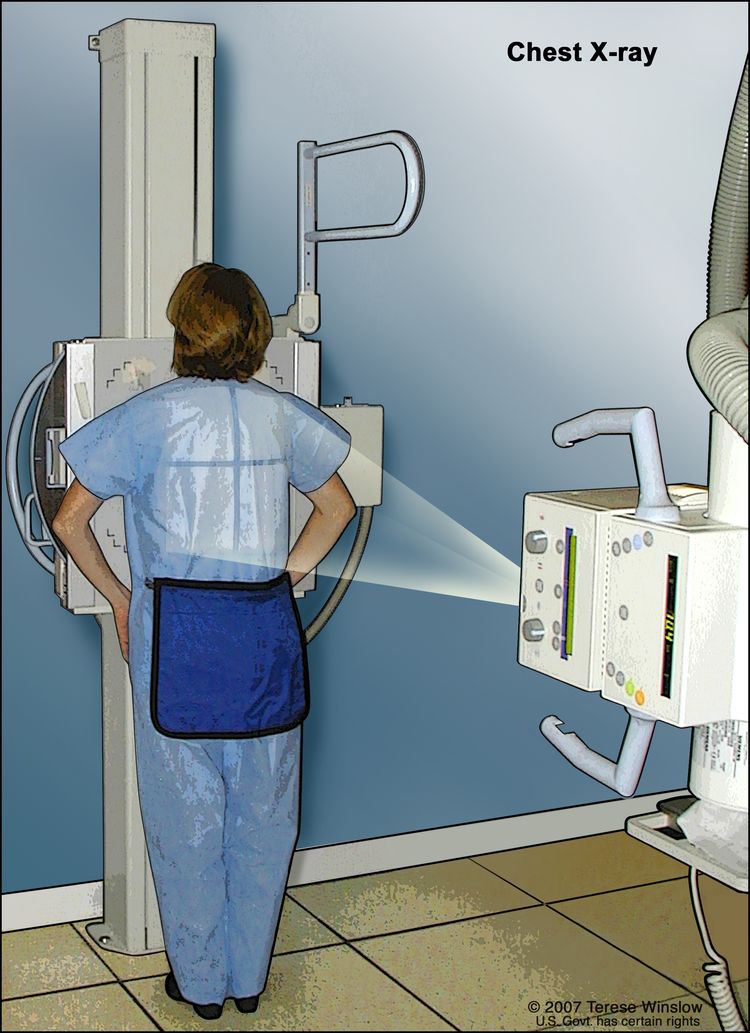
Chest x-ray is a type of radiation that can go through the body and make pictures of the organs and bones inside the chest.EnlargeA chest x-ray is used to take pictures of the structures and organs inside the chest. X-rays pass through the patient's body onto film or a computer.
CT scan (CAT scan) uses a computer linked to an x-ray machine to make a series of detailed pictures of areas inside the body, such as the brain, chest, and abdomen. The pictures are taken from different angles and are used to create 3-D views of tissues and organs. A dye may be injected into a vein or swallowed to help the organs or tissues show up more clearly. This procedure is also called computed tomography, computerized tomography, or computerized axial tomography. Learn more about Computed Tomography (CT) Scans and Cancer.
Sputum cytology uses a
microscope to check for cancer cells in the sputum (mucus coughed up
from the lungs).
Biopsy is the removal of a sample of cells or tissue from the tumor so that a pathologist can view it under a microscope to check for cancer. The different ways a biopsy can be done include:
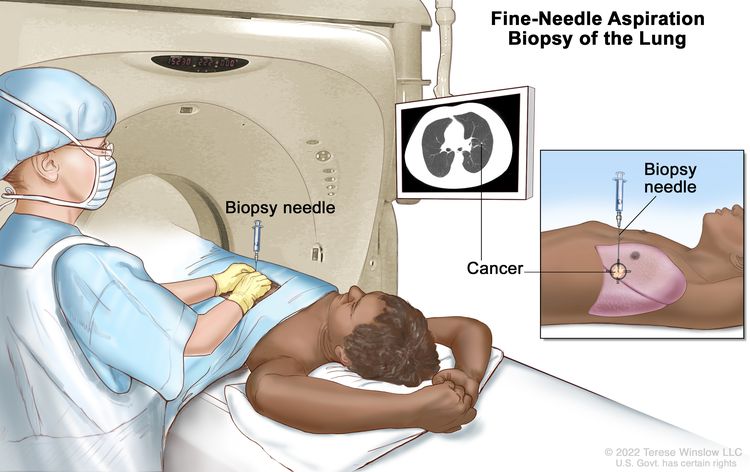
Fine-needle
aspiration (FNA) biopsy of the lung is the removal of tissue or fluid from the lung, using a thin needle. A CT scan, ultrasound, or other imaging procedure is used to find the abnormal tissue or fluid in the lung. A small incision may be made in the skin where the biopsy needle is inserted into the abnormal tissue or fluid. A sample is removed with the needle and sent to the laboratory. A pathologist then views the sample under a microscope to look for cancer cells. A chest x-ray is done after the procedure to make sure no air is leaking from the lung into the chest.EnlargeFine-needle aspiration biopsy of the lung. The patient lies on a table that slides through the computed tomography (CT) machine, which takes x-ray pictures of the inside of the body. The x-ray pictures help the doctor see where the abnormal tissue is in the lung. A biopsy needle is inserted through the chest wall and into the area of abnormal lung tissue. A small piece of tissue is removed through the needle and checked under the microscope for signs of cancer.
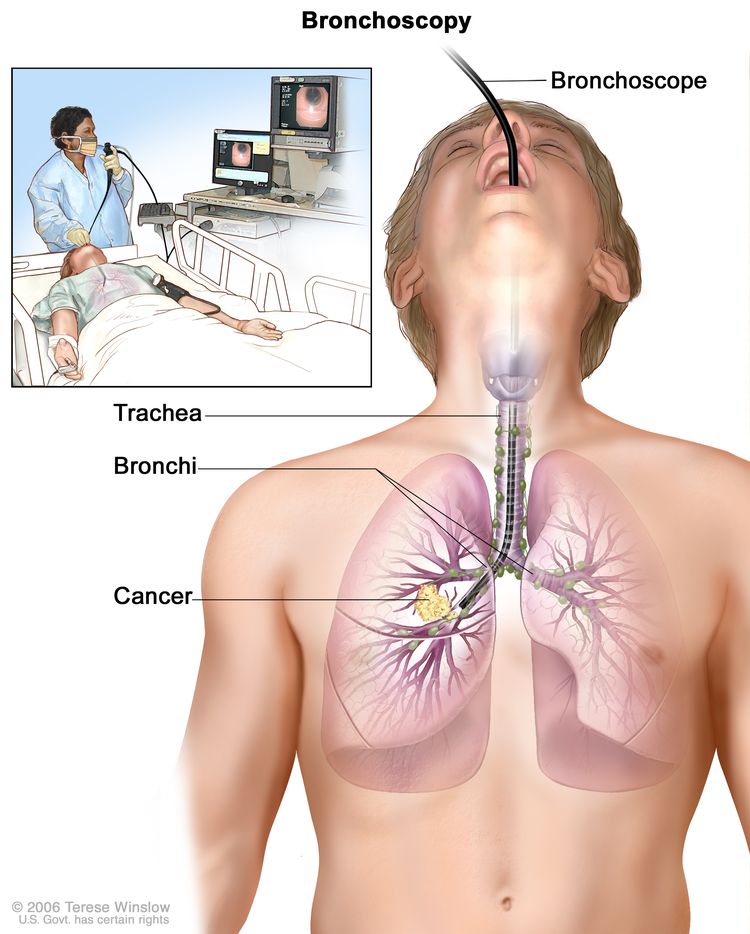
Bronchoscopy is a procedure to look inside the trachea and large airways in the lung for abnormal areas. A bronchoscope is inserted through the nose or mouth into the trachea and lungs. A bronchoscope is a thin, tube-like instrument with a light and a lens for viewing. It may also have a tool to remove tissue samples, which are checked under a microscope for signs of cancer.EnlargeBronchoscopy. A bronchoscope is inserted through the mouth, trachea, and major bronchi into the lung, to look for abnormal areas. A bronchoscope is a thin, tube-like instrument with a light and a lens for viewing. It may also have a cutting tool. Tissue samples may be taken to be checked under a microscope for signs of disease.
Thoracoscopy is a surgical procedure to look at the organs inside the chest to check for abnormal areas. An incision (cut) is made between two ribs, and a thoracoscope is inserted into the chest. A thoracoscope is a thin, tube-like instrument with a light and a lens for viewing. It may also have a tool to remove tissue or lymph node samples, which are checked under a microscope for signs of cancer. In some cases, this procedure is used to remove part of the esophagus or lung. If certain tissues, organs, or lymph nodes can't be reached, a thoracotomy may be done. In this procedure, a larger incision is made between the ribs and the chest is opened.
Thoracentesis is the removal of fluid from the space between the lining of the chest and the lung, using a needle. A pathologist views the fluid under a microscope to look for cancer cells.
Mediastinoscopy is a surgical procedure to look at the organs, tissues, and lymph nodes between the lungs for abnormal areas. An incision (cut) is made at the top of the breastbone and a mediastinoscope is inserted into the chest. A mediastinoscope is a thin, tube-like instrument with a light and a lens for viewing. It may also have a tool to remove tissue or lymph node samples, which are checked under a microscope for signs of cancer.
Light and electron microscopy is a laboratory test in which cells in a sample of tissue are viewed under regular and high-powered microscopes to look for certain changes in the cells.
Immunohistochemistry uses antibodies to check for certain antigens (markers) in a sample of a patient's cells or tissue. The antibodies are usually linked to an enzyme or fluorescent dye. After the antibodies bind to a specific antigen in the tissue sample, the enzyme or dye is activated, and the antigen can then be seen under a microscope. This type of test is used to help diagnose cancer and help tell one type of cancer from another type.
After small cell lung cancer has been diagnosed, tests are done
to find out if cancer cells have spread within the chest or to other parts of
the body.
The process used to find out if cancer has spread within the chest or to other parts
of the body is called staging. The
information gathered from the staging process determines the
stage of the disease. It is
important to know the stage in order to plan treatment. Some of the tests used to diagnose small cell lung cancer are also used to stage the disease.
Imaging tests that may be used in the staging process include:
MRI (magnetic
resonance imaging) uses a magnet, radio waves, and a computer to make a series of detailed pictures of areas inside the brain, such as the brain. This procedure is also called nuclear magnetic resonance imaging (NMRI).
PET scan (positron
emission tomography scan) uses a small amount of radioactive sugar (also called radioactive glucose) that is injected into a vein. The PET scanner rotates around the body and makes pictures of where sugar is being used by the body. Cancer cells show up brighter in the pictures because they are more active and take up more sugar than normal cells do. When this procedure is done at the same time as a CT scan, it is called a PET-CT scan.
Bone
scan checks if there are rapidly dividing cells, such as cancer cells, in the bone. A very small amount of radioactive material is injected into a vein and travels through the bloodstream. The radioactive material collects in the areas of the bones with cancer and is detected by a scanner.
Some people decide to get a second opinion.
You may want to get a second opinion to confirm your cancer diagnosis and treatment plan. If you seek a second opinion, you will need to get medical test results and reports from the first doctor to share with the second doctor. The second doctor will review the pathology report, slides, and scans. They may agree with the first doctor, suggest changes or another treatment approach, or provide more information about your cancer.
To learn more about choosing a doctor and getting a second opinion, visit Finding Cancer Care. You can contact NCI's Cancer Information Service via chat, email, or phone (both in English and Spanish) for help finding a doctor, hospital, or getting a second opinion. For questions you might want to ask at your appointments, visit Questions to Ask Your Doctor about Cancer.
Certain factors affect prognosis (chance of recovery) and
treatment options.
The prognosis and treatment options depend on:
the stage of the cancer (whether it is in the chest
cavity only or has spread to other places in the body)
the patient's age, sex,
and general health
For certain patients, prognosis also depends on whether the patient is treated with both chemotherapy and radiation.
For most people with small cell lung cancer, current
treatments do not cure the cancer. If lung cancer is found, you may want to think about taking part in one of the many
clinical trials being done to
improve treatment. Clinical trials are taking place in
most parts of the country for patients with all stages of small cell lung
cancer. Information about ongoing clinical trials is available from the
NCI website.
Stages of Small Cell Lung Cancer
Key Points
The following stages are used for small cell lung cancer:
Limited-stage small cell lung cancer
Extensive-stage small cell lung cancer
Small cell lung cancer can recur (come back) after it has been treated.
Cancer stage describes the extent of cancer in the body, such as the size of the tumor, whether it has spread, and how far it has spread from where it first formed. It is important to know the stage of small cell lung cancer to plan the best treatment.
Small cell lung cancer is usually classified into two stages due to its tendency to spread early.
The following stages are used for small cell lung cancer:
Small cell lung cancer can recur (come back) after it has been treated.
Recurrent cancer is cancer that has recurred
(come back) after it has been treated. If small cell lung cancer comes back, it may come
back in the chest,
central nervous system, or in other
parts of the body. Tests will be done to help determine where the cancer has returned. The type of treatment for small cell lung cancer will depend on where it has come back.
There are different types of treatment for patients with small
cell lung cancer.
The following types of treatment are used:
Surgery
Chemotherapy
Radiation therapy
Immunotherapy
Laser therapy
Endoscopic stent placement
New types of treatment are being tested in clinical trials.
Treatment for small cell lung cancer may cause side effects.
Follow-up care may be needed.
There are different types of treatment for patients with small
cell lung cancer.
Different types of treatments are available for people with small cell lung cancer. You and your cancer care team will work together to decide your treatment plan, which may include more than one type of treatment. Many factors will be considered, such as the stage of the cancer, your overall health, and your preferences. Your plan will include information about your cancer, the goals of treatment, your treatment options and the possible side effects, and the expected length of treatment.
Talking with your cancer care team before treatment begins about what to expect will be helpful. You'll want to learn what you need to do before treatment begins, how you'll feel while going through it, and what kind of help you will need. To learn more, visit Questions to Ask Your Doctor about Treatment.
The following types of treatment are used:
Surgery
Surgery may be used if
the cancer is found in one lung and in nearby lymph
nodes only. Because this type of lung cancer is usually found in
both lungs, surgery alone is not often used. During surgery, the
doctor will also remove lymph nodes to find out if they have cancer in them. Sometimes, surgery may be used
to remove a sample of lung tissue to find out the exact type of lung cancer.
After the doctor removes all the cancer that can be seen at the
time of the surgery, some patients may be given chemotherapy or radiation therapy after surgery to kill any cancer
cells that are left. Treatment given after the surgery, to lower the risk that the cancer will come back, is called adjuvant
therapy.
Chemotherapy
Chemotherapy (also called chemo) uses drugs to stop the growth of cancer cells, either by killing the cells or by stopping them from dividing.
Chemotherapy for small cell lung cancer is usually systemic, meaning it is injected into a vein or given by mouth. When given this way, the drugs enter the bloodstream to reach cancer cells throughout the body.
Chemotherapy drugs used to treat small cell lung cancer may include:
Radiation therapy is a cancer treatment that uses high-energy x-rays or other types of radiation to kill cancer cells or keep them from growing. External radiation therapy uses a machine outside the body to send radiation toward the area of the body with cancer. External radiation therapy is used to treat small cell lung cancer, and may also be used as palliative therapy to relieve symptoms and improve quality of life. Radiation therapy to the brain to lessen the risk that cancer will spread to
the brain may also be given.
Immunotherapy helps a person's immune system fight cancer. Your doctor may suggest biomarker tests to help predict your response to certain immunotherapy drugs. Learn more about Biomarker Testing for Cancer Treatment.
Immunotherapy drugs used to treat small cell lung cancer include:
Laser therapy is a
cancer treatment that uses a laser beam (a narrow beam of intense light) to kill cancer cells.
Endoscopic stent placement
An endoscope is a thin, tube-like instrument used to look at tissues inside the body. An endoscope has a light and a lens for viewing and may be used to place a stent in a body structure to keep the structure open. An endoscopic stent can be used to open an airway blocked by abnormal tissue.
New types of treatment are being tested in clinical trials.
For some people, joining a clinical trial may be an option. There are different types of clinical trials for people with cancer. For example, a treatment trial tests new treatments or new ways of using current treatments. Supportive care and palliative care trials look at ways to improve quality of life, especially for those who have side effects from cancer and its treatment.
You can use the clinical trial search to find NCI-supported cancer clinical trials accepting participants. The search allows you to filter trials based on the type of cancer, your age, and where the trials are being done. Clinical trials supported by other organizations can be found on the ClinicalTrials.gov website.
As you go through treatment, you will have follow-up tests or check-ups. Some tests that were done to diagnose or stage the cancer may be repeated to see how well the treatment is working. Decisions about whether to continue, change, or stop treatment may be based on the results of these tests.
Some of the tests will continue to be done from time to time after treatment has ended. The results of these tests can show if your condition has changed or if the cancer has recurred (come back).
Use our clinical trial search to find NCI-supported cancer clinical trials that are accepting patients. You can search for trials based on the type of cancer, the age of the patient, and where the trials are being done. General information about clinical trials is also available.
Treatment of Extensive-Stage Small Cell Lung Cancer
Use our clinical trial search to find NCI-supported cancer clinical trials that are accepting patients. You can search for trials based on the type of cancer, the age of the patient, and where the trials are being done. General information about clinical trials is also available.
Treatment of Recurrent Small Cell Lung Cancer
Treatment of recurrent
small cell lung cancer may include:
Use our clinical trial search to find NCI-supported cancer clinical trials that are accepting patients. You can search for trials based on the type of cancer, the age of the patient, and where the trials are being done. General information about clinical trials is also available.
Physician Data Query (PDQ) is the National Cancer Institute's (NCI's) comprehensive cancer information database. The PDQ database contains summaries of the latest published information on cancer prevention, detection, genetics, treatment, supportive care, and complementary and alternative medicine. Most summaries come in two versions. The health professional versions have detailed information written in technical language. The patient versions are written in easy-to-understand, nontechnical language. Both versions have cancer information that is accurate and up to date and most versions are also available in Spanish.
PDQ is a service of the NCI. The NCI is part of the National Institutes of Health (NIH). NIH is the federal government’s center of biomedical research. The PDQ summaries are based on an independent review of the medical literature. They are not policy statements of the NCI or the NIH.
Purpose of This Summary
This PDQ cancer information summary has current information about the treatment of small cell lung cancer. It is meant to inform and help patients, families, and caregivers. It does not give formal guidelines or recommendations for making decisions about health care.
Reviewers and Updates
Editorial Boards write the PDQ cancer information summaries and keep them up to date. These Boards are made up of experts in cancer treatment and other specialties related to cancer. The summaries are reviewed regularly and changes are made when there is new information. The date on each summary ("Updated") is the date of the most recent change.
The information in this patient summary was taken from the health professional version, which is reviewed regularly and updated as needed, by the PDQ Adult Treatment Editorial Board.
Clinical Trial Information
A clinical trial is a study to answer a scientific question, such as whether one treatment is better than another. Trials are based on past studies and what has been learned in the laboratory. Each trial answers certain scientific questions in order to find new and better ways to help cancer patients. During treatment clinical trials, information is collected about the effects of a new treatment and how well it works. If a clinical trial shows that a new treatment is better than one currently being used, the new treatment may become "standard." Patients may want to think about taking part in a clinical trial. Some clinical trials are open only to patients who have not started treatment.
Clinical trials can be found online at NCI's website. For more information, call the Cancer Information Service (CIS), NCI's contact center, at 1-800-4-CANCER (1-800-422-6237).
Permission to Use This Summary
PDQ is a registered trademark. The content of PDQ documents can be used freely as text. It cannot be identified as an NCI PDQ cancer information summary unless the whole summary is shown and it is updated regularly. However, a user would be allowed to write a sentence such as “NCI’s PDQ cancer information summary about breast cancer prevention states the risks in the following way: [include excerpt from the summary].”
Images in this summary are used with permission of the author(s), artist, and/or publisher for use in the PDQ summaries only. If you want to use an image from a PDQ summary and you are not using the whole summary, you must get permission from the owner. It cannot be given by the National Cancer Institute. Information about using the images in this summary, along with many other images related to cancer can be found in Visuals Online. Visuals Online is a collection of more than 3,000 scientific images.
Disclaimer
The information in these summaries should not be used to make decisions about insurance reimbursement. More information on insurance coverage is available on Cancer.gov on the Managing Cancer Care page.
Contact Us
More information about contacting us or receiving help with the Cancer.gov website can be found on our Contact Us for Help page. Questions can also be submitted to Cancer.gov through the website’s E-mail Us.