
Questions About Cancer? 1-800-4-CANCER

Stomach (Gastric) Cancer Screening (PDQ®)

Patient Version
Last Modified: 08/13/2010

General Information About Stomach (Gastric) Cancer

Key Points for This Section


Stomach cancer is a disease in which malignant (cancer) cells form in the lining of the stomach.

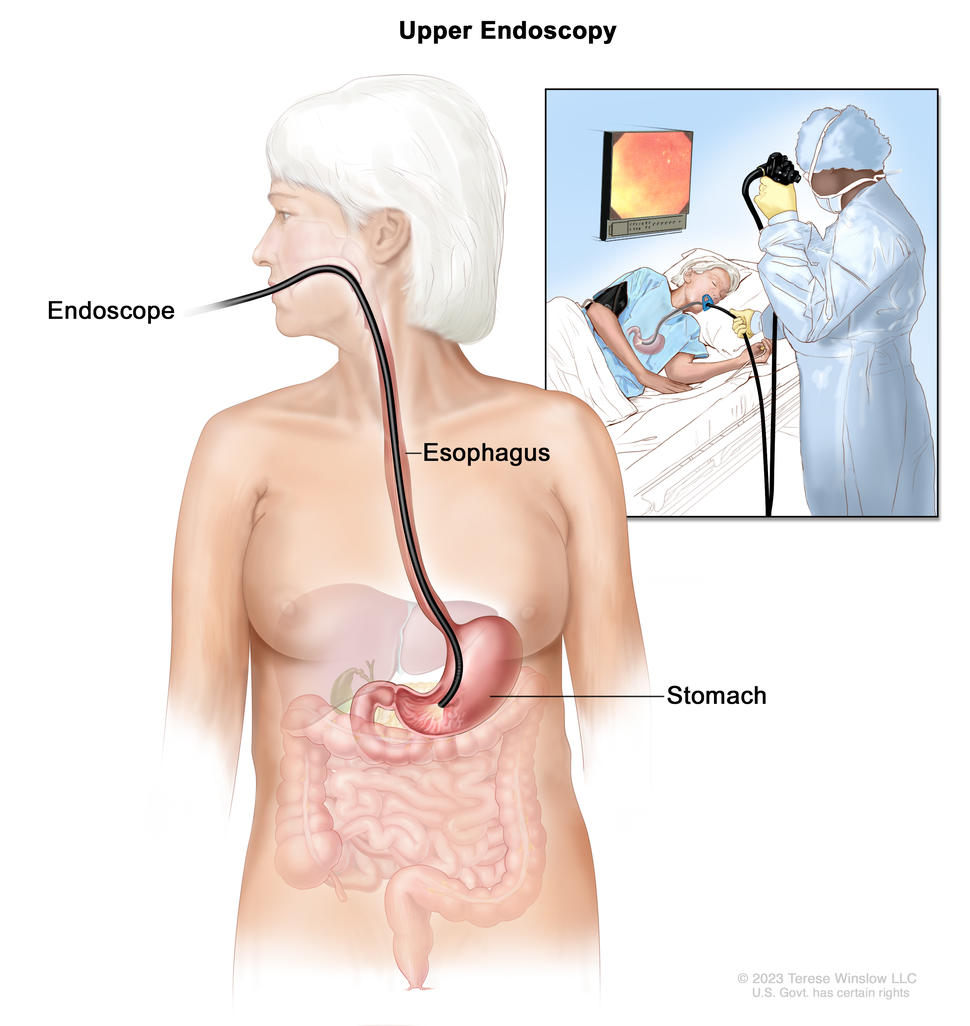
The stomach is a J-shaped organ in the upper abdomen. It is part of the digestive system, which processes nutrients (vitamins, minerals, carbohydrates, fats, proteins, and water) in foods that are eaten and helps pass waste material out of the body. Food moves from the throat to the stomach through a hollow, muscular tube called the esophagus. After leaving the stomach, partly-digested food passes into the small intestine and then into the large intestine.


The wall of the stomach is made up of 3 layers of tissue: the mucosal (innermost) layer, the muscularis (middle) layer, and the serosal (outermost) layer. Stomach cancer begins in the cells lining the mucosal layer and spreads through the outer layers as it grows.

See the following PDQ summaries for more information about stomach cancer:

Stomach cancer is less common in the United States than in the developing world.

Stomach cancer is much more common in many parts of Europe, Asia, and Central and South America, and is a major cause of death in the developing world.

Stomach cancer rates in the United States have greatly decreased since 1930. The reasons for this are not known, but may have to do with better food storage or changes in the diet, such as lower salt intake.

Older age and certain chronic conditions increase the risk of developing stomach cancer.

Anything that increases the chance of getting a disease is called a risk factor. Having a risk factor does not mean that you will get cancer; not having risk factors doesn't mean that you will not get cancer. People who think they may be at risk should discuss this with their doctor. Risk factors for stomach cancer include the following:


Glossary Terms

abdomen (AB-doh-men)
The area of the body that contains the pancreas, stomach, intestines, liver, gallbladder, and other organs.
cancer (KAN-ser)
A term for diseases in which abnormal cells divide without control and can invade nearby tissues. Cancer cells can also spread to other parts of the body through the blood and lymph systems. There are several main types of cancer. Carcinoma is a cancer that begins in the skin or in tissues that line or cover internal organs. Sarcoma is a cancer that begins in bone, cartilage, fat, muscle, blood vessels, or other connective or supportive tissue. Leukemia is a cancer that starts in blood-forming tissue such as the bone marrow, and causes large numbers of abnormal blood cells to be produced and enter the blood. Lymphoma and multiple myeloma are cancers that begin in the cells of the immune system. Central nervous system cancers are cancers that begin in the tissues of the brain and spinal cord. Also called malignancy.
carbohydrate (KAR-boh-HY-drayt)
A sugar molecule. Carbohydrates can be small and simple (for example, glucose) or they can be large and complex (for example, polysaccharides such as starch, chitin or cellulose).
cell (sel)
The individual unit that makes up the tissues of the body. All living things are made up of one or more cells.
chronic (KRAH-nik)
A disease or condition that persists or progresses over a long period of time.
diet (DY-et)
The things a person eats and drinks.
digestive system (dy-JES-tiv SIS-tem)
The organs that take in food and turn it into products that the body can use to stay healthy. Waste products the body cannot use leave the body through bowel movements. The digestive system includes the salivary glands, mouth, esophagus, stomach, liver, pancreas, gallbladder, small and large intestines, and rectum.
esophagus (ee-SAH-fuh-gus)
The muscular tube through which food passes from the throat to the stomach.
familial adenomatous polyposis (fuh-MIH-lee-ul A-deh-NOH-muh-tus PAH-lee-POH-sis)
An inherited condition in which numerous polyps (growths that protrude from mucous membranes) form on the inside walls of the colon and rectum. It increases the risk of colorectal cancer. Also called familial polyposis and FAP.
gastric (GAS-trik)
Having to do with the stomach.
gastritis (gas-TRY-tis)
Inflammation of the lining of the stomach.
Helicobacter pylori (HEEL-ih-koh-BAK-ter py-LOR-ee)
A type of bacterium that causes inflammation and ulcers in the stomach or small intestine. People with Helicobacter pylori infections may be more likely to develop cancer in the stomach, including MALT (mucosa-associated lymphoid tissue) lymphoma. Also called H. pylori.
infection (in-FEK-shun)
Invasion and multiplication of germs in the body. Infections can occur in any part of the body and can spread throughout the body. The germs may be bacteria, viruses, yeast, or fungi. They can cause a fever and other problems, depending on where the infection occurs. When the body’s natural defense system is strong, it can often fight the germs and prevent infection. Some cancer treatments can weaken the natural defense system.
inflammation (IN-fluh-MAY-shun)
Redness, swelling, pain, and/or a feeling of heat in an area of the body. This is a protective reaction to injury, disease, or irritation of the tissues.
intestinal (in-TES-tih-nul)
Having to do with the intestines.
intestine (in-TES-tin)
The long, tube-shaped organ in the abdomen that completes the process of digestion. The intestine has two parts, the small intestine and the large intestine. Also called bowel.
large intestine (larj in-TES-tin)
The long, tube-like organ that is connected to the small intestine at one end and the anus at the other. The large intestine has four parts: cecum, colon, rectum, and anal canal. Partly digested food moves through the cecum into the colon, where water and some nutrients and electrolytes are removed. The remaining material, solid waste called stool, moves through the colon, is stored in the rectum, and leaves the body through the anal canal and anus.
metaplasia (meh-tuh-PLAY-zhuh)
A change of cells to a form that does not normally occur in the tissue in which it is found.
mineral (MIH-neh-rul)
In medicine, a mineral is a nutrient that is needed in small amounts to keep the body healthy. Mineral nutrients include the elements calcium, magnesium, and iron.
mucosa (myoo-KOH-suh)
The moist, inner lining of some organs and body cavities (such as the nose, mouth, lungs, and stomach). Glands in the mucosa make mucus (a thick, slippery fluid). Also called mucous membrane.
nutrient (NOO-tree-ent)
A chemical compound (such as protein, fat, carbohydrate, vitamin, or mineral) contained in foods. These compounds are used by the body to function and grow.
organ (OR-gun)
A part of the body that performs a specific function. For example, the heart is an organ.
PDQ
PDQ is an online database developed and maintained by the National Cancer Institute. Designed to make the most current, credible, and accurate cancer information available to health professionals and the public, PDQ contains peer-reviewed summaries on cancer treatment, screening, prevention, genetics, complementary and alternative medicine, and supportive care; a registry of cancer clinical trials from around the world; and directories of physicians, professionals who provide genetics services, and organizations that provide cancer care. Most of this information, and more specific information about PDQ, can be found on the NCI's Web site at http://www.cancer.gov/cancertopics/pdq. Also called Physician Data Query.
pernicious anemia (per-NIH-shus uh-NEE-mee-uh)
A type of anemia (low red blood cell count) caused by the body's inability to absorb vitamin B12.
polyp (PAH-lip)
A growth that protrudes from a mucous membrane.
protein (PROH-teen)
A molecule made up of amino acids that are needed for the body to function properly. Proteins are the basis of body structures such as skin and hair and of substances such as enzymes, cytokines, and antibodies.
risk factor (... FAK-ter)
Something that increases the chance of developing a disease. Some examples of risk factors for cancer are age, a family history of certain cancers, use of tobacco products, being exposed to radiation or certain chemicals, infection with certain viruses or bacteria, and certain genetic changes.
serosa (seh-ROH-suh)
The outer lining of organs and body cavities of the abdomen and chest, including the stomach. Also called serous membrane.
small intestine (... in-TES-tin)
The part of the digestive tract that is located between the stomach and the large intestine.
stomach (STUH-muk)
An organ that is part of the digestive system. The stomach helps digest food by mixing it with digestive juices and churning it into a thin liquid.
stomach cancer (STUH-muk KAN-ser)
Cancer that forms in tissues lining the stomach. Also called gastric cancer.
throat (throte)
The hollow tube inside the neck that starts behind the nose and ends at the top of the trachea (windpipe) and esophagus (the tube that goes to the stomach). The throat is about 5 inches long, depending on body size. Also called pharynx.
tissue (TIH-shoo)
A group or layer of cells that work together to perform a specific function.
vitamin (VY-tuh-min)
A nutrient that the body needs in small amounts to function and stay healthy. Sources of vitamins are plant and animal food products and dietary supplements. Some vitamins are made in the human body from food products. Vitamins are either fat-soluble (can dissolve in fats and oils) or water-soluble (can dissolve in water). Excess fat-soluble vitamins are stored in the body’s fatty tissue, but excess water-soluble vitamins are removed in the urine. Examples are vitamin A, vitamin C, and vitamin E.

Table of Links

1http://www.cancer.gov/cancertopics/pdq/prevention/gastric/Patient
2http://www.cancer.gov/cancertopics/pdq/treatment/gastric/Patient