
National Cancer Institute National Cancer Institute
U.S. National Institutes of Health National Cancer Institute
Send to Printer
Stomach (Gastric) Cancer Screening (PDQ®)     
Last Modified: 06/08/2009
Patient Version
Risks of Stomach (Gastric) Cancer Screening

Key Points for This Section


Screening tests have risks.

Decisions about screening tests can be difficult. Not all screening tests are helpful and most have risks. Before having any screening test, you may want to discuss the test with your doctor. It is important to know the risks of the test and whether it has been proven to reduce the risk of dying from cancer.

The risks of stomach cancer screening include the following:

Finding stomach cancer may not improve health or help you live longer.

Screening may not improve your health or help you live longer if you have advanced stomach cancer or if it has already spread to other places in your body.

Some cancers never cause symptoms or become life-threatening, but if found by a screening test, the cancer may be treated. It is not known if treatment of these cancers would help you live longer than if no treatment were given, and treatments for cancer may have serious side effects.

False-negative test results can occur.

Screening test results may appear to be normal even though stomach cancer is present. A person who receives a false-negative result (one that shows there is no cancer when there really is) may delay seeking medical care even if there are symptoms.

False-positive test results can occur.

Screening test results may appear to be abnormal even though no cancer is present. A false-positive test result (one that shows there is cancer when there really isn't) can cause anxiety and is usually followed by more tests and procedures which also have risks.

Side effects may be caused by the screening test itself.

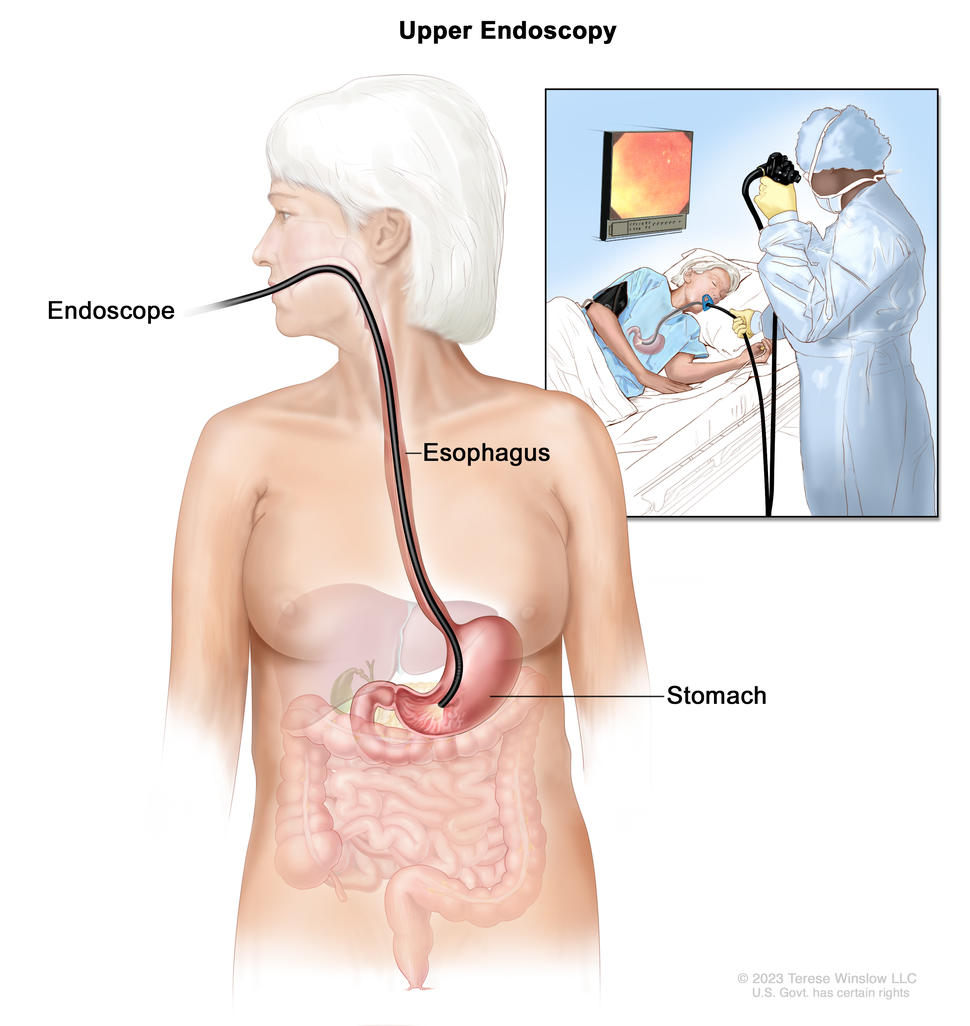
Upper endoscopy may cause the following rare, but serious, side effects:

  • A small hole (puncture) in the esophagus or stomach.
  • Heart problems.
  • Breathing problems.
  • Lung infection from inhaling food, fluid, or stomach acid into the lung.
  • Severe bleeding that needs to be treated at a hospital.


Glossary Terms

abnormal
Not normal. An abnormal lesion or growth may be cancer, premalignant (likely to become cancer), or benign (not cancer).
advanced cancer (ad-VANST KAN-ser)
Cancer that has spread to other places in the body and usually cannot be cured or controlled with treatment.
anxiety (ang-ZY-uh-tee)
Feelings of fear, dread, and uneasiness that may occur as a reaction to stress. A person with anxiety may sweat, feel restless and tense, and have a rapid heart beat. Extreme anxiety that happens often over time may be a sign of an anxiety disorder.
cancer (KAN-ser)
A term for diseases in which abnormal cells divide without control and can invade nearby tissues. Cancer cells can also spread to other parts of the body through the blood and lymph systems. There are several main types of cancer. Carcinoma is a cancer that begins in the skin or in tissues that line or cover internal organs. Sarcoma is a cancer that begins in bone, cartilage, fat, muscle, blood vessels, or other connective or supportive tissue. Leukemia is a cancer that starts in blood-forming tissue such as the bone marrow, and causes large numbers of abnormal blood cells to be produced and enter the blood. Lymphoma and multiple myeloma are cancers that begin in the cells of the immune system. Central nervous system cancers are cancers that begin in the tissues of the brain and spinal cord. Also called malignancy.
esophagus (ee-SAH-fuh-gus)
The muscular tube through which food passes from the throat to the stomach.
false-negative test result
A test result that indicates that a person does not have a specific disease or condition when the person actually does have the disease or condition.
false-positive test result (fawls-PAH-zih-tiv ... reh-ZULT)
A test result that indicates that a person has a specific disease or condition when the person actually does not have the disease or condition.
fluid (FLOO-id)
A substance that flows smoothly and takes the shape of its container. Liquids and gases are fluids.
infection
Invasion and multiplication of germs in the body. Infections can occur in any part of the body and can spread throughout the body. The germs may be bacteria, viruses, yeast, or fungi. They can cause a fever and other problems, depending on where the infection occurs. When the body’s natural defense system is strong, it can often fight the germs and prevent infection. Some cancer treatments can weaken the natural defense system.
inhalation
In medicine, refers to the act of taking a substance into the body by breathing.
lung
One of a pair of organs in the chest that supplies the body with oxygen, and removes carbon dioxide from the body.
screening (SKREEN-ing)
Checking for disease when there are no symptoms. Since screening may find diseases at an early stage, there may be a better chance of curing the disease. Examples of cancer screening tests are the mammogram (breast), colonoscopy (colon), Pap smear (cervix), and PSA blood level and digital rectal exam (prostate). Screening can also include checking for a person’s risk of developing an inherited disease by doing a genetic test.
side effect
A problem that occurs when treatment affects healthy tissues or organs. Some common side effects of cancer treatment are fatigue, pain, nausea, vomiting, decreased blood cell counts, hair loss, and mouth sores.
stomach (STUH-muk)
An organ that is part of the digestive system. The stomach helps digest food by mixing it with digestive juices and churning it into a thin liquid.
stomach cancer (STUH-muk KAN-ser)
Cancer that forms in tissues lining the stomach. Also called gastric cancer.
symptom
An indication that a person has a condition or disease. Some examples of symptoms are headache, fever, fatigue, nausea, vomiting, and pain.
upper endoscopy (UH-per en-DOS-koh-pee)
Examination of the inside of the stomach using an endoscope, passed through the mouth and esophagus. An endoscope is a thin, tube-like instrument with a light and a lens for viewing. It may also have a tool to remove tissue to be checked under a microscope for signs of disease. Also called gastroscopy.