
Treatment options for pituitary tumors
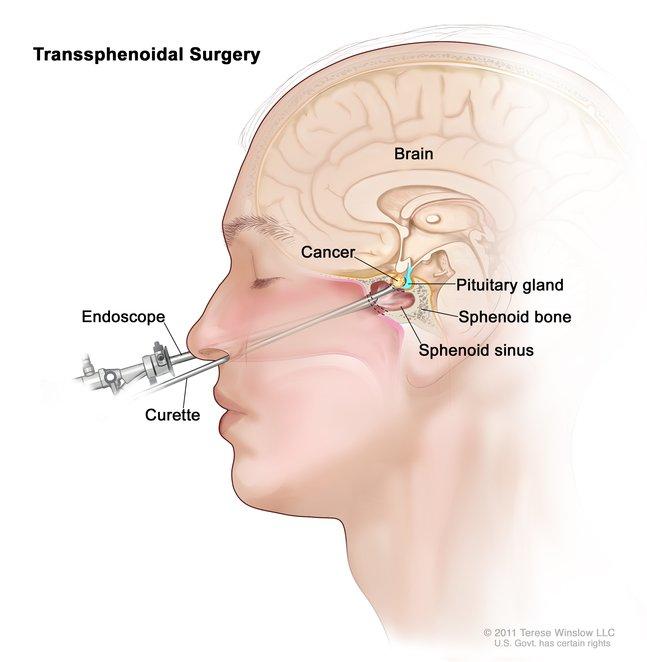
Transsphenoidal surgery. An endoscope and a curette are inserted through the nose and sphenoid sinus to remove cancer from the pituitary gland.
Credit: © Terese Winslow
The following types of treatment are used:
Surgery
Many pituitary tumors can be removed by surgery using one of the following operations:
- Transsphenoidal surgery: A type of surgery in which the instruments are inserted into part of the brain by going through an incision (cut) made under the upper lip or at the bottom of the nose between the nostrils and then through the sphenoid bone (a butterfly-shaped bone at the base of the skull) to reach the pituitary gland. The pituitary gland lies just above the sphenoid bone.
- Endoscopic transsphenoidal surgery: A type of surgery in which an endoscope is inserted through an incision (cut) made at the back of the inside of the nose and then through the sphenoid bone to reach the pituitary gland. An endoscope is a thin, tube-like instrument with a light, a lens for viewing, and a tool for removing tumor tissue.
- Craniotomy: Surgery to remove the tumor through an opening made in the skull.
After the doctor removes all the cancer that can be seen at the time of the surgery, some patients may be given chemotherapy or radiation therapy after surgery to kill any cancer cells that are left. Treatment given after the surgery, to lower the risk that the cancer will come back, is called adjuvant therapy.
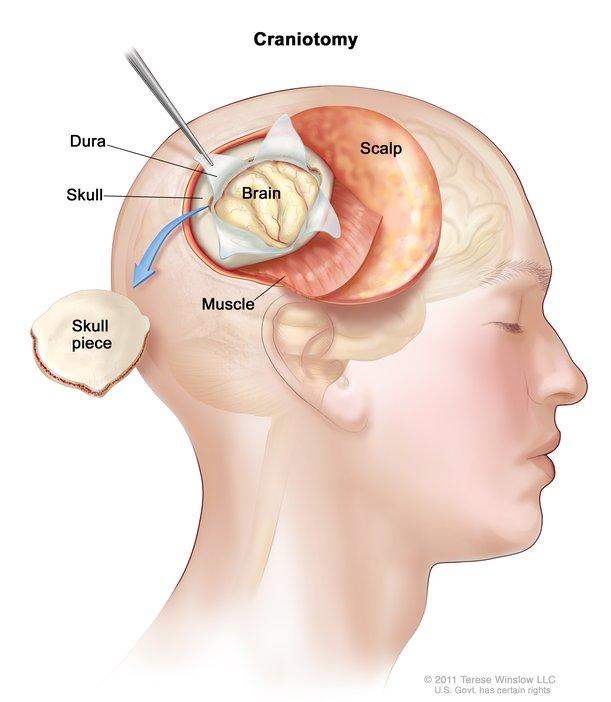
Craniotomy. An opening is made in the skull and a piece of the skull is removed to show part of the brain.
Credit: © Terese Winslow
Radiation therapy
Radiation therapy is a cancer treatment that uses high-energy x-rays or other types of radiation to kill cancer cells or keep them from growing. External radiation therapy uses a machine outside the body to send radiation toward the area of the body with cancer. Certain ways of giving radiation therapy can help keep radiation from damaging nearby healthy tissue. This type of radiation therapy may include:
- Stereotactic radiosurgery: A rigid head frame is attached to the skull to keep the head still during the radiation treatment. A machine aims a single large dose of radiation directly at the tumor. This procedure does not involve surgery. It is also called stereotaxic radiosurgery, radiosurgery, and radiation surgery.
Drug therapy
Drugs may be given to stop a functioning pituitary tumor from making too many hormones.
Chemotherapy
Chemotherapy may be used as palliative treatment for pituitary carcinomas, to relieve symptoms and improve the patient's quality of life. Chemotherapy uses drugs to stop the growth of cancer cells, either by killing the cells or by stopping them from dividing. When chemotherapy is taken by mouth or injected into a vein or muscle, the drugs enter the bloodstream and can reach cancer cells throughout the body (systemic chemotherapy). When chemotherapy is placed directly into the cerebrospinal fluid, an organ, or a body cavity such as the abdomen, the drugs mainly affect cancer cells in those areas (regional chemotherapy). The way the chemotherapy is given depends on the type of the cancer being treated.
Treatment of nonfunctioning pituitary tumors
Treatment may include:
- Surgery (transsphenoidal surgery, if possible) to remove the tumor, followed by watchful waiting (closely monitoring a patient’s condition without giving any treatment until signs or symptoms appear or change). Radiation therapy is given if the tumor comes back.
- Radiation therapy alone.
Treatment for luteinizing hormone–producing and follicle-stimulating hormone–producing tumors is usually transsphenoidal surgery to remove the tumor.
Treatment of prolactin-producing pituitary tumors
Treatment may include:
- Drug therapy to stop the tumor from making prolactin and to stop the tumor from growing.
- Surgery to remove the tumor (transsphenoidal surgery or craniotomy) when the tumor does not respond to drug therapy or when the patient cannot take the drug.
- Radiation therapy.
- Surgery followed by radiation therapy.
Treatment of adrenocorticotropic hormone (ACTH)–producing pituitary tumors
Treatment may include:
- Surgery (usually transsphenoidal surgery) to remove the tumor, with or without radiation therapy.
- Radiation therapy alone.
- Drug therapy to stop the tumor from making ACTH.
- A clinical trial of stereotactic radiation surgery.
Treatment of growth hormone–producing pituitary tumors
Treatment may include:
- Surgery (usually transsphenoidal or endoscopic transsphenoidal surgery) to remove the tumor, with or without radiation therapy.
- Drug therapy to stop the tumor from making growth hormone.
Treatment of thyroid-stimulating hormone–producing tumors
Treatment may include:
- Surgery (usually transsphenoidal surgery) to remove the tumor, with or without radiation therapy.
- Drug therapy to stop the tumor from making hormones.
Treatment of pituitary carcinomas
Treatment of pituitary carcinomas is palliative, to relieve symptoms and improve the quality of life. Treatment may include:
- Surgery (transsphenoidal surgery or craniotomy) to remove the cancer, with or without radiation therapy.
- Drug therapy to stop the tumor from making hormones.
- Chemotherapy.
Treatment of recurrent pituitary tumors
Treatment may include:
Clinical trials
For some patients, taking part in a clinical trial may be the best treatment choice. Clinical trials are part of the cancer research process. Clinical trials are done to find out if new cancer treatments are safe and effective or better than the standard treatment.
Many of today's standard treatments for cancer are based on earlier clinical trials. Patients who take part in a clinical trial may receive the standard treatment or be among the first to receive a new treatment.
Patients who take part in clinical trials also help improve the way cancer will be treated in the future. Even when clinical trials do not lead to effective new treatments, they often answer important questions and help move research forward.
Patients can enter clinical trials before, during, or after starting their cancer treatment
Some clinical trials only include patients who have not yet received treatment. Other trials test treatments for patients whose cancer has not gotten better. There are also clinical trials that test new ways to stop cancer from recurring (coming back) or reduce the side effects of cancer treatment.
Clinical trials are taking place in many parts of the country. Find clinical trials for pituitary tumors at Clinical Trials to Treat Pituitary Tumors. Clinical trials supported by other organizations can be found on the ClinicalTrials.gov website. General information about clinical trials is also available.
Side effects of treatment
Treatment for pituitary tumors may cause side effects. For information about side effects caused by treatment for cancer, visit our Side Effects page.
Follow-up care
As you go through treatment, you will have follow-up tests or check-ups. Some tests that were done to diagnose or stage the cancer may be repeated to see how well the treatment is working. Decisions about whether to continue, change, or stop treatment may be based on the results of these tests.
Some of the tests will continue to be done from time to time after treatment has ended. The results of these tests can show if your condition has changed or if the cancer has recurred (come back).