National Cancer Institute National Cancer Institute
U.S. National Institutes of Health National Cancer Institute
Send to Printer
Pituitary Tumors Treatment (PDQ®)     
Last Modified: 07/03/2008
Patient Version
Table of Contents

Description
What are pituitary tumors?
Stage Explanation
Types of pituitary tumors
Prolactin-producing tumors
ACTH-producing tumors
Growth hormone-producing tumors
Nonfunctioning pituitary tumors
Thyroid-stimulating hormone-producing tumors
Pituitary carcinomas
Other pituitary tumors
Recurrent pituitary tumors
Treatment Option Overview
How pituitary tumors are treated
Treatment in a clinical trial
Prolactin-Producing Pituitary Tumors
ACTH-Producing Pituitary Tumors
Growth Hormone-Producing Pituitary Tumors
Nonfunctioning Pituitary Tumors
Thyroid-Stimulating Hormone-Producing Tumors
Pituitary Carcinomas
Recurrent Pituitary Tumors
To Learn More About Pituitary Tumors
Get More Information From NCI
Changes to This Summary (07/03/2008)
About PDQ

Description


What are pituitary tumors?

Pituitary tumors are tumors found in the pituitary gland, a small organ about the size of a pea in the center of the brain just above the back of the nose. The pituitary gland makes hormones that affect growth and the functions of other glands in the body. Pituitary tumors may be grouped as follows:

  • Benign adenomas, which are noncancer. These grow very slowly and do not spread from the pituitary gland to other parts of the body.
  • Invasive adenomas, which spread to the outer covering of the brain, bones of the skull, or the sinus cavity below the pituitary gland.
  • Carcinomas, which are malignant (cancer). These are pituitary tumors that have spread far from the pituitary gland in the central nervous system (brain and spinal cord) or outside of the central nervous system.

These pituitary tumors may be either functioning or nonfunctioning. Tumors that make one or more of the pituitary hormones are called functioning tumors, while those that do not make hormones are called nonfunctioning tumors. Each type of functioning tumor causes different symptoms, depending on the type of hormone that is being made by the tumor. Symptoms may also be caused if the tumor grows large and presses on nearby parts of the brain. A doctor should be seen if there are symptoms such as these:

  • Headaches.
  • Trouble seeing or moving the eyes.
  • Vomiting.
  • Any of the symptoms caused by too many hormones, as described under the tumor types in the Stage Explanation 1 section.

Some cancers in other parts of the body may metastasize (spread) to the pituitary gland, but these pituitary tumors usually do not cause symptoms. Breast and lung cancer are the most common types of cancer that spread to the pituitary.

If there are symptoms, a doctor may order laboratory tests to see what the hormone levels are in the blood. The doctor may also order an MRI (magnetic resonance imaging) scan, which uses magnetic waves to make a picture of the inside of the brain. Other special x-rays may also be done.

Stage Explanation


Types of pituitary tumors

Pituitary tumors are classified according to size:

  • Microadenomas are smaller than 10 millimeters.
  • Macroadenomas are 10 millimeters or larger.

Most pituitary adenomas are microadenomas.

Once a pituitary tumor is found, more tests will be done to find out how far the tumor has spread, the type of tumor, and whether or not it makes hormones. Treatment of the tumor depends on these factors and also on the symptoms caused by the tumor and the patient’s age and general health. The following types of pituitary tumors are found:

Prolactin-producing tumors

These tumors make prolactin, a hormone that stimulates a woman’s breasts to make milk during and after pregnancy. Prolactin-secreting tumors can cause the breasts to make milk and menstrual periods to stop when a woman is not pregnant. In men, prolactin-producing tumors can cause impotence.

ACTH-producing tumors

These tumors make a hormone called adrenocorticotropic hormone (ACTH), which stimulates the adrenal glands to make glucocorticoids. When the body makes too much ACTH, it causes Cushing disease. In Cushing disease, fat builds up in the face, back, and chest, and the arms and legs become very thin. Another symptom of ACTH-producing tumors is weakened bones.

Growth hormone-producing tumors

These tumors make growth hormone. Too much growth hormone can cause acromegaly (the hands, feet, and face are larger than normal) or gigantism (the whole body grows much larger than normal).

Nonfunctioning pituitary tumors

Nonfunctioning tumors do not produce hormones. Symptoms such as headache or trouble seeing may be caused by the tumor pressing on nearby brain tissue. If the tumor presses on or destroys parts of the pituitary gland, the pituitary gland may stop making one or more of its hormones. Lack of a certain hormone will affect the work of the gland or organ that the hormone controls. For example, if the pituitary gland stops making the hormone that affects the ovaries, the ovaries will not work normally or will not develop normally in a child.

Thyroid-stimulating hormone-producing tumors

These tumors make thyrotrophin, which stimulates the thyroid gland to make thyroid hormone. The thyroid hormone helps regulate heart rate, body temperature, the level of calcium in the blood, and the rate at which food is changed into energy. Too much thyroid hormone can cause rapid heartbeat, weight loss, and other symptoms. Thyroid-stimulating hormone -producing tumors may be large and may spread. They sometimes also make growth hormone and/or prolactin.

Pituitary carcinomas

These tumors usually grow quickly and make hormones, commonly ACTH and prolactin. Symptoms may be caused by the hormone that is made by the tumor and by the tumor pressing on nearby brain tissue.

Other pituitary tumors

For information about other types of pituitary tumors, refer to the following PDQ summaries:

Recurrent pituitary tumors

Recurrent disease means that the tumor has come back (recurred) after it has been treated. It may come back in the pituitary gland or in another part of the body.

Treatment Option Overview


How pituitary tumors are treated

Different types of treatment are available for patients with pituitary tumors. Some treatments are standard (the currently used treatment), and some are being tested in clinical trials. A treatment clinical trial is a research study meant to help improve current treatments or obtain information on new treatments for patients with cancer. When clinical trials show that a new treatment is better than the standard treatment, the new treatment may become the standard treatment. Patients may want to think about taking part in a clinical trial. Some clinical trials are open only to patients who have not started treatment.

Three kinds of standard treatment are used:

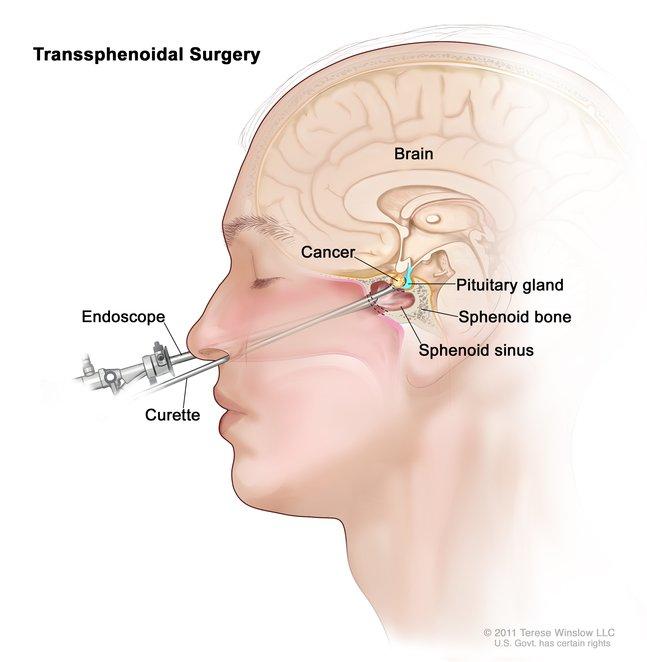
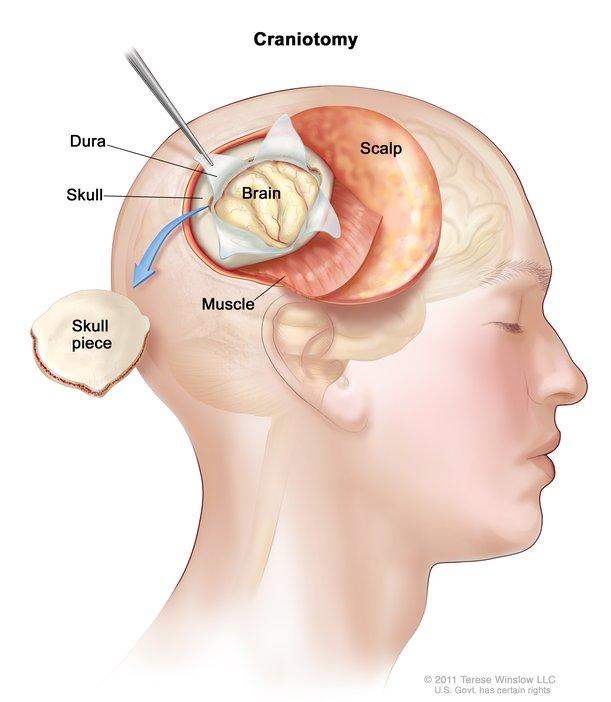
Surgery is a common treatment of pituitary tumors. A doctor may remove the tumor using one of the following operations:

  • Transsphenoidal surgery removes the tumor through a cut in the nasal passage.
  • A craniotomy removes the tumor through a cut in the front of the skull.

Radiation therapy uses high-energy x-rays to kill cancer cells and shrink tumors. Radiation for pituitary tumors usually comes from a machine outside the body (external radiation therapy). Clinical trials are testing stereotactic radiation surgery, in which radiation is aimed to the tumor only, with less damage to healthy tissue. A CT scan or MRI is used to find the exact location of the tumor. A rigid head frame is attached to the skull and high-dose radiation is directed to the tumor through openings in the head frame, so only a small amount of normal brain tissue is affected. This procedure does not involve surgery. Radiation therapy may be used alone or in addition to surgery or drug therapy.

Drug therapy is the use of drugs to stop the pituitary gland from making too many hormones.

Treatment in a clinical trial

For some patients, taking part in a clinical trial may be the best treatment choice. Clinical trials are part of the cancer research process. Clinical trials are done to find out if new cancer treatments are safe and effective or better than the standard treatment.

Many of today's standard treatments for cancer are based on earlier clinical trials. Patients who take part in a clinical trial may receive the standard treatment or be among the first to receive a new treatment.

Patients who take part in clinical trials also help improve the way cancer will be treated in the future. Even when clinical trials do not lead to effective new treatments, they often answer important questions and help move research forward.

Some clinical trials only include patients who have not yet received treatment. Other trials test treatments for patients whose cancer has not gotten better. There are also clinical trials that test new ways to stop cancer from recurring (coming back) or reduce the side effects of cancer treatment.

Clinical trials are taking place in many parts of the country. In the following lists of treatments for the different types of pituitary tumors, a link to search results for current clinical trials is included for each section. These have been retrieved from NCI's clinical trials database. For some types of tumors, there may not be any trials listed. Check with your doctor for clinical trials that are not listed here but may be right for you.

Prolactin-Producing Pituitary Tumors

Treatment may be one of the following:

  1. Drug therapy to stop the tumor from making prolactin.
  2. Surgery to remove the tumor (transsphenoidal surgery or craniotomy) when the tumor does not respond to drug therapy or when the patient cannot take the drug.
  3. Radiation therapy.

Check for U.S. clinical trials from NCI's PDQ Cancer Clinical Trials Registry that are now accepting patients with pituitary tumor 4.

ACTH-Producing Pituitary Tumors

Treatment may be one of the following:

  1. Surgery to remove the tumor (usually transsphenoidal surgery) with or without radiation therapy.
  2. Radiation therapy alone.
  3. Drug therapy to stop the tumor from making ACTH.
  4. A clinical trial of stereotactic radiation surgery.

Check for U.S. clinical trials from NCI's PDQ Cancer Clinical Trials Registry that are now accepting patients with pituitary tumor 4.

Growth Hormone-Producing Pituitary Tumors

Treatment may be one of the following:

  1. Surgery to remove the tumor (usually transsphenoidal surgery).
  2. Drug therapy to stop the tumor from making growth hormone.
  3. Surgery followed by radiation therapy.

Check for U.S. clinical trials from NCI's PDQ Cancer Clinical Trials Registry that are now accepting patients with pituitary tumor 4.

Nonfunctioning Pituitary Tumors

Treatment may be one of the following:

  1. Surgery to remove the tumor (transsphenoidal surgery or craniotomy) followed by watchful waiting (closely monitoring a patient’s condition without giving any treatment until symptoms appear or change). Radiation therapy is given if the tumor comes back.
  2. Radiation therapy.
  3. Surgery followed by radiation therapy.

Check for U.S. clinical trials from NCI's PDQ Cancer Clinical Trials Registry that are now accepting patients with pituitary tumor 4.

Thyroid-Stimulating Hormone-Producing Tumors

Treatment may be one of the following:

  1. Surgery to remove the tumor (usually transsphenoidal surgery) with or without radiation therapy.
  2. Drug therapy to stop the tumor from making hormones.

Check for U.S. clinical trials from NCI's PDQ Cancer Clinical Trials Registry that are now accepting patients with pituitary tumor 4.

Pituitary Carcinomas

Treatment is usually palliative, to relieve symptoms and improve the patient's quality of life. Treatment may be one of the following:

  1. Surgery to remove the cancer (transsphenoidal surgery or craniotomy) with or without radiation therapy.
  2. Drug therapy to stop the tumor from making hormones.
  3. Chemotherapy.

Check for U.S. clinical trials from NCI's PDQ Cancer Clinical Trials Registry that are now accepting patients with pituitary tumor 4.

Recurrent Pituitary Tumors

Treatment of recurrent pituitary tumor depends on the type of tumor, the type of treatment the patient has already had, and other factors such as the patient’s general condition. Patients may want to take part in a clinical trial of new treatments. Treatment may be one of the following:

  1. Radiation therapy.
  2. A clinical trial of stereotactic radiation surgery.

Check for U.S. clinical trials from NCI's PDQ Cancer Clinical Trials Registry that are now accepting patients with recurrent pituitary tumor 5.

To Learn More About Pituitary Tumors

For more information from the National Cancer Institute about pituitary tumors, see the Pituitary Tumors Home Page 6.

For general cancer information and other resources from the National Cancer Institute, see the following:

Get More Information From NCI

Call 1-800-4-CANCER

For more information, U.S. residents may call the National Cancer Institute's (NCI's) Cancer Information Service toll-free at 1-800-4-CANCER (1-800-422-6237) Monday through Friday from 9:00 a.m. to 4:30 p.m. Deaf and hard-of-hearing callers with TTY equipment may call 1-800-332-8615. The call is free and a trained Cancer Information Specialist is available to answer your questions.

Chat online

The NCI's LiveHelp® 16 online chat service provides Internet users with the ability to chat online with an Information Specialist. The service is available from 9:00 a.m. to 11:00 p.m. Eastern time, Monday through Friday. Information Specialists can help Internet users find information on NCI Web sites and answer questions about cancer.

Write to us

For more information from the NCI, please write to this address:

NCI Public Inquiries Office
Suite 3036A
6116 Executive Boulevard, MSC8322
Bethesda, MD 20892-8322

Search the NCI Web site

The NCI Web site 17 provides online access to information on cancer, clinical trials, and other Web sites and organizations that offer support and resources for cancer patients and their families. For a quick search, use our “Best Bets” search box in the upper right hand corner of each Web page. The results that are most closely related to your search term will be listed as Best Bets at the top of the list of search results.

There are also many other places to get materials and information about cancer treatment and services. Hospitals in your area may have information about local and regional agencies that have information on finances, getting to and from treatment, receiving care at home, and dealing with problems related to cancer treatment.

Find Publications

The NCI has booklets and other materials for patients, health professionals, and the public. These publications discuss types of cancer, methods of cancer treatment, coping with cancer, and clinical trials. Some publications provide information on tests for cancer, cancer causes and prevention, cancer statistics, and NCI research activities. NCI materials on these and other topics may be ordered online or printed directly from the NCI Publications Locator 18. These materials can also be ordered by telephone from the Cancer Information Service toll-free at 1-800-4-CANCER (1-800-422-6237), TTY at 1-800-332-8615.

Changes to This Summary (07/03/2008)

The PDQ cancer information summaries are reviewed regularly and updated as new information becomes available. This section describes the latest changes made to this summary as of the date above.

Editorial changes were made to this summary.

About PDQ

PDQ is a comprehensive cancer database available on NCI's Web site.

PDQ is the National Cancer Institute's (NCI's) comprehensive cancer information database. Most of the information contained in PDQ is available online at NCI's Web site 17. PDQ is provided as a service of the NCI. The NCI is part of the National Institutes of Health, the federal government's focal point for biomedical research.

PDQ contains cancer information summaries.

The PDQ database contains summaries of the latest published information on cancer prevention, detection, genetics, treatment, supportive care, and complementary and alternative medicine. Most summaries are available in two versions. The health professional versions provide detailed information written in technical language. The patient versions are written in easy-to-understand, nontechnical language. Both versions provide current and accurate cancer information.

The PDQ cancer information summaries are developed by cancer experts and reviewed regularly.

Editorial Boards made up of experts in oncology and related specialties are responsible for writing and maintaining the cancer information summaries. The summaries are reviewed regularly and changes are made as new information becomes available. The date on each summary ("Date Last Modified") indicates the time of the most recent change.

PDQ also contains information on clinical trials.

A clinical trial is a study to answer a scientific question, such as whether one treatment is better than another. Trials are based on past studies and what has been learned in the laboratory. Each trial answers certain scientific questions in order to find new and better ways to help cancer patients. During treatment clinical trials, information is collected about the effects of a new treatment and how well it works. If a clinical trial shows that a new treatment is better than one currently being used, the new treatment may become "standard." Patients may want to think about taking part in a clinical trial. Some clinical trials are open only to patients who have not started treatment.

Listings of clinical trials are included in PDQ and are available online at NCI's Web site 19. Descriptions of the trials are available in health professional and patient versions. Many cancer doctors who take part in clinical trials are also listed in PDQ. For more information, call the Cancer Information Service 1-800-4-CANCER (1-800-422-6237); TTY at 1-800-332-8615.


Glossary Terms

acromegaly (A-kroh-MEH-guh-lee)
A condition in which the pituitary gland makes too much growth hormone after normal growth of the skeleton is finished. This causes the bones of the hands, feet, head, and face to grow larger than normal. Acromegaly can be caused by a pituitary gland tumor.
ACTH
A hormone made in the pituitary gland. ACTH acts on the outer part of the adrenal gland to control its release of corticosteroid hormones. More ACTH is made during times of stress. Also called adrenocorticotropic hormone and corticotropin.
adenoma (A-deh-NOH-muh)
A noncancerous tumor that starts in gland-like cells of the epithelial tissue (thin layer of tissue that covers organs, glands, and other structures within the body).
adrenal gland (uh-DREE-nul...)
A small gland that makes steroid hormones, adrenaline, and noradrenaline. These hormones help control heart rate, blood pressure, and other important body functions. There are two adrenal glands, one on top of each kidney. Also called suprarenal gland.
adrenocorticotropic hormone (uh-DREE-noh-KOR-tih-koh-TROH-pik HOR-mone)
ACTH. A hormone made in the pituitary gland. Adrenocorticotropic hormone acts on the outer part of the adrenal gland to control its release of corticosteroid hormones. More adrenocorticotropic hormone is made during times of stress. Also called corticotropin and ACTH.
benign (beh-NINE)
Not cancerous. Benign tumors may grow larger but do not spread to other parts of the body.
blood
A tissue with red blood cells, white blood cells, platelets, and other substances suspended in fluid called plasma. Blood takes oxygen and nutrients to the tissues, and carries away wastes.
breast (brest)
Glandular organ located on the chest. The breast is made up of connective tissue, fat, and breast tissue that contains the glands that can make milk. Also called mammary gland.
breast cancer (brest KAN-ser)
Cancer that forms in tissues of the breast, usually the ducts (tubes that carry milk to the nipple) and lobules (glands that make milk). It occurs in both men and women, although male breast cancer is rare.
calcium (KAL-see-um)
A mineral found in teeth, bones, and other body tissues.
cancer (KAN-ser)
A term for diseases in which abnormal cells divide without control. Cancer cells can invade nearby tissues and can spread to other parts of the body through the blood and lymph systems. There are several main types of cancer. Carcinoma is cancer that begins in the skin or in tissues that line or cover internal organs. Sarcoma is cancer that begins in bone, cartilage, fat, muscle, blood vessels, or other connective or supportive tissue. Leukemia is cancer that starts in blood-forming tissue such as the bone marrow, and causes large numbers of abnormal blood cells to be produced and enter the blood. Lymphoma and multiple myeloma are cancers that begin in the cells of the immune system. Central nervous system cancers are cancers that begin in the tissues of the brain and spinal cord.
carcinoma (KAR-sih-NOH-muh)
Cancer that begins in the skin or in tissues that line or cover internal organs.
cell (sel)
The individual unit that makes up the tissues of the body. All living things are made up of one or more cells.
central nervous system (SEN-trul NER-vus SIS-tem)
CNS. The brain and spinal cord. Also called CNS.
chemotherapy (KEE-moh-THAYR-uh-pee)
Treatment with drugs that kill cancer cells.
clinical trial
A type of research study that tests how well new medical approaches work in people. These studies test new methods of screening, prevention, diagnosis, or treatment of a disease. Also called a clinical study.
craniotomy (KRAY-nee-AH-toh-mee)
An operation in which an opening is made in the skull.
CT scan
Computed tomography scan. A series of detailed pictures of areas inside the body taken from different angles; the pictures are created by a computer linked to an x-ray machine. Also called computed tomography scan, computerized tomography, computerized axial tomography scan, and CAT scan.
dose
The amount of medicine taken, or radiation given, at one time.
drug
Any substance, other than food, that is used to prevent, diagnose, treat or relieve symptoms of a disease or abnormal condition. Also refers to a substance that alters mood or body function, or that can be habit-forming or addictive, especially a narcotic.
external radiation therapy (...RAY-dee-AY-shun THAYR-uh-pee)
A type of radiation therapy that uses a machine to aim high-energy rays at the cancer from outside of the body. Also called external-beam radiation therapy.
functioning tumor (FUNK-shuh-ning TOO-mer)
A tumor that is found in endocrine tissue and makes hormones (chemicals that travel in the bloodstream and control the actions of other cells or organs).
gigantism (jy-GAN-tih-zum)
A condition in which the whole body or any of its parts grow much larger than normal.
gland
An organ that makes one or more substances, such as hormones, digestive juices, sweat, tears, saliva, or milk. Endocrine glands release the substances directly into the bloodstream. Exocrine glands release the substances into a duct or opening to the inside or outside of the body.
glucocorticoid
A compound that belongs to the family of compounds called corticosteroids (steroids). Glucocorticoids affect metabolism and have anti-inflammatory and immunosuppressive effects. They may be naturally produced (hormones) or synthetic (drugs).
growth hormone
A protein made by the pituitary gland that helps control body growth and the use of glucose and fat in the body. Also called somatotropin.
high-dose radiation (hy-dose RAY-dee-AY-shun)
An amount of radiation that is greater than that given in typical radiation therapy. High-dose radiation is precisely directed at the tumor to avoid damaging healthy tissue, and may kill more cancer cells in fewer treatments. Also called HDR.
hormone (HOR-mone)
One of many chemicals made by glands in the body. Hormones circulate in the bloodstream and control the actions of certain cells or organs. Some hormones can also be made in the laboratory.
impotence
In medicine, refers to the inability to have an erection of the penis adequate for sexual intercourse. Also called erectile dysfunction.
laboratory test
A medical procedure that involves testing a sample of blood, urine, or other substance from the body. Tests can help determine a diagnosis, plan treatment, check to see if treatment is working, or monitor the disease over time.
lung cancer (lung KAN-ser)
Cancer that forms in tissues of the lung, usually in the cells lining air passages. The two main types are small cell lung cancer and non-small cell lung cancer. These types are diagnosed based on how the cells look under a microscope.
malignant (muh-LIG-nunt)
Cancerous. Malignant tumors can invade and destroy nearby tissue and spread to other parts of the body.
menstrual cycle (MEN-stroo-al)
The monthly cycle of hormonal changes from the beginning of one menstrual period to the beginning of the next.
metastasize (meh-TAS-tuh-size)
To spread from one part of the body to another. When cancer cells metastasize and form secondary tumors, the cells in the metastatic tumor are like those in the original (primary) tumor.
millimeter
A measure of length in the metric system. A millimeter is one thousandth of a meter. There are 25 millimeters in an inch.
MRI
A procedure in which radio waves and a powerful magnet linked to a computer are used to create detailed pictures of areas inside the body. These pictures can show the difference between normal and diseased tissue. MRI makes better images of organs and soft tissue than other scanning techniques, such as computed tomography (CT) or x-ray. MRI is especially useful for imaging the brain, the spine, the soft tissue of joints, and the inside of bones. Also called magnetic resonance imaging, nuclear magnetic resonance imaging, and NMRI.
nasal (NAY-zul)
By or having to do with the nose.
National Cancer Institute
The National Cancer Institute, part of the National Institutes of Health of the United States Department of Health and Human Services, is the Federal Government's principal agency for cancer research. The National Cancer Institute conducts, coordinates, and funds cancer research, training, health information dissemination, and other programs with respect to the cause, diagnosis, prevention, and treatment of cancer. Access the National Cancer Institute Web site at http://www.cancer.gov. Also called NCI.
NCI
NCI, part of the National Institutes of Health of the United States Department of Health and Human Services, is the Federal Government's principal agency for cancer research. It conducts, coordinates, and funds cancer research, training, health information dissemination, and other programs with respect to the cause, diagnosis, prevention, and treatment of cancer. Access the NCI Web site at http://www.cancer.gov. Also called National Cancer Institute.
nonfunctioning tumor (non-FUNK-shuh-ning TOO-mer)
A tumor that is found in endocrine tissue but that does not make extra hormones (chemicals that travel in the blood and control the actions of other cells or organs).
organ
A part of the body that performs a specific function. For example, the heart is an organ.
ovary (OH-vuh-ree)
One of a pair of female reproductive glands in which the ova, or eggs, are formed. The ovaries are located in the pelvis, one on each side of the uterus.
palliative therapy (PA-lee-uh-tiv THAYR-uh-pee)
Treatment given to relieve the symptoms and reduce the suffering caused by cancer and other life-threatening diseases. Palliative cancer therapies are given together with other cancer treatments, from the time of diagnosis, through treatment, survivorship, recurrent or advanced disease, and at the end of life.
PDQ
PDQ is an online database developed and maintained by the National Cancer Institute. Designed to make the most current, credible, and accurate cancer information available to health professionals and the public, PDQ contains peer-reviewed summaries on cancer treatment, screening, prevention, genetics, complementary and alternative medicine, and supportive care; a registry of cancer clinical trials from around the world; and directories of physicians, professionals who provide genetics services, and organizations that provide cancer care. Most of this information, and more specific information about PDQ, can be found on the NCI's Web site at http://www.cancer.gov/cancertopics/pdq. Also called Physician Data Query.
pituitary gland (pih-TOO-ih-TAYR-ee...)
The main endocrine gland. It produces hormones that control other glands and many body functions, especially growth.
pituitary tumor (pih-TOO-ih-TAYR-ee TOO-mer)
A tumor that forms in the pituitary gland. The pituitary is a pea-sized organ in the center of the brain above the back of the nose. It makes hormones that affect other glands and many body functions, especially growth. Most pituitary tumors are benign (not cancer).
prolactin (proh-LAK-tin)
A hormone that is made by the pituitary gland (a pea-sized organ in the center of the brain). Prolactin causes a woman’s breasts to make milk during and after pregnancy, and has many other effects in the body.
quality of life
The overall enjoyment of life. Many clinical trials assess the effects of cancer and its treatment on the quality of life. These studies measure aspects of an individual’s sense of well-being and ability to carry out various activities.
radiation (RAY-dee-AY-shun)
Energy released in the form of particles or electromagnetic waves. Common sources of radiation include radon gas, cosmic rays from outer space, and medical x-rays.
radiation therapy (RAY-dee-AY-shun THAYR-uh-pee)
The use of high-energy radiation from x-rays, gamma rays, neutrons, protons, and other sources to kill cancer cells and shrink tumors. Radiation may come from a machine outside the body (external-beam radiation therapy), or it may come from radioactive material placed in the body near cancer cells (internal radiation therapy). Systemic radiation therapy uses a radioactive substance, such as a radiolabeled monoclonal antibody, that travels in the blood to tissues throughout the body. Also called radiotherapy and irradiation.
recur
To come back or to return.
recurrent cancer (ree-KER-ent KAN-ser)
Cancer that has recurred (come back), usually after a period of time during which the cancer could not be detected. The cancer may come back to the same place as the original (primary) tumor or to another place in the body. Also called recurrence.
side effect
A problem that occurs when treatment affects healthy tissues or organs. Some common side effects of cancer treatment are fatigue, pain, nausea, vomiting, decreased blood cell counts, hair loss, and mouth sores.
spinal cord
A column of nerve tissue that runs from the base of the skull down the back. It is surrounded by three protective membranes, and is enclosed within the vertebrae (back bones). The spinal cord and the brain make up the central nervous system, and spinal cord nerves carry most messages between the brain and the rest of the body.
standard therapy (...THAYR-uh-pee)
In medicine, treatment that experts agree is appropriate, accepted, and widely used. Health care providers are obligated to provide patients with standard therapy. Also called standard of care or best practice.
stereotactic radiosurgery (STAYR-ee-oh-TAK-tik RAY-dee-oh-SER-juh-ree)
A type of external radiation therapy that uses special equipment to position the patient and precisely give a single large dose of radiation to a tumor. It is used to treat brain tumors and other brain disorders that cannot be treated by regular surgery. It is also being studied in the treatment of other types of cancer. Also called stereotaxic radiosurgery, radiosurgery, and radiation surgery.
surgery (SER-juh-ree)
A procedure to remove or repair a part of the body or to find out whether disease is present. An operation.
symptom
An indication that a person has a condition or disease. Some examples of symptoms are headache, fever, fatigue, nausea, vomiting, and pain.
therapy (THAYR-uh-pee)
Treatment.
thyroid gland (THY-royd...)
A gland located beneath the voice box (larynx) that produces thyroid hormone. The thyroid helps regulate growth and metabolism.
thyroid hormone (THY-royd HOR-mone)
A hormone that affects heart rate, blood pressure, body temperature, and weight. Thyroid hormone is made by the thyroid gland and can also be made in the laboratory.
thyroid-stimulating hormone (THY-royd STIM-yoo-LAY-ting HOR-mone)
TSH. A hormone produced by the pituitary gland. TSH stimulates the release of thyroid hormone from thyroglobulin. It also stimulates the growth of thyroid follicular cells. An abnormal TSH level may mean that the thyroid hormonal regulation system is out of control, usually as a result of a benign condition (hyperthyroidism or hypothyroidism). Also called TSH.
tissue (TISH-oo)
A group or layer of cells that work together to perform a specific function.
tumor (TOO-mer)
An abnormal mass of tissue that results when cells divide more than they should or do not die when they should. Tumors may be benign (not cancerous), or malignant (cancerous). Also called neoplasm.
vomit
To eject some or all of the contents of the stomach through the mouth.
watchful waiting
Closely monitoring a patient's condition but withholding treatment until symptoms appear or change. Also called observation.
x-ray
A type of high-energy radiation. In low doses, x-rays are used to diagnose diseases by making pictures of the inside of the body. In high doses, x-rays are used to treat cancer.


Table of Links

1http://cancer.gov/cancertopics/pdq/treatment/pituitary/Patient/10.cdr#Section_10
2http://cancer.gov/cancertopics/pdq/treatment/adultbrain/Patient
3http://cancer.gov/cancertopics/pdq/treatment/childbrain/Patient
4http://www.cancer.gov/Search/ClinicalTrialsLink.aspx?diagnosis=38812&tt=1&a
mp;format=1&cn=1
5http://www.cancer.gov/Search/ClinicalTrialsLink.aspx?diagnosis=38816&tt=1&a
mp;format=1&cn=1
6http://www.cancer.gov/cancertopics/types/pituitary
7http://www.cancer.gov/cancertopics/wyntk/overview/allpages
8http://www.cancer.gov/cancertopics/understandingcancer/cancer
9http://www.cancer.gov/cancertopics/factsheet/Detection/staging
10http://www.cancer.gov/cancertopics/chemotherapy-and-you/allpages
11http://www.cancer.gov/cancertopics/radiation-therapy-and-you/allpages
12http://www.cancer.gov/cancertopics/coping
13http://www.cancer.gov/cancertopics/support
14http://www.cancer.gov/cancertopics/cancerlibrary
15http://dccps.cancer.gov/ocs/resources.html
16https://cissecure.nci.nih.gov/livehelp/welcome.asp
17http://cancer.gov
18https://cissecure.nci.nih.gov/ncipubs
19http://cancer.gov/clinical_trials