General Information About Thymoma and Thymic Carcinoma
Stages of Thymoma and Thymic Carcinoma
Recurrent Thymoma and Thymic Carcinoma
Treatment Option Overview
Treatment Options for Thymoma and Thymic Carcinoma
To Learn More About Thymoma and Thymic Carcinoma
Get More Information From NCI
Changes to This Summary (07/01/2011)
About PDQ
General Information About Thymoma and Thymic Carcinoma
Thymoma and thymic carcinoma are diseases in which malignant (cancer) cells form on the outside surface of the thymus.
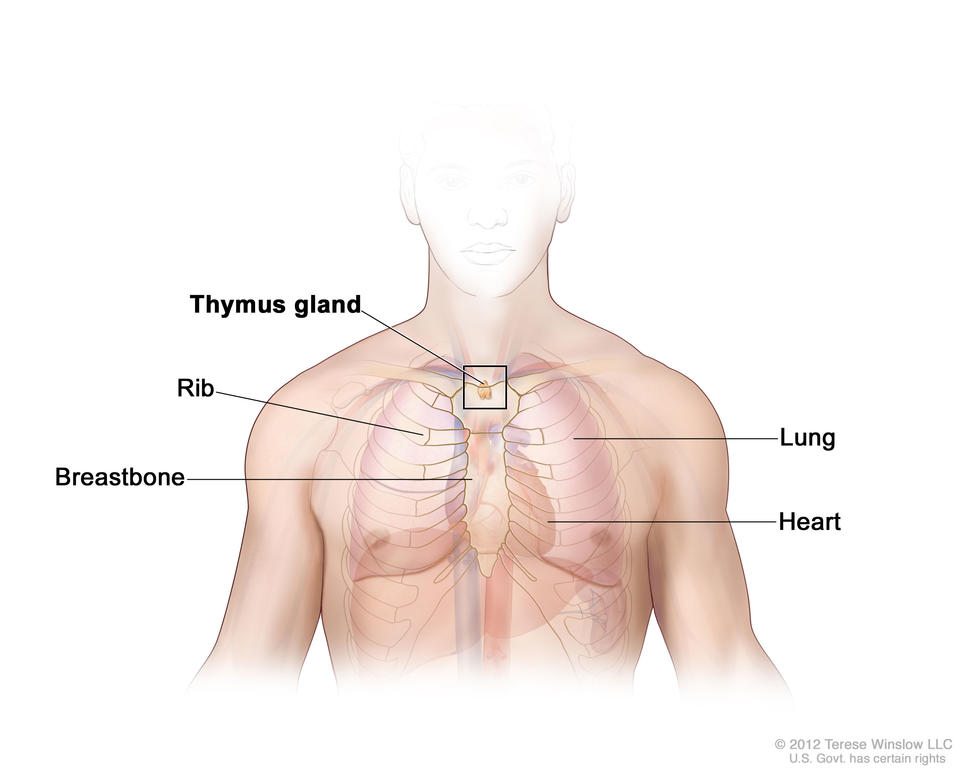
The thymus, a small organ that lies in the upper chest under the breastbone, is part of the lymph system. It makes white blood cells, called lymphocytes, that protect the body against infections.
There are different types of tumors of the thymus. Thymomas and thymic carcinomas are rare tumors of the cells that are on the outside surface of the thymus. The tumor cells in a thymoma look similar to the normal cells of the thymus, grow slowly, and rarely spread beyond the thymus. On the other hand, the tumor cells in a thymic carcinoma look very different from the normal cells of the thymus, grow more quickly, and have usually spread to other parts of the body when the cancer is found. Thymic carcinoma is more difficult to treat than thymoma.
Thymoma is linked with myasthenia gravis and other autoimmune diseases.
People with thymoma often have autoimmune diseases as well. These diseases cause the immune system to attack healthy tissue and organs. They include:
- Myasthenia gravis.
- Autoimmune pure red cell aplasia.
- Hypogammaglobulinemia.
- Polymyositis.
- Lupus erythematosus.
- Rheumatoid arthritis.
- Thyroiditis.
- Sjögren syndrome.
Possible signs of thymoma and thymic carcinoma include a cough and chest pain.
Sometimes thymoma and thymic carcinoma do not cause symptoms. The cancer may be found during a routine chest x-ray. The following symptoms may be caused by thymoma, thymic carcinoma, or other conditions. A doctor should be consulted if any of the following problems occur:
- A cough that doesn't go away.
- Chest pain.
- Trouble breathing.
Tests that examine the thymus are used to detect (find) thymoma or thymic carcinoma.
The following tests and procedures may be used:
- Physical exam and history: An exam of the body to check general signs of health, including checking for signs of disease, such as lumps or anything else that seems unusual. A history of the patient’s health habits and past illnesses and treatments will also be taken.
- Chest x-ray: An x-ray of the organs and bones inside the chest. An x-ray is a type of energy beam that can go through the body and onto film, making a picture of areas inside the body.
- CT scan (CAT scan): A procedure that makes a series of detailed pictures of areas inside the body, such as the chest, taken from different angles. The pictures are made by a computer linked to an x-ray machine. A dye may be injected into a vein or swallowed to help the organs or tissues show up more clearly. This procedure is also called computed tomography, computerized tomography, or computerized axial tomography.
- MRI (magnetic resonance imaging): A procedure that uses a magnet, radio waves, and a computer to make a series of detailed pictures of areas inside the body, such as the chest. This procedure is also called nuclear magnetic resonance imaging (NMRI).
- PET scan (positron emission tomography scan): A procedure to find malignant tumor cells in the body. A small amount of radioactive glucose (sugar) is injected into a vein. The PET scanner rotates around the body and makes a picture of where glucose is being used in the body. Malignant tumor cells show up brighter in the picture because they are more active and take up more glucose than normal cells do.
Thymoma and thymic carcinoma are usually diagnosed, staged, and treated during surgery.
A biopsy of the tumor is done to diagnose the disease. The biopsy may be done before or during surgery, using a thin needle to remove a sample of cells. This is called a fine-needle aspiration (FNA) biopsy. A pathologist will view the sample under a microscope to check for cancer. If thymoma or thymic carcinoma is diagnosed, the pathologist will determine the type of cancer cell in the tumor. There may be more than one type of cancer cell in a thymoma. The surgeon will decide if all or part of the tumor can be removed by surgery. In some cases, lymph nodes and other tissues may be removed as well.
Certain factors affect prognosis (chance of recovery) and treatment options.
The prognosis (chance of recovery) and treatment options depend on the following:
- The stage of the cancer.
- The type of cancer cell.
- Whether the tumor can be removed completely by surgery.
- The patient's general health.
- Whether the cancer has just been diagnosed or has recurred (come back).
Stages of Thymoma and Thymic Carcinoma
Tests done to detect thymoma or thymic carcinoma are also used to stage the disease.
Staging is the process used to find out if cancer has spread from the thymus to other parts of the body. The findings made during surgery and the results of tests and procedures are used to determine the stage of the disease. It is important to know the stage in order to plan treatment.
There are three ways that cancer spreads in the body.
The three ways that cancer spreads in the body are:
- Through tissue. Cancer invades the surrounding normal tissue.
- Through the lymph system. Cancer invades the lymph system and travels through the lymph vessels to other places in the body.
- Through the blood. Cancer invades the veins and capillaries and travels through the blood to other places in the body.
When cancer cells break away from the primary (original) tumor and travel through the lymph or blood to other places in the body, another (secondary) tumor may form. This process is called metastasis. The secondary (metastatic) tumor is the same type of cancer as the primary tumor. For example, if breast cancer spreads to the bones, the cancer cells in the bones are actually breast cancer cells. The disease is metastatic breast cancer, not bone cancer.
The following stages are used for thymoma:
In stage I, cancer is found only within the thymus. All cancer cells are inside the capsule (sac) that surrounds the thymus.
In stage II, cancer has spread through the capsule and into the fat around the thymus or into the lining of the chest cavity.
In stage III, cancer has spread to nearby organs in the chest, including the lung, the sac around the heart, or large blood vessels that carry blood to the heart.
Stage IV is divided into stage IVA and stage IVB, depending on where the cancer has spread.
- In stage IVA, cancer has spread widely around the lungs and heart.
- In stage IVB, cancer has spread to the blood or lymph system.
Thymic carcinomas have usually spread to other parts of the body when diagnosed.
The staging system used for thymomas is sometimes used for thymic carcinomas.
Recurrent Thymoma and Thymic Carcinoma
Recurrent thymoma and thymic carcinoma is cancer that has recurred (come back) after it has been treated. The cancer may come back in the thymus or in other parts of the body. Thymic carcinomas commonly recur. Thymomas may recur after a long time. There is also an increased risk of having another type of cancer after having a thymoma. For these reasons, lifelong follow-up is needed.
Treatment Option Overview
There are different types of treatment for patients with thymoma and thymic carcinoma.
Different types of treatments are available for patients with thymoma and thymic carcinoma. Some treatments are standard (the currently used treatment), and some are being tested in clinical trials. A treatment clinical trial is a research study meant to help improve current treatments or obtain information on new treatments for patients with cancer. When clinical trials show that a new treatment is better than the standard treatment, the new treatment may become the standard treatment. Patients may want to think about taking part in a clinical trial. Some clinical trials are open only to patients who have not started treatment.
Four types of standard treatment are used:
Surgery to remove the tumor is the most common treatment of thymoma.
Even if the doctor removes all the cancer that can be seen at the time of the surgery, some patients may be given radiation therapy after surgery to kill any cancer cells that are left. Treatment given after the surgery, to lower the risk that the cancer will come back, is called adjuvant therapy.
Radiation therapy is a cancer treatment that uses high-energy x-rays or other types of radiation to kill cancer cells or keep them from growing. There are two types of radiation therapy. External radiation therapy uses a machine outside the body to send radiation toward the cancer. Internal radiation therapy uses a radioactive substance sealed in needles, seeds, wires, or catheters that are placed directly into or near the cancer. The way the radiation therapy is given depends on the type and stage of the cancer being treated.
Chemotherapy is a cancer treatment that uses drugs to stop the growth of cancer cells, either by killing the cells or by stopping them from dividing. When chemotherapy is taken by mouth or injected into a vein or muscle, the drugs enter the bloodstream and can reach cancer cells throughout the body (systemic chemotherapy). When chemotherapy is placed directly into the cerebrospinal fluid, an organ, or a body cavity such as the abdomen, the drugs mainly affect cancer cells in those areas (regional chemotherapy). The way the chemotherapy is given depends on the type and stage of the cancer being treated.
Chemotherapy may be used to shrink the tumor before surgery or radiation therapy. This is called neoadjuvant chemotherapy.
Hormone therapy is a cancer treatment that removes hormones or blocks their action and stops cancer cells from growing. Hormones are substances produced by glands in the body and circulated in the bloodstream. Some hormones can cause certain cancers to grow. If tests show that the cancer cells have places where hormones can attach (receptors), drugs, surgery, or radiation therapy is used to reduce the production of hormones or block them from working.
Hormone therapy with drugs called corticosteroids may be used to treat thymoma or thymic carcinoma.
New types of treatment are being tested in clinical trials.
This summary section describes treatments that are being studied in clinical trials. It may not mention every new treatment being studied. Information about clinical trials is available from the NCI Web site 1.
Patients may want to think about taking part in a clinical trial.
For some patients, taking part in a clinical trial may be the best treatment choice. Clinical trials are part of the cancer research process. Clinical trials are done to find out if new cancer treatments are safe and effective or better than the standard treatment.
Many of today's standard treatments for cancer are based on earlier clinical trials. Patients who take part in a clinical trial may receive the standard treatment or be among the first to receive a new treatment.
Patients who take part in clinical trials also help improve the way cancer will be treated in the future. Even when clinical trials do not lead to effective new treatments, they often answer important questions and help move research forward.
Patients can enter clinical trials before, during, or after starting their cancer treatment.
Some clinical trials only include patients who have not yet received treatment. Other trials test treatments for patients whose cancer has not gotten better. There are also clinical trials that test new ways to stop cancer from recurring (coming back) or reduce the side effects of cancer treatment.
Clinical trials are taking place in many parts of the country. See the Treatment Options section that follows for links to current treatment clinical trials. These have been retrieved from NCI's listing of clinical trials.
Follow-up tests may be needed.
Some of the tests that were done to diagnose the cancer or to find out the stage of the cancer may be repeated. Some tests will be repeated in order to see how well the treatment is working. Decisions about whether to continue, change, or stop treatment may be based on the results of these tests. This is sometimes called re-staging.
Some of the tests will continue to be done from time to time after treatment has ended. The results of these tests can show if your condition has changed or if the cancer has recurred (come back). These tests are sometimes called follow-up tests or check-ups.
Treatment Options for Thymoma and Thymic Carcinoma
A link to a list of current clinical trials is included for each treatment section. For some types or stages of cancer, there may not be any trials listed. Check with your doctor for clinical trials that are not listed here but may be right for you.
Stage I and Stage II ThymomaTreatment of stage I thymoma is surgery.
Treatment of stage II thymoma is surgery followed by radiation therapy.
Check for U.S. clinical trials from NCI's list of cancer clinical trials that are now accepting patients with stage I thymoma 2 and stage II thymoma 3. For more specific results, refine the search by using other search features, such as the location of the trial, the type of treatment, or the name of the drug. General information about clinical trials is available from the NCI Web site 4.
Stage III and Stage IV ThymomaTreatment of stage III and stage IV thymoma that may be completely removed by surgery includes the following:
- Surgery with or without radiation therapy.
- Neoadjuvant chemotherapy followed by surgery with or without radiation therapy.
- A clinical trial of anticancer drugs in new combinations or doses.
- A clinical trial of new ways of giving radiation therapy.
Treatment of stage III and stage IV thymoma that cannot be completely removed by surgery includes the following:
- Neoadjuvant chemotherapy followed by surgery and/or radiation therapy.
- Radiation therapy.
- Chemotherapy.
- A clinical trial of anticancer drugs in new combinations or doses.
- A clinical trial of new ways of giving radiation therapy.
Check for U.S. clinical trials from NCI's list of cancer clinical trials that are now accepting patients with stage III thymoma 5 and stage IV thymoma 6. For more specific results, refine the search by using other search features, such as the location of the trial, the type of treatment, or the name of the drug. General information about clinical trials is available from the NCI Web site 4.
Thymic CarcinomaTreatment of thymic carcinoma that may be completely removed by surgery includes the following:
- Surgery with or without radiation therapy.
- A clinical trial of anticancer drugs in new combinations or doses.
- A clinical trial of new ways of giving radiation therapy.
Treament of thymic carcinoma that cannot be completely removed by surgery includes the following:
- Radiation therapy.
- Chemotherapy with or without surgery to remove part of the tumor and/or radiation therapy.
- Chemotherapy with radiation therapy.
- Chemotherapy.
- A clinical trial of anticancer drugs in new combinations or doses.
- A clinical trial of new ways of giving radiation therapy.
Check for U.S. clinical trials from NCI's list of cancer clinical trials that are now accepting patients with thymic carcinoma 7. For more specific results, refine the search by using other search features, such as the location of the trial, the type of treatment, or the name of the drug. General information about clinical trials is available from the NCI Web site 4.
Recurrent Thymoma and Thymic CarcinomaTreatment of recurrent thymoma and thymic carcinoma may include the following:
- Surgery with or without radiation therapy.
- Radiation therapy.
- Hormone therapy.
- Chemotherapy.
- A clinical trial of anticancer drugs in new combinations or doses.
- A clinical trial of new ways of giving radiation therapy.
Check for U.S. clinical trials from NCI's list of cancer clinical trials that are now accepting patients with recurrent thymoma and thymic carcinoma 8. For more specific results, refine the search by using other search features, such as the location of the trial, the type of treatment, or the name of the drug. General information about clinical trials is available from the NCI Web site 4.
To Learn More About Thymoma and Thymic Carcinoma
For more information from the National Cancer Institute about thymoma and thymic carcinoma, see the Thymoma and Thymic Carcinoma Home Page 9.
For general cancer information and other resources from the National Cancer Institute, see the following:
- What You Need to Know About™ Cancer 10
- Understanding Cancer Series: Cancer 11
- Cancer Staging 12
- Chemotherapy and You: Support for People With Cancer 13
- Radiation Therapy and You: Support for People With Cancer 14
- Coping with Cancer: Supportive and Palliative Care 15
- Cancer Library 16
- Information For Survivors/Caregivers/Advocates 17
Get More Information From NCI
Call 1-800-4-CANCER
For more information, U.S. residents may call the National Cancer Institute's (NCI's) Cancer Information Service toll-free at 1-800-4-CANCER (1-800-422-6237) Monday through Friday from 8:00 a.m. to 8:00 p.m., Eastern Time. A trained Cancer Information Specialist is available to answer your questions.
Chat online
The NCI's LiveHelp® 18 online chat service provides Internet users with the ability to chat online with an Information Specialist. The service is available from 8:00 a.m. to 11:00 p.m. Eastern time, Monday through Friday. Information Specialists can help Internet users find information on NCI Web sites and answer questions about cancer.
Write to us
For more information from the NCI, please write to this address:
- NCI Public Inquiries Office
- Suite 3036A
- 6116 Executive Boulevard, MSC8322
- Bethesda, MD 20892-8322
Search the NCI Web site
The NCI Web site 19 provides online access to information on cancer, clinical trials, and other Web sites and organizations that offer support and resources for cancer patients and their families. For a quick search, use the search box in the upper right corner of each Web page. The results for a wide range of search terms will include a list of "Best Bets," editorially chosen Web pages that are most closely related to the search term entered.
There are also many other places to get materials and information about cancer treatment and services. Hospitals in your area may have information about local and regional agencies that have information on finances, getting to and from treatment, receiving care at home, and dealing with problems related to cancer treatment.
Find Publications
The NCI has booklets and other materials for patients, health professionals, and the public. These publications discuss types of cancer, methods of cancer treatment, coping with cancer, and clinical trials. Some publications provide information on tests for cancer, cancer causes and prevention, cancer statistics, and NCI research activities. NCI materials on these and other topics may be ordered online or printed directly from the NCI Publications Locator 20. These materials can also be ordered by telephone from the Cancer Information Service toll-free at 1-800-4-CANCER (1-800-422-6237).
Changes to This Summary (07/01/2011)
The PDQ cancer information summaries are reviewed regularly and updated as new information becomes available. This section describes the latest changes made to this summary as of the date above.
Editorial changes were made to this summary.
About PDQ
PDQ is a comprehensive cancer database available on NCI's Web site.
PDQ is the National Cancer Institute's (NCI's) comprehensive cancer information database. Most of the information contained in PDQ is available online at NCI's Web site 19. PDQ is provided as a service of the NCI. The NCI is part of the National Institutes of Health, the federal government's focal point for biomedical research.
PDQ contains cancer information summaries.
The PDQ database contains summaries of the latest published information on cancer prevention, detection, genetics, treatment, supportive care, and complementary and alternative medicine. Most summaries are available in two versions. The health professional versions provide detailed information written in technical language. The patient versions are written in easy-to-understand, nontechnical language. Both versions provide current and accurate cancer information.
The PDQ cancer information summaries are developed by cancer experts and reviewed regularly.
Editorial Boards made up of experts in oncology and related specialties are responsible for writing and maintaining the cancer information summaries. The summaries are reviewed regularly and changes are made as new information becomes available. The date on each summary ("Date Last Modified") indicates the time of the most recent change.
PDQ also contains information on clinical trials.
A clinical trial is a study to answer a scientific question, such as whether one treatment is better than another. Trials are based on past studies and what has been learned in the laboratory. Each trial answers certain scientific questions in order to find new and better ways to help cancer patients. During treatment clinical trials, information is collected about the effects of a new treatment and how well it works. If a clinical trial shows that a new treatment is better than one currently being used, the new treatment may become "standard." Patients may want to think about taking part in a clinical trial. Some clinical trials are open only to patients who have not started treatment.
Listings of clinical trials are included in PDQ and are available online at NCI's Web site 4. Descriptions of the trials are available in health professional and patient versions. Many cancer doctors who take part in clinical trials are also listed in PDQ. For more information, call the Cancer Information Service 1-800-4-CANCER (1-800-422-6237).
Glossary Termsautoimmune disease (AW-toh-ih-MYOON dih-ZEEZ)A condition in which the body recognizes its own tissues as foreign and directs an immune response against them.biopsy (BY-op-see) The removal of cells or tissues for examination by a pathologist. The pathologist may study the tissue under a microscope or perform other tests on the cells or tissue. There are many different types of biopsy procedures. The most common types include: (1) incisional biopsy, in which only a sample of tissue is removed; (2) excisional biopsy, in which an entire lump or suspicious area is removed; and (3) needle biopsy, in which a sample of tissue or fluid is removed with a needle. When a wide needle is used, the procedure is called a core biopsy. When a thin needle is used, the procedure is called a fine-needle aspiration biopsy.cancer (KAN-ser) A term for diseases in which abnormal cells divide without control and can invade nearby tissues. Cancer cells can also spread to other parts of the body through the blood and lymph systems. There are several main types of cancer. Carcinoma is a cancer that begins in the skin or in tissues that line or cover internal organs. Sarcoma is a cancer that begins in bone, cartilage, fat, muscle, blood vessels, or other connective or supportive tissue. Leukemia is a cancer that starts in blood-forming tissue such as the bone marrow, and causes large numbers of abnormal blood cells to be produced and enter the blood. Lymphoma and multiple myeloma are cancers that begin in the cells of the immune system. Central nervous system cancers are cancers that begin in the tissues of the brain and spinal cord. Also called malignancy.carcinoma (KAR-sih-NOH-muh) Cancer that begins in the skin or in tissues that line or cover internal organs.cell (sel) The individual unit that makes up the tissues of the body. All living things are made up of one or more cells.chest x-ray (chest EX-ray) An x-ray of the structures inside the chest. An x-ray is a type of high-energy radiation that can go through the body and onto film, making pictures of areas inside the chest, which can be used to diagnose disease.clinical trial (KLIH-nih-kul TRY-ul) A type of research study that tests how well new medical approaches work in people. These studies test new methods of screening, prevention, diagnosis, or treatment of a disease. Also called clinical study.contrast material (KON-trast muh-TEER-ee-ul) A dye or other substance that helps show abnormal areas inside the body. It is given by injection into a vein, by enema, or by mouth. Contrast material may be used with x-rays, CT scans, MRI, or other imaging tests.CT scan (… skan) A series of detailed pictures of areas inside the body taken from different angles. The pictures are created by a computer linked to an x-ray machine. Also called CAT scan, computed tomography scan, computerized axial tomography scan, and computerized tomography.diagnosis (DY-ug-NOH-sis) The process of identifying a disease, such as cancer, from its signs and symptoms.fine-needle aspiration biopsy (... NEE-dul AS-pih-RAY-shun BY-op-see) The removal of tissue or fluid with a thin needle for examination under a microscope. Also called FNA biopsy.glucose (GLOO-kose) A type of sugar; the chief source of energy for living organisms.hypogammaglobulinemia (HY-poh-GA-muh-GLAH-byoo-lih-NEE-mee-uh) A condition in which the level of immunoglobulins (antibodies) in the blood is low and the risk of infection is high.immune system (ih-MYOON SIS-tem) The complex group of organs and cells that defends the body against infections and other diseases.infection (in-FEK-shun) Invasion and multiplication of germs in the body. Infections can occur in any part of the body and can spread throughout the body. The germs may be bacteria, viruses, yeast, or fungi. They can cause a fever and other problems, depending on where the infection occurs. When the body’s natural defense system is strong, it can often fight the germs and prevent infection. Some cancer treatments can weaken the natural defense system.injection (in-JEK-shun) Use of a syringe and needle to push fluids or drugs into the body; often called a "shot."lymph node (limf node) A rounded mass of lymphatic tissue that is surrounded by a capsule of connective tissue. Lymph nodes filter lymph (lymphatic fluid), and they store lymphocytes (white blood cells). They are located along lymphatic vessels. Also called lymph gland.lymphatic system (lim-FA-tik SIS-tem) The tissues and organs that produce, store, and carry white blood cells that fight infections and other diseases. This system includes the bone marrow, spleen, thymus, lymph nodes, and lymphatic vessels (a network of thin tubes that carry lymph and white blood cells). Lymphatic vessels branch, like blood vessels, into all the tissues of the body.lymphocyte (LIM-foh-site) A type of immune cell that is made in the bone marrow and is found in the blood and in lymph tissue. The two main types of lymphocytes are B lymphocytes and T lymphocytes. B lymphocytes make antibodies, and T lymphocytes help kill tumor cells and help control immune responses. A lymphocyte is a type of white blood cell.malignant (muh-LIG-nunt) Cancerous. Malignant cells can invade and destroy nearby tissue and spread to other parts of the body.MRI A procedure in which radio waves and a powerful magnet linked to a computer are used to create detailed pictures of areas inside the body. These pictures can show the difference between normal and diseased tissue. MRI makes better images of organs and soft tissue than other scanning techniques, such as computed tomography (CT) or x-ray. MRI is especially useful for imaging the brain, the spine, the soft tissue of joints, and the inside of bones. Also called magnetic resonance imaging, NMRI, and nuclear magnetic resonance imaging.myasthenia gravis (MY-us-THEE-nee-uh GRA-vis) A disease in which antibodies made by a person’s immune system prevent certain nerve-muscle interactions. It causes weakness in the arms and legs, vision problems, and drooping eyelids or head. It may also cause paralysis and problems with swallowing, talking, climbing stairs, lifting things, and getting up from a sitting position. The muscle weakness gets worse during activity, and improves after periods of rest.organ (OR-gun) A part of the body that performs a specific function. For example, the heart is an organ.pathologist (puh-THAH-loh-jist) A doctor who identifies diseases by studying cells and tissues under a microscope.PDQ PDQ is an online database developed and maintained by the National Cancer Institute. Designed to make the most current, credible, and accurate cancer information available to health professionals and the public, PDQ contains peer-reviewed summaries on cancer treatment, screening, prevention, genetics, complementary and alternative medicine, and supportive care; a registry of cancer clinical trials from around the world; and directories of physicians, professionals who provide genetics services, and organizations that provide cancer care. Most of this information, and more specific information about PDQ, can be found on the NCI's Web site at http://www.cancer.gov/cancertopics/pdq. Also called Physician Data Query.PET scan (… skan) A procedure in which a small amount of radioactive glucose (sugar) is injected into a vein, and a scanner is used to make detailed, computerized pictures of areas inside the body where the glucose is used. Because cancer cells often use more glucose than normal cells, the pictures can be used to find cancer cells in the body. Also called positron emission tomography scan.physical examination (FIH-zih-kul eg-ZA-mih-NAY-shun) An exam of the body to check for general signs of disease.polymyositis (PAH-lee-MY-oh-SY-tis) An inflammatory disease of the muscles closest to the center of the body. It causes weakness, inability to stand, climb stairs, lift, or reach. It may also cause muscle pain and difficulty swallowing, and may affect the lungs and heart. Having polymyositis increases the risk of certain types of cancer.prognosis (prog-NO-sis) The likely outcome or course of a disease; the chance of recovery or recurrence.radioactive (RAY-dee-oh-AK-tiv) Giving off radiation.recur (ree-KER) To come back or to return.recurrent cancer (ree-KER-ent KAN-ser) Cancer that has recurred (come back), usually after a period of time during which the cancer could not be detected. The cancer may come back to the same place as the original (primary) tumor or to another place in the body. Also called recurrence.rheumatoid arthritis (ROO-muh-TOYD ar-THRY-tis) An autoimmune disease that causes pain, swelling, and stiffness in the joints, and may cause severe joint damage, loss of function, and disability. The disease may last from months to a lifetime, and symptoms may improve and worsen over time.scanner (SKA-ner) In medicine, an instrument that takes pictures of the inside of the body.Sjögren syndrome (SHOH-grin SIN-drome) An autoimmune disease that affects the tear glands and salivary glands, and may affect glands in the stomach, pancreas, and intestines. The disease causes dry eyes and mouth, and may cause dryness in the nose, throat, air passages, skin, and vagina. It may also cause inflammation in the joints, muscles, and skin; pneumonia; tingling in the fingers and toes; and fatigue. It often occurs with rheumatoid arthritis or other connective tissue diseases.stage (stayj) The extent of a cancer in the body. Staging is usually based on the size of the tumor, whether lymph nodes contain cancer, and whether the cancer has spread from the original site to other parts of the body.surgeon (SER-jun) A doctor who removes or repairs a part of the body by operating on the patient.surgery (SER-juh-ree) A procedure to remove or repair a part of the body or to find out whether disease is present. An operation.symptom (SIMP-tum) An indication that a person has a condition or disease. Some examples of symptoms are headache, fever, fatigue, nausea, vomiting, and pain.systemic lupus erythematosus (sis-TEH-mik LOO-pus AYR-ih-THEE-muh-TOH-sus) A chronic, inflammatory, connective tissue disease that can affect the joints and many organs, including the skin, heart, lungs, kidneys, and nervous system. It can cause many different symptoms; however, not everyone with systemic lupus erythematosus has all of the symptoms. Also called lupus and SLE.thymoma (thy-MOH-muh) A tumor of the thymus, an organ that is part of the lymphatic system and is located in the chest, behind the breastbone.thymus (THY-mus) An organ that is part of the lymphatic system, in which T lymphocytes grow and multiply. The thymus is in the chest behind the breastbone.thyroiditis (thy-roy-DY-tis) Inflammation of the thyroid gland. Thyroiditis may be an autoimmune disease that affects the thyroid gland over time, causing hypothyroidism (too little thyroid hormone). A temporary form of thyroiditis may also occur after the birth of a baby, or when viral or bacterial infections spread to the thyroid.tissue (TIH-shoo) A group or layer of cells that work together to perform a specific function.tumor (TOO-mer) An abnormal mass of tissue that results when cells divide more than they should or do not die when they should. Tumors may be benign (not cancer), or malignant (cancer). Also called neoplasm.vein (vayn) A blood vessel that carries blood to the heart from tissues and organs in the body.white blood cell (hwite blud sel) A type of immune cell. Most white blood cells are made in the bone marrow and are found in the blood and lymph tissue. White blood cells help the body fight infections and other diseases. Granulocytes, monocytes, and lymphocytes are white blood cells. Also called leukocyte and WBC.x-ray (EX-ray) A type of radiation used in the diagnosis and treatment of cancer and other diseases. In low doses, x-rays are used to diagnose diseases by making pictures of the inside of the body. In high doses, x-rays are used to treat cancer. |