HPV and Pap Test Results: Next Steps after an Abnormal Cervical Cancer Screening Test
People who have cervical cancerscreening at regular intervals are rarely found to have cancer. Most people who receive abnormal cervical cancer screening results either have human papillomavirus (HPV) infections or have early cell changes that can be monitored (since they often go away on their own) or treated early (to prevent the development of cervical cancer).
See Cervical Cancer Screening for information about when to get screened and what to expect during the tests.
HPV test results: What positive and negative results on a screening test mean
HPV test results show whether high-risk HPV types were found in cervical cells. An HPV test will come back as a negative test result or a positive test result.
Negative HPV test result: High-risk HPV was not found. You should have the next test in 5 years. You may need to come back sooner if you had abnormal results in the past.
Positive HPV test result: High-risk HPV was found. Your health care provider will recommend follow-up steps you need to take, based on your specific test result.
What does it mean if you have a positive HPV test after years of negative tests?
Sometimes, after several negative HPV tests, a woman may have a positive HPV test result. This is not necessarily a sign of a new HPV infection. Sometimes an HPV infection can become active again after many years. Some other viruses behave this way. For example, the virus that causes chickenpox can reactivate later in life to cause shingles.
Researchers don’t know whether a reactivated HPV infection has the same risk of causing cervical cell changes or cervical cancer as a new HPV infection.
Pap test results: What normal, abnormal, and unsatisfactory screening test results mean
Pap test results show whether cervical cells are normal or abnormal. A Pap test may also come back as unsatisfactory.
Normal Pap test results: No abnormal cervical cells were found. A normal test result may also be called a negative test result or negative for intraepithelial lesion (area of abnormal growth) or malignancy.
Unsatisfactory Pap test results: The lab sample may not have had enough cells, or the cells may have been clumped together or hidden by blood or mucus. Your health care provider will ask you to come in for another Pap test in 2 to 4 months.
Abnormal Pap test results: An abnormal test result may also be called a positive test result. Some of the cells of the cervix look different from the normal cells. An abnormal test result does not mean you have cancer. Your health care provider will recommend monitoring, more testing, or treatment.
Abnormal Pap test results include
Atypical squamous cells of undetermined significance (ASC-US): This is the most common abnormal Pap test finding. It means that some cells don't look completely normal, but it's not clear if the changes are caused by HPV infection. Other things can cause cells to look abnormal, including irritation, some infections (such as a yeast infection), growths (such as polyps in the uterus), and changes in hormones that occur during pregnancy or menopause. Although these things may make cervical cells look abnormal, they are not related to cancer. Your health care provider will usually do an HPV test to see if the changes may be caused by an HPV infection. If the HPV test is negative, estrogen cream may be prescribed to see if the cell changes are caused by low hormone levels. If the HPV test is positive, you may need additional follow-up tests.
Atypical glandular cells (AGC): Some glandular cells were found that do not look normal. This can be a sign of a more serious problem up inside the uterus, so your health care provider will likely ask you to come back for a colposcopy.
Low-grade squamous intraepithelial lesions (LSIL): There are low-grade changes that are usually caused by an HPV infection. Your health care provider will likely ask you to come back for additional testing to make sure that there are not more serious (high-grade) changes.
Atypical squamous cells, cannot exclude high-grade squamous intraepithelial lesion (ASC-H): Some abnormal squamous cells were found that may be a high-grade squamous intraepithelial lesion (HSIL), although it's not certain. Your health care provider will likely ask you to come back for a colposcopy.
High-grade squamous intraepithelial lesions (HSIL): There are moderately or severely abnormal cervical cells that could become cancer in the future if not treated. Your health care provider will likely ask you to come back for a colposcopy.
Adenocarcinoma in situ (AIS): An advanced lesion (area of abnormal growth) was found in the glandular tissue of the cervix. AIS lesions may be referred to as precancer and may become cancer (cervical adenocarcinoma) if not treated. Your health care provider will likely ask you to come back for a colposcopy.
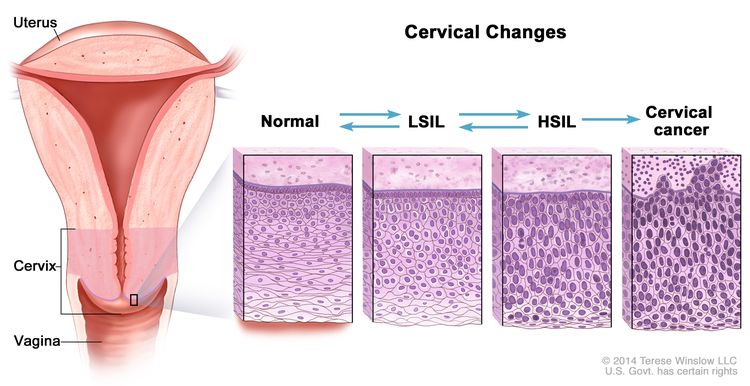
Cervical cancer cells (squamous cell carcinoma or adenocarcinoma): Cancer cells were found; this finding is very rare for people who have been screened at regular intervals. If a biopsy shows that cervical cancer is present, your doctor will order certain tests to find out if cancer cells have spread within the cervix or to other parts of the body. See the Cervical Cancer Diagnosis page for information about tests that may be used to diagnose and stage cervical cancer.EnlargeCervical changes. The cervix is the lower, narrow end of the uterus that forms a canal between the uterus and vagina. Before cancer cells form in tissues of the cervix, the cells of the cervix go through abnormal changes called dysplasia. There are different types of dysplasia. Mild dysplasia, called low-grade intraepithelial lesion (LSIL) is one type. Moderate or severe dysplasia, called high-grade intraepithelial lesion (HSIL) is another type of dysplasia. LSIL and HSIL may or may not become cancer.
Follow-up tests and procedures after an abnormal Pap test (Pap smear) or HPV test
Keep in mind that most people with abnormal cervical screening test results do not have cancer. However, if you have an abnormal test result, it’s important to get the follow-up care that your health care provider recommends.
Until recently, follow-up recommendations were based on the results of a person's most recent cervical screening test. However, updated ASCCP risk-based management consensus guidelines advise a more tailored approach to follow-up care.
What these updated guidelines mean is that, in addition to your current Pap, HPV, or cotest screening result, your health care provider will consider additional factors when recommending follow-up care, including
previous screening test results
previous treatments for precancerous cervical cell changes
personal health factors, such as your age
Based on your individual risk of developing severe cervical cell changes that could become cervical cancer, you may be advised to
return for a repeat HPV test or HPV/Pap cotest in 1 or 3 years
These updated guidelines focus on detecting and treating severe cervical cell changes that could develop into cervical cancer while also decreasing testing and treatment for less severe conditions (low-grade cervical cell changes).
Colposcopy
During a colposcopy, your doctor inserts a speculum to gently open the vagina and see the cervix. A vinegar solution is applied to the cervix to help show abnormal areas. Your doctor then places an instrument called a colposcope close to the vagina. It has a bright light and a magnifying lens and allows your doctor to look closely at your vagina and cervix for abnormal areas.
A colposcopy usually includes a biopsy, so that the cells or tissues can be checked under a microscope for signs of disease, including cervical cancer.
Cervical biopsy
A biopsy is a procedure used to remove cervical cells or tissue to be checked under a microscope for abnormal cervical cells, including cancer. In addition to removing a sample for further testing, some types of biopsies may be used as treatment, to remove abnormal cervical tissue or lesions.
Talk with your doctor to learn what to expect during and after your biopsy procedure. Bleeding and/or discharge after a biopsy may occur. Some people have pain that feels like cramps during menstruation.
Biopsy samples are checked by a pathologist for CIN. CIN is the term used to describe abnormal cervical cells that were found on the surface of the cervix after a biopsy.
CIN is graded on a scale of 1 to 3, based on how abnormal the cells look under a microscope and how much of the cervical tissue is affected. LSIL changes seen on a Pap test are generally CIN 1. HSIL changes seen on a Pap test can be CIN 2, CIN2/3, or CIN 3.
CIN 1 changes are mild, or low grade. They usually go away on their own and do not require treatment.
CIN 2 changes are moderate and are typically treated by removing the abnormal cells. However, CIN 2 can sometimes go away on its own. Some people, after consulting with their health care provider, may decide to have a colposcopy with biopsy every 6 months. CIN 2 must be treated if it progresses to CIN 3 or does not go away in 1 to 2 years.
CIN 3 changes are severely abnormal. Although CIN 3 is not cancer, it may become cancer and spread to nearby normal tissue if not treated. Doctors do not yet have a way to tell which cases of CIN 3 will become cancer and which will not. CIN 3 should be treated right away, unless you are pregnant. See Pregnancy and Treatment for High-Grade Cervical Cell Changes for more information.
Treatment for high-grade cervical cell changes
The goal of treating high-grade cervical cell changes is to remove or destroy abnormal cervical cells that have a high chance of becoming cancer. Some of these treatments are also used for early-stage cervical cancer.
The most common treatment for high-grade cervical cell changes is conization, the removal of a cone-shaped piece of tissue from the cervix and cervical canal. There are two types of conization.
Loop electrosurgical excision procedure (LEEP) uses a thin wire loop, through which an electrical current is passed, to remove abnormal tissue. This procedure is typically done in a doctor’s office. It usually takes only a few minutes, and local anesthesia is used to numb the area.
Cold knife conization uses a scalpel to remove the abnormal tissue. This procedure is done at the hospital under general anesthesia.
Several other treatments may also be used.
Laser therapy uses a laser (narrow beam of intense light) to remove or destroy abnormal tissue. This is an outpatient procedure that may be done under local or general anesthesia.
Cryotherapy uses a special cold probe to destroy abnormal tissue by freezing it. This procedure is done at a doctor’s office. It takes only a few minutes and usually does not require anesthesia.
Total hysterectomy is the surgical removal of the uterus and cervix. It is often used to treat AIS. It is used to treat CIN3 only if the abnormal cells were not completely removed by other treatments.
Pregnancy and treatment for high-grade cervical cell changes
Rarely, procedures to treat cervical cell abnormalities can weaken the cervix, increasing the risk of premature birth or miscarriage.
If you are pregnant or plan to become pregnant, your health care provider will talk with you about procedures that are recommended for you and the timing of these procedures. Depending on your specific diagnosis, you may be treated postpartum, or after delivery.