National Cancer Institute National Cancer Institute
U.S. National Institutes of Health National Cancer Institute
Send to Printer
Anal Cancer Treatment (PDQ®)     
Last Modified: 09/20/2007
Patient Version
Treatment Option Overview

Key Points for This Section


There are different types of treatment for patients with anal cancer.

Different types of treatments are available for patients with anal cancer. Some treatments are standard (the currently used treatment), and some are being tested in clinical trials. Before starting treatment, patients may want to think about taking part in a clinical trial. A treatment clinical trial is a research study meant to help improve current treatments or obtain information on new treatments for patients with cancer. When clinical trials show that a new treatment is better than the standard treatment, the new treatment may become the standard treatment.

Clinical trials are taking place in many parts of the country. Information about ongoing clinical trials is available from the NCI Web site 1. Choosing the most appropriate cancer treatment is a decision that ideally involves the patient, family, and health care team.

Three types of standard treatment are used:

Radiation therapy

Radiation therapy is a cancer treatment that uses high-energy x-rays or other types of radiation to kill cancer cells. There are two types of radiation therapy. External radiation therapy uses a machine outside the body to send radiation toward the cancer. Internal radiation therapy uses a radioactive substance sealed in needles, seeds, wires, or catheters that are placed directly into or near the cancer. The way the radiation therapy is given depends on the type and stage of the cancer being treated.

Chemotherapy

Chemotherapy is a cancer treatment that uses drugs to stop the growth of cancer cells, either by killing the cells or by stopping the cells from dividing. When chemotherapy is taken by mouth or injected into a vein or muscle, the drugs enter the bloodstream and can reach cancer cells throughout the body (systemic chemotherapy). When chemotherapy is placed directly into the spinal column, an organ, or a body cavity such as the abdomen, the drugs mainly affect cancer cells in those areas (regional chemotherapy). The way the chemotherapy is given depends on the type and stage of the cancer being treated.

Surgery

  • Local resection: A surgical procedure in which the tumor is cut from the anus along with some of the healthy tissue around it. Local resection may be used if the cancer is small and has not spread. This procedure may save the sphincter muscles so the patient can still control bowel movements. Tumors that develop in the lower part of the anus can often be removed with local resection.


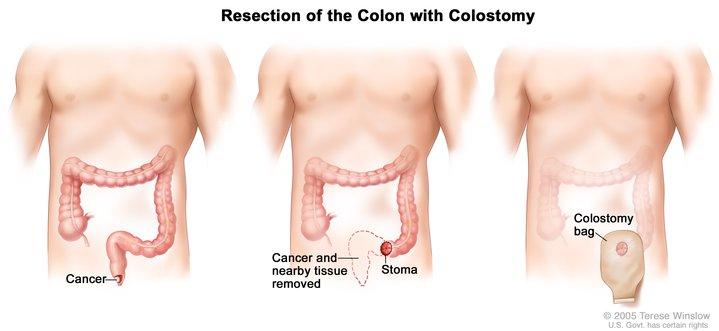
  • Abdominoperineal resection: A surgical procedure in which the anus, the rectum, and part of the sigmoid colon are removed through an incision made in the abdomen. The doctor sews the end of the intestine to an opening, called a stoma, made in the surface of the abdomen so body waste can be collected in a disposable bag outside of the body. This is called a colostomy. Lymph nodes that contain cancer may also be removed during this operation.

    Enlarge
    Three panel drawing showing anal cancer surgery with colostomy; first panel shows area of anus with cancer, middle panel shows cancer and nearby tissue removed and stoma created, last panel shows a colostomy bag attached to the stoma.
    Anal cancer surgery with colostomy. The anus, rectum, and part of the colon are removed, a stoma is created, and a colostomy bag is attached to the stoma.


Having the human immunodeficiency virus can affect treatment of anal cancer.

Cancer therapy can further damage the already weakened immune systems of patients who have the human immunodeficiency virus (HIV). For this reason, patients who have anal cancer and HIV are usually treated with lower doses of anticancer drugs and radiation than patients who do not have HIV.

Other types of treatment are being tested in clinical trials. These include the following:

Radiosensitizers

Radiosensitizers are drugs that make tumor cells more sensitive to radiation therapy. Combining radiation therapy with radiosensitizers may kill more tumor cells.

This summary section refers to specific treatments under study in clinical trials, but it may not mention every new treatment being studied. Information about ongoing clinical trials is available from the NCI Web site 1.


Glossary Terms

abdomen (AB-doh-men)
The area of the body that contains the pancreas, stomach, intestines, liver, gallbladder, and other organs.
abdominoperineal resection
Surgery to remove the anus, the rectum, and part of the sigmoid colon through an incision made in the abdomen. The end of the intestine is attached to an opening in the surface of the abdomen and body waste is collected in a disposable bag outside of the body. This opening is called a colostomy. Lymph nodes that contain cancer may also be removed during this operation.
anal (AY-nul)
Having to do with the anus. The anus is the opening of the rectum (last part of the large intestine) to the outside of the body.
anus (AY-nus)
The opening of the rectum to the outside of the body.
bowel (BOW-ul)
The long, tube-shaped organ in the abdomen that completes the process of digestion. The bowel has two parts, the small bowel and the large bowel. Also called the intestine.
cancer (KAN-ser)
A term for diseases in which abnormal cells divide without control. Cancer cells can invade nearby tissues and can spread to other parts of the body through the blood and lymph systems. There are several main types of cancer. Carcinoma is cancer that begins in the skin or in tissues that line or cover internal organs. Sarcoma is cancer that begins in bone, cartilage, fat, muscle, blood vessels, or other connective or supportive tissue. Leukemia is cancer that starts in blood-forming tissue such as the bone marrow, and causes large numbers of abnormal blood cells to be produced and enter the blood. Lymphoma and multiple myeloma are cancers that begin in the cells of the immune system. Central nervous system cancers are cancers that begin in the tissues of the brain and spinal cord.
catheter (KA-theh-ter)
A flexible tube used to deliver fluids into or withdraw fluids from the body.
cell (sel)
The individual unit that makes up the tissues of the body. All living things are made up of one or more cells.
chemotherapy (KEE-moh-THAYR-uh-pee)
Treatment with drugs that kill cancer cells.
clinical trial
A type of research study that tests how well new medical approaches work in people. These studies test new methods of screening, prevention, diagnosis, or treatment of a disease. Also called a clinical study.
colostomy (koh-LOS-toh-mee)
An opening into the colon from the outside of the body. A colostomy provides a new path for waste material to leave the body after part of the colon has been removed.
dose
The amount of medicine taken, or radiation given, at one time.
drug
Any substance, other than food, that is used to prevent, diagnose, treat or relieve symptoms of a disease or abnormal condition. Also refers to a substance that alters mood or body function, or that can be habit-forming or addictive, especially a narcotic.
external radiation therapy (...RAY-dee-AY-shun THAYR-uh-pee)
A type of radiation therapy that uses a machine to aim high-energy rays at the cancer from outside of the body. Also called external-beam radiation therapy.
human immunodeficiency virus (HYOO-mun ih-MYOO-noh-dih-FIH-shun-see VY-rus)
HIV. The cause of acquired immunodeficiency syndrome (AIDS). Also called HIV.
immune system (ih-MYOON SIS-tem)
The complex group of organs and cells that defends the body against infections and other diseases.
incision (in-SIH-zhun)
A cut made in the body to perform surgery.
injection
Use of a syringe and needle to push fluids or drugs into the body; often called a "shot."
internal radiation therapy (in-TER-nul RAY-dee-AY-shun THAYR-uh-pee)
A type of radiation therapy in which radioactive material sealed in needles, seeds, wires, or catheters is placed directly into or near a tumor. Also called brachytherapy, radiation brachytherapy, and implant radiation therapy.
intestine (in-TES-tin)
The long, tube-shaped organ in the abdomen that completes the process of digestion. The intestine has two parts, the small intestine and the large intestine. Also called the bowel.
local therapy (...THAYR-uh-pee)
Treatment that affects cells in the tumor and the area close to it.
lymph node (limf node)
A rounded mass of lymphatic tissue that is surrounded by a capsule of connective tissue. Lymph nodes filter lymph (lymphatic fluid), and they store lymphocytes (white blood cells). They are located along lymphatic vessels. Also called lymph gland.
organ
A part of the body that performs a specific function. For example, the heart is an organ.
radiation (RAY-dee-AY-shun)
Energy released in the form of particles or electromagnetic waves. Common sources of radiation include radon gas, cosmic rays from outer space, and medical x-rays.
radiation therapy (RAY-dee-AY-shun THAYR-uh-pee)
The use of high-energy radiation from x-rays, gamma rays, neutrons, protons, and other sources to kill cancer cells and shrink tumors. Radiation may come from a machine outside the body (external-beam radiation therapy), or it may come from radioactive material placed in the body near cancer cells (internal radiation therapy). Systemic radiation therapy uses a radioactive substance, such as a radiolabeled monoclonal antibody, that travels in the blood to tissues throughout the body. Also called radiotherapy and irradiation.
radioactive seed (RAY-dee-oh-AK-tiv...)
A small, radioactive pellet that is placed in or near a tumor. Cancer cells are killed by the energy given off as the radioactive material breaks down and becomes more stable.
radiosensitizer (RAY-dee-oh-SEN-sih-TIZE-er)
A drug that makes tumor cells more sensitive to radiation therapy.
rectum
The last several inches of the large intestine. The rectum ends at the anus.
regional chemotherapy (REE-juh-nul KEE-moh-THAYR-uh-pee)
Treatment with anticancer drugs directed to a specific area of the body.
resection (ree-SEK-shun)
A procedure that uses surgery to remove tissue or part or all of an organ.
sigmoid colon (SIG-moyd KO-lun)
The S-shaped section of the colon that connects to the rectum.
sphincter
A ring-shaped muscle that relaxes or tightens to open or close a passage or opening in the body. Examples are the anal sphincter (around the opening of the anus) and the pyloric sphincter (at the lower opening of the stomach).
spinal column (SPY-nul KAH-lum)
The bones, muscles, tendons, and other tissues that reach from the base of the skull to the tailbone. The spinal column encloses the spinal cord and the fluid surrounding the spinal cord. Also called spine, backbone, and vertebral column.
stage
The extent of a cancer in the body. Staging is usually based on the size of the tumor, whether lymph nodes contain cancer, and whether the cancer has spread from the original site to other parts of the body.
standard therapy (...THAYR-uh-pee)
In medicine, treatment that experts agree is appropriate, accepted, and widely used. Health care providers are obligated to provide patients with standard therapy. Also called standard of care or best practice.
stoma (STOH-muh)
A surgically created opening from an area inside the body to the outside.
surgery (SER-juh-ree)
A procedure to remove or repair a part of the body or to find out whether disease is present. An operation.
systemic chemotherapy (sis-TEH-mik KEE-moh-THAYR-uh-pee)
Treatment with anticancer drugs that travel through the blood to cells all over the body.
therapy (THAYR-uh-pee)
Treatment.
tissue (TISH-oo)
A group or layer of cells that work together to perform a specific function.
tumor (TOO-mer)
An abnormal mass of tissue that results when cells divide more than they should or do not die when they should. Tumors may be benign (not cancerous), or malignant (cancerous). Also called neoplasm.
x-ray
A type of high-energy radiation. In low doses, x-rays are used to diagnose diseases by making pictures of the inside of the body. In high doses, x-rays are used to treat cancer.


Table of Links

1http://cancer.gov/clinicaltrials