National Cancer Institute National Cancer Institute
U.S. National Institutes of Health National Cancer Institute
Send to Printer
Anal Cancer Treatment (PDQ®)     
Last Modified: 09/20/2007
Patient Version
Table of Contents

General Information About Anal Cancer
Stages of Anal Cancer
Recurrent Anal Cancer
Treatment Option Overview
Treatment Options by Stage
Stage 0 (Carcinoma in Situ)
Stage I Anal Cancer
Stage II Anal Cancer
Stage IIIA Anal Cancer
Stage IIIB Anal Cancer
Stage IV Anal Cancer
Treatment Options for Recurrent Anal Cancer
Get More Information From NCI
Changes to This Summary (09/20/2007)
About PDQ

General Information About Anal Cancer

Key Points for This Section


Anal cancer is a disease in which malignant (cancer) cells form in the tissues of the anus.

The anus is the end of the large intestine, below the rectum, through which stool (solid waste) leaves the body. The anus is formed partly from the outer, skin layers of the body and partly from the intestine. Two ring-like muscles, called sphincter muscles, open and close the anal opening to let stool pass out of the body. The anal canal, the part of the anus between the rectum and the anal opening, is about 1½ inches long.

Enlarge
Gastrointestinal (digestive) system anatomy; shows esophagus, liver, stomach, colon, small intestine, rectum, and anus
Anatomy of the lower digestive system, showing the colon and other organs.

The skin around the outside of the anus is called the perianal area. Tumors in this area are skin tumors, not anal cancer.

Being infected with the human papillomavirus (HPV) can affect the risk of developing anal cancer.

Risk factors include the following:

  • Being over 50 years old.
  • Being infected with human papillomavirus (HPV).
  • Having many sexual partners.
  • Having receptive anal intercourse (anal sex).
  • Frequent anal redness, swelling, and soreness.
  • Having anal fistulas (abnormal openings).
  • Smoking cigarettes.

Possible signs of anal cancer include bleeding from the anus or rectum or a lump near the anus.

These and other symptoms may be caused by anal cancer. Other conditions may cause the same symptoms. A doctor should be consulted if any of the following problems occur:

  • Bleeding from the anus or rectum.
  • Pain or pressure in the area around the anus.
  • Itching or discharge from the anus.
  • A lump near the anus.
  • A change in bowel habits.

Tests that examine the rectum and anus are used to detect (find) and diagnose anal cancer.

The following tests and procedures may be used:

  • Physical exam and history: An exam of the body to check general signs of health, including checking for signs of disease, such as lumps or anything else that seems unusual. A history of the patient’s health habits and past illnesses and treatments will also be taken.
  • Digital rectal examination (DRE): An exam of the anus and rectum. The doctor or nurse inserts a lubricated, gloved finger into the lower part of the rectum to feel for lumps or anything else that seems unusual.
  • Anoscopy: An exam of the anus and lower rectum using a short, lighted tube called an anoscope.
  • Proctoscopy: An exam of the rectum using a short, lighted tube called a proctoscope.
  • Endo-anal or endorectal ultrasound: A procedure in which an ultrasound transducer (probe) is inserted into the anus or rectum and used to bounce high-energy sound waves (ultrasound) off internal tissues or organs and make echoes. The echoes form a picture of body tissues called a sonogram.
  • Biopsy: The removal of cells or tissues so they can be viewed under a microscope by a pathologist to check for signs of cancer. If an abnormal area is seen during the anoscopy, a biopsy may be done at that time.

Certain factors affect the prognosis (chance of recovery) and treatment options.

The prognosis (chance of recovery) depends on the following:

  • The size of the tumor.
  • Where the tumor is in the anus.
  • Whether the cancer has spread to the lymph nodes.

The treatment options depend on the following:

Stages of Anal Cancer

Key Points for This Section


After anal cancer has been diagnosed, tests are done to find out if cancer cells have spread within the anus or to other parts of the body.

The process used to find out if cancer has spread within the anus or to other parts of the body is called staging. The information gathered from the staging process determines the stage of the disease. It is important to know the stage in order to plan treatment. The following tests may be used in the staging process:

  • CT scan (CAT scan): A procedure that makes a series of detailed pictures of areas inside the body, taken from different angles. The pictures are made by a computer linked to an x-ray machine. A dye may be injected into a vein or swallowed to help the organs or tissues show up more clearly. This procedure is also called computed tomography, computerized tomography, or computerized axial tomography. For anal cancer, a CT scan of the pelvis and abdomen may be done.
  • Chest x-ray: An x-ray of the organs and bones inside the chest. An x-ray is a type of energy beam that can go through the body and onto film, making a picture of areas inside the body.
  • Endo-anal or endorectal ultrasound: A procedure in which an ultrasound transducer (probe) is inserted into the anus or rectum and used to bounce high-energy sound waves (ultrasound) off internal tissues or organs and make echoes. The echoes form a picture of body tissues called a sonogram.

The following stages are used for anal cancer:

Stage 0 (Carcinoma in Situ)

In stage 0, abnormal cells are found in the innermost lining of the anus. These abnormal cells may become cancer and spread into nearby normal tissue. Stage 0 is also called carcinoma in situ.

Enlarge
Pea, peanut, walnut, and lime show tumor sizes.

Stage I

In stage I, cancer has formed and the tumor is 2 centimeters or smaller.

Stage II

In stage II, the tumor is larger than 2 centimeters.

Stage IIIA

In stage IIIA, the tumor may be any size and has spread to either:

Stage IIIB

In stage IIIB, the tumor may be any size and has spread:

  • to nearby organs and to lymph nodes near the rectum; or
  • to lymph nodes on one side of the pelvis and/or groin, and may have spread to nearby organs; or
  • to lymph nodes near the rectum and in the groin, and/or to lymph nodes on both sides of the pelvis and/or groin, and may have spread to nearby organs.

Stage IV

In stage IV, the tumor may be any size and cancer may have spread to lymph nodes or nearby organs and has spread to distant parts of the body.

Recurrent Anal Cancer

Recurrent anal cancer is cancer that has recurred (come back) after it has been treated. The cancer may come back in the anus or in other parts of the body.

Treatment Option Overview

Key Points for This Section


There are different types of treatment for patients with anal cancer.

Different types of treatments are available for patients with anal cancer. Some treatments are standard (the currently used treatment), and some are being tested in clinical trials. Before starting treatment, patients may want to think about taking part in a clinical trial. A treatment clinical trial is a research study meant to help improve current treatments or obtain information on new treatments for patients with cancer. When clinical trials show that a new treatment is better than the standard treatment, the new treatment may become the standard treatment.

Clinical trials are taking place in many parts of the country. Information about ongoing clinical trials is available from the NCI Web site 1. Choosing the most appropriate cancer treatment is a decision that ideally involves the patient, family, and health care team.

Three types of standard treatment are used:

Radiation therapy

Radiation therapy is a cancer treatment that uses high-energy x-rays or other types of radiation to kill cancer cells. There are two types of radiation therapy. External radiation therapy uses a machine outside the body to send radiation toward the cancer. Internal radiation therapy uses a radioactive substance sealed in needles, seeds, wires, or catheters that are placed directly into or near the cancer. The way the radiation therapy is given depends on the type and stage of the cancer being treated.

Chemotherapy

Chemotherapy is a cancer treatment that uses drugs to stop the growth of cancer cells, either by killing the cells or by stopping the cells from dividing. When chemotherapy is taken by mouth or injected into a vein or muscle, the drugs enter the bloodstream and can reach cancer cells throughout the body (systemic chemotherapy). When chemotherapy is placed directly into the spinal column, an organ, or a body cavity such as the abdomen, the drugs mainly affect cancer cells in those areas (regional chemotherapy). The way the chemotherapy is given depends on the type and stage of the cancer being treated.

Surgery

  • Local resection: A surgical procedure in which the tumor is cut from the anus along with some of the healthy tissue around it. Local resection may be used if the cancer is small and has not spread. This procedure may save the sphincter muscles so the patient can still control bowel movements. Tumors that develop in the lower part of the anus can often be removed with local resection.


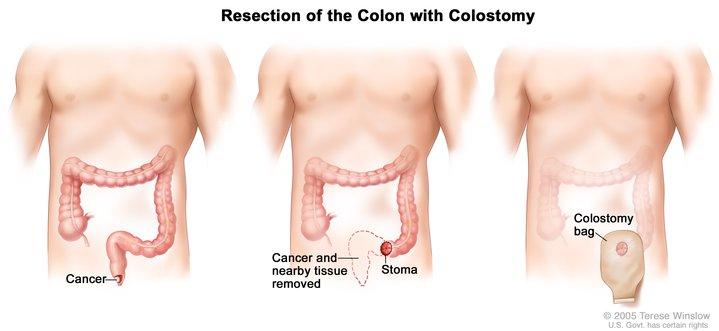
  • Abdominoperineal resection: A surgical procedure in which the anus, the rectum, and part of the sigmoid colon are removed through an incision made in the abdomen. The doctor sews the end of the intestine to an opening, called a stoma, made in the surface of the abdomen so body waste can be collected in a disposable bag outside of the body. This is called a colostomy. Lymph nodes that contain cancer may also be removed during this operation.

    Enlarge
    Three panel drawing showing anal cancer surgery with colostomy; first panel shows area of anus with cancer, middle panel shows cancer and nearby tissue removed and stoma created, last panel shows a colostomy bag attached to the stoma.
    Anal cancer surgery with colostomy. The anus, rectum, and part of the colon are removed, a stoma is created, and a colostomy bag is attached to the stoma.


Having the human immunodeficiency virus can affect treatment of anal cancer.

Cancer therapy can further damage the already weakened immune systems of patients who have the human immunodeficiency virus (HIV). For this reason, patients who have anal cancer and HIV are usually treated with lower doses of anticancer drugs and radiation than patients who do not have HIV.

Other types of treatment are being tested in clinical trials. These include the following:

Radiosensitizers

Radiosensitizers are drugs that make tumor cells more sensitive to radiation therapy. Combining radiation therapy with radiosensitizers may kill more tumor cells.

This summary section refers to specific treatments under study in clinical trials, but it may not mention every new treatment being studied. Information about ongoing clinical trials is available from the NCI Web site 1.

Treatment Options by Stage


Stage 0 (Carcinoma in Situ)

Treatment of stage 0 is usually local resection.

Check for clinical trials from NCI's PDQ Cancer Clinical Trials Registry that are now accepting patients with stage 0 anal cancer 2.

Stage I Anal Cancer

Treatment of stage I anal cancer may include the following:

Patients who have had treatment that saves the sphincter muscles may receive follow-up exams every 3 months for the first 2 years, including rectal exams with endoscopy and biopsy, as needed.

Check for clinical trials from NCI's PDQ Cancer Clinical Trials Registry that are now accepting patients with stage I anal cancer 3.

Stage II Anal Cancer

Treatment of stage II anal cancer may include the following:

Patients who have had treatment that saves the sphincter muscles may receive follow-up exams every 3 months for the first 2 years, including rectal exams with endoscopy and biopsy, as needed.

Information about ongoing clinical trials is available from the NCI Web site 1.

Check for clinical trials from NCI's PDQ Cancer Clinical Trials Registry that are now accepting patients with stage II anal cancer 4.

Stage IIIA Anal Cancer

Treatment of stage IIIA anal cancer may include the following:

Information about ongoing clinical trials is available from the NCI Web site 1.

Check for clinical trials from NCI's PDQ Cancer Clinical Trials Registry that are now accepting patients with stage IIIA anal cancer 5.

Stage IIIB Anal Cancer

Treatment of stage IIIB anal cancer may include the following:

Information about ongoing clinical trials is available from the NCI Web site 1.

Check for clinical trials from NCI's PDQ Cancer Clinical Trials Registry that are now accepting patients with stage IIIB anal cancer 6.

Stage IV Anal Cancer

Treatment of stage IV anal cancer may include the following:

Information about ongoing clinical trials is available from the NCI Web site 1.

Check for clinical trials from NCI's PDQ Cancer Clinical Trials Registry that are now accepting patients with stage IV anal cancer 7.

Treatment Options for Recurrent Anal Cancer

Treatment of recurrent anal cancer may include the following:

This summary section refers to specific treatments under study in clinical trials, but it may not mention every new treatment being studied. Information about ongoing clinical trials is available from the NCI Web site 1.

Check for clinical trials from NCI's PDQ Cancer Clinical Trials Registry that are now accepting patients with recurrent anal cancer 8.

Get More Information From NCI

Call 1-800-4-CANCER

For more information, U.S. residents may call the National Cancer Institute's (NCI's) Cancer Information Service toll-free at 1-800-4-CANCER (1-800-422-6237) Monday through Friday from 9:00 a.m. to 4:30 p.m. Deaf and hard-of-hearing callers with TTY equipment may call 1-800-332-8615. The call is free and a trained Cancer Information Specialist is available to answer your questions.

Chat online

The NCI's LiveHelp® 9 online chat service provides Internet users with the ability to chat online with an Information Specialist. The service is available from 9:00 a.m. to 11:00 p.m. Eastern time, Monday through Friday. Information Specialists can help Internet users find information on NCI Web sites and answer questions about cancer.

Write to us

For more information from the NCI, please write to this address:

NCI Public Inquiries Office
Suite 3036A
6116 Executive Boulevard, MSC8322
Bethesda, MD 20892-8322

Search the NCI Web site

The NCI Web site 10 provides online access to information on cancer, clinical trials, and other Web sites and organizations that offer support and resources for cancer patients and their families. For a quick search, use our “Best Bets” search box in the upper right hand corner of each Web page. The results that are most closely related to your search term will be listed as Best Bets at the top of the list of search results.

There are also many other places to get materials and information about cancer treatment and services. Hospitals in your area may have information about local and regional agencies that have information on finances, getting to and from treatment, receiving care at home, and dealing with problems related to cancer treatment.

Find Publications

The NCI has booklets and other materials for patients, health professionals, and the public. These publications discuss types of cancer, methods of cancer treatment, coping with cancer, and clinical trials. Some publications provide information on tests for cancer, cancer causes and prevention, cancer statistics, and NCI research activities. NCI materials on these and other topics may be ordered online or printed directly from the NCI Publications Locator 11. These materials can also be ordered by telephone from the Cancer Information Service toll-free at 1-800-4-CANCER (1-800-422-6237), TTY at 1-800-332-8615.

Changes to This Summary (09/20/2007)

The PDQ cancer information summaries are reviewed regularly and updated as new information becomes available. This section describes the latest changes made to this summary as of the date above.

Editorial changes were made to this summary.

About PDQ

PDQ is a comprehensive cancer database available on NCI's Web site.

PDQ is the National Cancer Institute's (NCI's) comprehensive cancer information database. Most of the information contained in PDQ is available online at NCI's Web site 10. PDQ is provided as a service of the NCI. The NCI is part of the National Institutes of Health, the federal government's focal point for biomedical research.

PDQ contains cancer information summaries.

The PDQ database contains summaries of the latest published information on cancer prevention, detection, genetics, treatment, supportive care, and complementary and alternative medicine. Most summaries are available in two versions. The health professional versions provide detailed information written in technical language. The patient versions are written in easy-to-understand, nontechnical language. Both versions provide current and accurate cancer information.

The PDQ cancer information summaries are developed by cancer experts and reviewed regularly.

Editorial Boards made up of experts in oncology and related specialties are responsible for writing and maintaining the cancer information summaries. The summaries are reviewed regularly and changes are made as new information becomes available. The date on each summary ("Date Last Modified") indicates the time of the most recent change.

PDQ also contains information on clinical trials.

A clinical trial is a study to answer a scientific question, such as whether one treatment is better than another. Trials are based on past studies and what has been learned in the laboratory. Each trial answers certain scientific questions in order to find new and better ways to help cancer patients. During treatment clinical trials, information is collected about the effects of a new treatment and how well it works. If a clinical trial shows that a new treatment is better than one currently being used, the new treatment may become "standard." Patients may want to think about taking part in a clinical trial. Some clinical trials are open only to patients who have not started treatment.

Listings of clinical trials are included in PDQ and are available online at NCI's Web site 12. Descriptions of the trials are available in health professional and patient versions. Many cancer doctors who take part in clinical trials are also listed in PDQ. For more information, call the Cancer Information Service 1-800-4-CANCER (1-800-422-6237); TTY at 1-800-332-8615.


Glossary Terms

abdomen (AB-doh-men)
The area of the body that contains the pancreas, stomach, intestines, liver, gallbladder, and other organs.
abdominoperineal resection
Surgery to remove the anus, the rectum, and part of the sigmoid colon through an incision made in the abdomen. The end of the intestine is attached to an opening in the surface of the abdomen and body waste is collected in a disposable bag outside of the body. This opening is called a colostomy. Lymph nodes that contain cancer may also be removed during this operation.
abnormal
Not normal. An abnormal lesion or growth may be cancerous, premalignant (likely to become cancer), or benign.
anal (AY-nul)
Having to do with the anus. The anus is the opening of the rectum (last part of the large intestine) to the outside of the body.
anus (AY-nus)
The opening of the rectum to the outside of the body.
biopsy (BY-op-see)
The removal of cells or tissues for examination by a pathologist. The pathologist may study the tissue under a microscope or perform other tests on the cells or tissue. There are many different types of biopsy procedures. The most common types include: (1) incisional biopsy, in which only a sample of tissue is removed; (2) excisional biopsy, in which an entire lump or suspicious area is removed; and (3) needle biopsy, in which a sample of tissue or fluid is removed with a needle. When a wide needle is used, the procedure is called a core biopsy. When a thin needle is used, the procedure is called a fine-needle aspiration biopsy.
bladder (BLA-der)
The organ that stores urine.
bowel (BOW-ul)
The long, tube-shaped organ in the abdomen that completes the process of digestion. The bowel has two parts, the small bowel and the large bowel. Also called the intestine.
cancer (KAN-ser)
A term for diseases in which abnormal cells divide without control. Cancer cells can invade nearby tissues and can spread to other parts of the body through the blood and lymph systems. There are several main types of cancer. Carcinoma is cancer that begins in the skin or in tissues that line or cover internal organs. Sarcoma is cancer that begins in bone, cartilage, fat, muscle, blood vessels, or other connective or supportive tissue. Leukemia is cancer that starts in blood-forming tissue such as the bone marrow, and causes large numbers of abnormal blood cells to be produced and enter the blood. Lymphoma and multiple myeloma are cancers that begin in the cells of the immune system. Central nervous system cancers are cancers that begin in the tissues of the brain and spinal cord.
carcinoma in situ (KAR-sih-NOH-muh in SY-too)
A group of abnormal cells that remain in the tissue in which they first formed. These abnormal cells may become cancer and spread into nearby normal tissue.
catheter (KA-theh-ter)
A flexible tube used to deliver fluids into or withdraw fluids from the body.
cell (sel)
The individual unit that makes up the tissues of the body. All living things are made up of one or more cells.
centimeter (SEN-tih-MEE-ter)
A measure of length in the metric system. There are 100 centimeters in a meter and 2½ centimeters in an inch.
chemotherapy (KEE-moh-THAYR-uh-pee)
Treatment with drugs that kill cancer cells.
chest x-ray
An x-ray of the structures inside the chest. An x-ray is a type of high-energy radiation that can go through the body and onto film, making pictures of areas inside the chest, which can be used to diagnose disease.
clinical trial
A type of research study that tests how well new medical approaches work in people. These studies test new methods of screening, prevention, diagnosis, or treatment of a disease. Also called a clinical study.
colostomy (koh-LOS-toh-mee)
An opening into the colon from the outside of the body. A colostomy provides a new path for waste material to leave the body after part of the colon has been removed.
CT scan
Computed tomography scan. A series of detailed pictures of areas inside the body taken from different angles; the pictures are created by a computer linked to an x-ray machine. Also called computed tomography scan, computerized tomography, computerized axial tomography scan, and CAT scan.
digital rectal examination (DIH-jih-tul REK-tul eg-zam-ih-NAY-shun)
DRE. An examination in which a doctor inserts a lubricated, gloved finger into the rectum to feel for abnormalities. Also called DRE.
dose
The amount of medicine taken, or radiation given, at one time.
drug
Any substance, other than food, that is used to prevent, diagnose, treat or relieve symptoms of a disease or abnormal condition. Also refers to a substance that alters mood or body function, or that can be habit-forming or addictive, especially a narcotic.
endoscopy (en-DOSS-koh-pee)
A procedure that uses an endoscope to examine the inside of the body. An endoscope is a thin, tube-like instrument with a light and a lens for viewing. It may also have a tool to remove tissue to be checked under a microscope for signs of disease.
external radiation therapy (...RAY-dee-AY-shun THAYR-uh-pee)
A type of radiation therapy that uses a machine to aim high-energy rays at the cancer from outside of the body. Also called external-beam radiation therapy.
external-beam radiation therapy (...RAY-dee-AY-shun THAYR-uh-pee)
A type of radiation therapy that uses a machine to aim high-energy rays at the cancer from outside of the body. Also called external radiation therapy.
follow-up
Monitoring a person's health over time after treatment. This includes keeping track of the health of people who participate in a clinical study or clinical trial for a period of time, both during the study and after the study ends.
groin
The area where the thigh meets the abdomen.
human immunodeficiency virus (HYOO-mun ih-MYOO-noh-dih-FIH-shun-see VY-rus)
HIV. The cause of acquired immunodeficiency syndrome (AIDS). Also called HIV.
human papillomavirus (HYOO-mun PA-pih-LOH-muh-VY-rus)
A member of a family of viruses that can cause abnormal tissue growth (for example, genital warts) and other changes to cells. Infection with certain types of human papillomavirus increases the risk of developing cervical cancer. Also called HPV.
immune system (ih-MYOON SIS-tem)
The complex group of organs and cells that defends the body against infections and other diseases.
incision (in-SIH-zhun)
A cut made in the body to perform surgery.
infection
Invasion and multiplication of germs in the body. Infections can occur in any part of the body and can spread throughout the body. The germs may be bacteria, viruses, yeast, or fungi. They can cause a fever and other problems, depending on where the infection occurs. When the body’s natural defense system is strong, it can often fight the germs and prevent infection. Some cancer treatments can weaken the natural defense system.
injection
Use of a syringe and needle to push fluids or drugs into the body; often called a "shot."
internal radiation therapy (in-TER-nul RAY-dee-AY-shun THAYR-uh-pee)
A type of radiation therapy in which radioactive material sealed in needles, seeds, wires, or catheters is placed directly into or near a tumor. Also called brachytherapy, radiation brachytherapy, and implant radiation therapy.
intestine (in-TES-tin)
The long, tube-shaped organ in the abdomen that completes the process of digestion. The intestine has two parts, the small intestine and the large intestine. Also called the bowel.
large intestine
The long, tube-like organ that is connected to the small intestine at one end and the anus at the other. The large intestine has four parts: cecum, colon, rectum, and anal canal. Partly digested food moves through the cecum into the colon, where water and some nutrients and electrolytes are removed. The remaining material, solid waste called stool, moves through the colon, is stored in the rectum, and leaves the body through the anal canal and anus.
local therapy (...THAYR-uh-pee)
Treatment that affects cells in the tumor and the area close to it.
lymph node (limf node)
A rounded mass of lymphatic tissue that is surrounded by a capsule of connective tissue. Lymph nodes filter lymph (lymphatic fluid), and they store lymphocytes (white blood cells). They are located along lymphatic vessels. Also called lymph gland.
organ
A part of the body that performs a specific function. For example, the heart is an organ.
palliative therapy (PA-lee-uh-tiv THAYR-uh-pee)
Treatment given to relieve the symptoms and reduce the suffering caused by cancer and other life-threatening diseases. Palliative cancer therapies are given together with other cancer treatments, from the time of diagnosis, through treatment, survivorship, recurrent or advanced disease, and at the end of life.
pathologist (puh-THAH-loh-jist)
A doctor who identifies diseases by studying cells and tissues under a microscope.
pelvis
The lower part of the abdomen, located between the hip bones.
physical examination
An exam of the body to check for general signs of disease.
proctoscopy (prok-TOS-koh-pee)
Examination of the rectum using a proctoscope, inserted into the rectum. A proctoscope is a thin, tube-like instrument with a light and a lens for viewing. It may also have a tool to remove tissue to be checked under a microscope for signs of disease.
prognosis (prog-NO-sis)
The likely outcome or course of a disease; the chance of recovery or recurrence.
quality of life
The overall enjoyment of life. Many clinical trials assess the effects of cancer and its treatment on the quality of life. These studies measure aspects of an individual’s sense of well-being and ability to carry out various activities.
radiation (RAY-dee-AY-shun)
Energy released in the form of particles or electromagnetic waves. Common sources of radiation include radon gas, cosmic rays from outer space, and medical x-rays.
radiation therapy (RAY-dee-AY-shun THAYR-uh-pee)
The use of high-energy radiation from x-rays, gamma rays, neutrons, protons, and other sources to kill cancer cells and shrink tumors. Radiation may come from a machine outside the body (external-beam radiation therapy), or it may come from radioactive material placed in the body near cancer cells (internal radiation therapy). Systemic radiation therapy uses a radioactive substance, such as a radiolabeled monoclonal antibody, that travels in the blood to tissues throughout the body. Also called radiotherapy and irradiation.
radioactive seed (RAY-dee-oh-AK-tiv...)
A small, radioactive pellet that is placed in or near a tumor. Cancer cells are killed by the energy given off as the radioactive material breaks down and becomes more stable.
radiosensitizer (RAY-dee-oh-SEN-sih-TIZE-er)
A drug that makes tumor cells more sensitive to radiation therapy.
rectum
The last several inches of the large intestine. The rectum ends at the anus.
recurrence (ree-KER-ents)
Cancer that has recurred (come back), usually after a period of time during which the cancer could not be detected. The cancer may come back to the same place as the original (primary) tumor or to another place in the body. Also called recurrent cancer.
recurrent cancer (ree-KER-ent KAN-ser)
Cancer that has recurred (come back), usually after a period of time during which the cancer could not be detected. The cancer may come back to the same place as the original (primary) tumor or to another place in the body. Also called recurrence.
regional chemotherapy (REE-juh-nul KEE-moh-THAYR-uh-pee)
Treatment with anticancer drugs directed to a specific area of the body.
resection (ree-SEK-shun)
A procedure that uses surgery to remove tissue or part or all of an organ.
risk factor
Something that may increase the chance of developing a disease. Some examples of risk factors for cancer include age, a family history of certain cancers, use of tobacco products, certain eating habits, obesity, lack of exercise, exposure to radiation or other cancer-causing agents, and certain genetic changes.
sigmoid colon (SIG-moyd KO-lun)
The S-shaped section of the colon that connects to the rectum.
sonogram (SON-o-gram)
A computer picture of areas inside the body created by bouncing high-energy sound waves (ultrasound) off internal tissues or organs. Also called an ultrasonogram.
sphincter
A ring-shaped muscle that relaxes or tightens to open or close a passage or opening in the body. Examples are the anal sphincter (around the opening of the anus) and the pyloric sphincter (at the lower opening of the stomach).
spinal column (SPY-nul KAH-lum)
The bones, muscles, tendons, and other tissues that reach from the base of the skull to the tailbone. The spinal column encloses the spinal cord and the fluid surrounding the spinal cord. Also called spine, backbone, and vertebral column.
stage
The extent of a cancer in the body. Staging is usually based on the size of the tumor, whether lymph nodes contain cancer, and whether the cancer has spread from the original site to other parts of the body.
stage 0 anal carcinoma in situ (... AY-nul KAR-sih-NOH-muh in SY-too)
Abnormal cells are found in the innermost lining of the anus. These abnormal cells may become cancer and spread into nearby normal tissue.
stage I anal cancer
The tumor is no larger than 2 centimeters.
stage II anal cancer
The tumor is larger than 2 centimeters.
stage IIIA anal cancer
Stage III anal cancer is divided into stages IIIA and IIIB. In stage IIIA, the tumor may be any size and has spread to either (1) lymph nodes near the rectum; or (2) nearby organs, such as the vagina, urethra, and bladder.
stage IIIB anal cancer
Stage III anal cancer is divided into stages IIIA and IIIB. In stage IIIB, the tumor may be any size and has spread to (1) nearby organs and to lymph nodes near the rectum; or (2) lymph nodes on one side of the pelvis and/or groin, and may have spread to nearby organs; or (3) lymph nodes near the rectum and in the groin, and/or to lymph nodes on both sides of the pelvis and/or groin, and may have spread to nearby organs.
stage IV anal cancer
The tumor may be any size, and cancer has spread to distant parts of the body. It may also have spread to lymph nodes and nearby organs.
staging (STAY-jing)
Performing exams and tests to learn the extent of the cancer within the body, especially whether the disease has spread from the original site to other parts of the body. It is important to know the stage of the disease in order to plan the best treatment.
standard therapy (...THAYR-uh-pee)
In medicine, treatment that experts agree is appropriate, accepted, and widely used. Health care providers are obligated to provide patients with standard therapy. Also called standard of care or best practice.
stoma (STOH-muh)
A surgically created opening from an area inside the body to the outside.
stool
The material in a bowel movement. Stool is made up of food that was not digested, bacteria, mucus, and cells from the intestines. Also called feces.
surgery (SER-juh-ree)
A procedure to remove or repair a part of the body or to find out whether disease is present. An operation.
symptom
An indication that a person has a condition or disease. Some examples of symptoms are headache, fever, fatigue, nausea, vomiting, and pain.
systemic chemotherapy (sis-TEH-mik KEE-moh-THAYR-uh-pee)
Treatment with anticancer drugs that travel through the blood to cells all over the body.
therapy (THAYR-uh-pee)
Treatment.
tissue (TISH-oo)
A group or layer of cells that work together to perform a specific function.
tumor (TOO-mer)
An abnormal mass of tissue that results when cells divide more than they should or do not die when they should. Tumors may be benign (not cancerous), or malignant (cancerous). Also called neoplasm.
ultrasound (UL-truh-SOWND)
A procedure in which high-energy sound waves (ultrasound) are bounced off internal tissues or organs and make echoes. The echo patterns are shown on the screen of an ultrasound machine, forming a picture of body tissues called a sonogram. Also called ultrasonography.
urethra (yoo-REE-thruh)
The tube through which urine leaves the body. It empties urine from the bladder.
vagina (vuh-JY-nuh)
The muscular canal extending from the uterus to the exterior of the body. Also called birth canal.
x-ray
A type of high-energy radiation. In low doses, x-rays are used to diagnose diseases by making pictures of the inside of the body. In high doses, x-rays are used to treat cancer.


Table of Links

1http://cancer.gov/clinicaltrials
2http://www.cancer.gov/Search/ClinicalTrialsLink.aspx?diagnosis=43540&tt=1&a
mp;format=1
3http://www.cancer.gov/Search/ClinicalTrialsLink.aspx?diagnosis=40600&tt=1&a
mp;format=1
4http://www.cancer.gov/Search/ClinicalTrialsLink.aspx?diagnosis=40684&tt=1&a
mp;format=1
5http://www.cancer.gov/Search/ClinicalTrialsLink.aspx?diagnosis=43700&tt=1&a
mp;format=1
6http://www.cancer.gov/Search/ClinicalTrialsLink.aspx?diagnosis=43710&tt=1&a
mp;format=1
7http://www.cancer.gov/Search/ClinicalTrialsLink.aspx?diagnosis=43438&tt=1&a
mp;format=1
8http://www.cancer.gov/Search/ClinicalTrialsLink.aspx?diagnosis=43482&tt=1&a
mp;format=1
9https://cissecure.nci.nih.gov/livehelp/welcome.asp
10http://cancer.gov
11https://cissecure.nci.nih.gov/ncipubs
12http://cancer.gov/clinical_trials