
Questions About Cancer? 1-800-4-CANCER

Testicular Cancer Treatment (PDQ®)

Patient Version
Last Modified: 05/16/2012

General Information About Testicular Cancer

Key Points for This Section


Testicular cancer is a disease in which malignant (cancer) cells form in the tissues of one or both testicles.

The testicles are 2 egg-shaped glands located inside the scrotum (a sac of loose skin that lies directly below the penis). The testicles are held within the scrotum by the spermatic cord, which also contains the vas deferens and vessels and nerves of the testicles.

Enlarge 1
Anatomy of the  male reproductive and urinary systems; drawing shows front and side views of ureters, lymph nodes, rectum, bladder, prostate gland, vas deferens, urethra, penis, testicles, seminal vesicle, and ejaculatory duct. 1
Anatomy of the male reproductive and urinary systems, showing the testicles, prostate, bladder, and other organs.


The testicles are the male sex glands and produce testosterone and sperm. Germ cells within the testicles produce immature sperm that travel through a network of tubules (tiny tubes) and larger tubes into the epididymis (a long coiled tube next to the testicles) where the sperm mature and are stored.

Almost all testicular cancers start in the germ cells. The two main types of testicular germ cell tumors are seminomas and nonseminomas. These 2 types grow and spread differently and are treated differently. Nonseminomas tend to grow and spread more quickly than seminomas. Seminomas are more sensitive to radiation. A testicular tumor that contains both seminoma and nonseminoma cells is treated as a nonseminoma.

Testicular cancer is the most common cancer in men 20 to 35 years old.

Health history can affect the risk of developing testicular cancer.

Anything that increases the chance of getting a disease is called a risk factor. Having a risk factor does not mean that you will get cancer; not having risk factors doesn’t mean that you will not get cancer. People who think they may be at risk should discuss this with their doctor. Risk factors for testicular cancer include:

Possible signs of testicular cancer include swelling or discomfort in the scrotum.

These and other symptoms may be caused by testicular cancer. Other conditions may cause the same symptoms. A doctor should be consulted if any of the following problems occur:

  • A painless lump or swelling in either testicle.
  • A change in how the testicle feels.
  • A dull ache in the lower abdomen or the groin.
  • A sudden build-up of fluid in the scrotum.
  • Pain or discomfort in a testicle or in the scrotum.

Tests that examine the testicles and blood are used to detect (find) and diagnose testicular cancer.

The following tests and procedures may be used:

  • Physical exam and history: An exam of the body to check general signs of health, including checking for signs of disease, such as lumps or anything else that seems unusual. The testicles will be examined to check for lumps, swelling, or pain. A history of the patient's health habits and past illnesses and treatments will also be taken.

  • Ultrasound exam: A procedure in which high-energy sound waves (ultrasound) are bounced off internal tissues or organs and make echoes. The echoes form a picture of body tissues called a sonogram.

  • Serum tumor marker test: A procedure in which a sample of blood is examined to measure the amounts of certain substances released into the blood by organs, tissues, or tumor cells in the body. Certain substances are linked to specific types of cancer when found in increased levels in the blood. These are called tumor markers. The following 3 tumor markers are used to detect testicular cancer:Tumor marker levels are measured before radical inguinal orchiectomy and biopsy, to help diagnose testicular cancer.

  • Radical inguinal orchiectomy and biopsy: A procedure to remove the entire testicle through an incision in the groin. A tissue sample from the testicle is then viewed under a microscope to check for cancer cells. (The surgeon does not cut through the scrotum into the testicle to remove a sample of tissue for biopsy, because if cancer is present, this procedure could cause it to spread into the scrotum and lymph nodes. It's important to choose a surgeon who has experience with this kind of surgery.) If cancer is found, the cell type (seminoma or nonseminoma) is determined in order to help plan treatment.

Certain factors affect prognosis (chance of recovery) and treatment options.

The prognosis (chance of recovery) and treatment options depend on the following:

  • Stage of the cancer (whether it is in or near the testicle or has spread to other places in the body, and blood levels of AFP, β-hCG, and LDH).
  • Type of cancer.
  • Size of the tumor.
  • Number and size of retroperitoneal lymph nodes.

Testicular cancer can usually be cured.

Treatment for testicular cancer can cause infertility.

Certain treatments for testicular cancer can cause infertility that may be permanent. Patients who may wish to have children should consider sperm banking before having treatment. Sperm banking is the process of freezing sperm and storing it for later use.

Stages of Testicular Cancer

Key Points for This Section


After testicular cancer has been diagnosed, tests are done to find out if cancer cells have spread within the testicles or to other parts of the body.

The process used to find out if cancer has spread within the testicles or to other parts of the body is called staging. The information gathered from the staging process determines the stage of the disease. It is important to know the stage in order to plan treatment. The following tests and procedures may be used in the staging process:

  • Chest x-ray: An x-ray of the organs and bones inside the chest. An x-ray is a type of energy beam that can go through the body and onto film, making a picture of areas inside the body.

  • CT scan (CAT scan): A procedure that makes a series of detailed pictures of areas inside the body, taken from different angles. The pictures are made by a computer linked to an x-ray machine. A dye may be injected into a vein or swallowed to help the organs or tissues show up more clearly. This procedure is also called computed tomography, computerized tomography, or computerized axial tomography.

  • Lymphangiography: A procedure used to x-ray the lymph system. A dye is injected into the lymph vessels in the feet. The dye travels upward through the lymph nodes and lymph vessels, and x-rays are taken to see if there are any blockages. This test helps find out whether cancer has spread to the lymph nodes.

  • Abdominal lymph node dissection: A surgical procedure in which lymph nodes in the abdomen are removed and a sample of tissue is checked under a microscope for signs of cancer. This procedure is also called lymphadenectomy. For patients with nonseminoma, removing the lymph nodes may help stop the spread of disease. Cancer cells in the lymph nodes of seminoma patients can be treated with radiation therapy.

  • Radical inguinal orchiectomy and biopsy: A procedure to remove the entire testicle through an incision in the groin. A tissue sample from the testicle is then viewed under a microscope to check for cancer cells. (The surgeon does not cut through the scrotum into the testicle to remove a sample of tissue for biopsy, because if cancer is present, this procedure could cause it to spread into the scrotum and lymph nodes.)

  • Serum tumor marker test: A procedure in which a sample of blood is examined to measure the amounts of certain substances released into the blood by organs, tissues, or tumor cells in the body. Certain substances are linked to specific types of cancer when found in increased levels in the blood. These are called tumor markers. The following 3 tumor markers are used in staging testicular cancer:Tumor marker levels are measured again, after radical inguinal orchiectomy and biopsy, in order to determine the stage of the cancer. This helps to show if all of the cancer has been removed or if more treatment is needed. Tumor marker levels are also measured during follow-up as a way of checking if the cancer has come back.

There are three ways that cancer spreads in the body.

The three ways that cancer spreads in the body are:

  • Through tissue. Cancer invades the surrounding normal tissue.
  • Through the lymph system. Cancer invades the lymph system and travels through the lymph vessels to other places in the body.
  • Through the blood. Cancer invades the veins and capillaries and travels through the blood to other places in the body.

When cancer cells break away from the primary (original) tumor and travel through the lymph or blood to other places in the body, another (secondary) tumor may form. This process is called metastasis. The secondary (metastatic) tumor is the same type of cancer as the primary tumor. For example, if breast cancer spreads to the bones, the cancer cells in the bones are actually breast cancer cells. The disease is metastatic breast cancer, not bone cancer.

The following stages are used for testicular cancer:

Stage 0 (Carcinoma in Situ)

In stage 0, abnormal cells are found in the tiny tubules where the sperm cells begin to develop. These abnormal cells may become cancer and spread into nearby normal tissue. All tumor marker levels are normal. Stage 0 is also called carcinoma in situ.

Stage I

In stage I, cancer has formed. Stage I is divided into stage IA, stage IB, and stage IS and is determined after a radical inguinal orchiectomy is done.

Enlarge 2
Tumor size compared to everyday objects; shows various measurements of a tumor compared to a pea, peanut, walnut, and lime 2
Pea, peanut, walnut, and lime show tumor sizes.

Stage II

Stage II is divided into stage IIA, stage IIB, and stage IIC and is determined after a radical inguinal orchiectomy is done.

Stage III

Stage III is divided into stage IIIA, stage IIIB, and stage IIIC and is determined after a radical inguinal orchiectomy is done.

Recurrent Testicular Cancer

Recurrent testicular cancer is cancer that has recurred (come back) after it has been treated. The cancer may come back many years after the initial cancer, in the other testicle or in other parts of the body.

Treatment Option Overview

Key Points for This Section


There are different types of treatment for patients with testicular cancer.

Different types of treatments are available for patients with testicular cancer. Some treatments are standard (the currently used treatment), and some are being tested in clinical trials. A treatment clinical trial is a research study meant to help improve current treatments or obtain information on new treatments for patients with cancer. When clinical trials show that a new treatment is better than the standard treatment, the new treatment may become the standard treatment. Patients may want to think about taking part in a clinical trial. Some clinical trials are open only to patients who have not started treatment.

Testicular tumors are divided into 3 groups, based on how well the tumors are expected to respond to treatment.

Good Prognosis

For nonseminoma, all of the following must be true:

For seminoma, all of the following must be true:

Intermediate Prognosis

For nonseminoma, all of the following must be true:

  • The tumor is found in one testicle only or in the retroperitoneum (area outside or behind the abdominal wall); and
  • The tumor has not spread to organs other than the lungs; and
  • The level of any one of the tumor markers is more than slightly above normal.

For seminoma, all of the following must be true:

  • The tumor has spread to organs other than the lungs; and
  • The level of AFP is normal. β-hCG and LDH may be at any level.

Poor Prognosis

For nonseminoma, at least one of the following must be true:

  • The tumor is in the center of the chest between the lungs; or
  • The tumor has spread to organs other than the lungs; or
  • The level of any one of the tumor markers is high.

There is no poor prognosis grouping for seminoma testicular tumors.

Five types of standard treatment are used:

Surgery

Surgery to remove the testicle (radical inguinal orchiectomy) and some of the lymph nodes may be done at diagnosis and staging. (See the General Information 3 and Stages 4 sections of this summary.) Tumors that have spread to other places in the body may be partly or entirely removed by surgery.

Even if the doctor removes all the cancer that can be seen at the time of the surgery, some patients may be given chemotherapy or radiation therapy after surgery to kill any cancer cells that are left. Treatment given after the surgery, to lower the risk that the cancer will come back, is called adjuvant therapy.

Radiation therapy

Radiation therapy is a cancer treatment that uses high-energy x-rays or other types of radiation to kill cancer cells. There are two types of radiation therapy. External radiation therapy uses a machine outside the body to send radiation toward the cancer. Internal radiation therapy uses a radioactive substance sealed in needles, seeds, wires, or catheters that are placed directly into or near the cancer. The way the radiation therapy is given depends on the type and stage of the cancer being treated.

Chemotherapy

Chemotherapy is a cancer treatment that uses drugs to stop the growth of cancer cells, either by killing the cells or by stopping the cells from dividing. When chemotherapy is taken by mouth or injected into a vein or muscle, the drugs enter the bloodstream and can reach cancer cells throughout the body (systemic chemotherapy). When chemotherapy is placed directly into the cerebrospinal fluid, an organ, or a body cavity such as the abdomen, the drugs mainly affect cancer cells in those areas (regional chemotherapy). The way the chemotherapy is given depends on the type and stage of the cancer being treated.

See Drugs Approved for Testicular Cancer 5 for more information.

Watchful waiting

Watchful waiting is closely monitoring a patient’s condition without giving any treatment until symptoms appear or change. This is also called observation.

High-dose chemotherapy with stem cell transplant
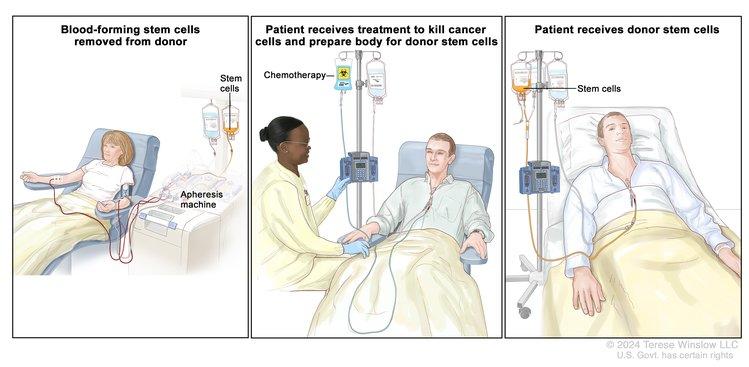
High-dose chemotherapy with stem cell transplant is a method of giving high doses of chemotherapy and replacing blood -forming cells destroyed by the cancer treatment. Stem cells (immature blood cells) are removed from the blood or bone marrow of the patient or a donor and are frozen and stored. After the chemotherapy is completed, the stored stem cells are thawed and given back to the patient through an infusion. These reinfused stem cells grow into (and restore) the body’s blood cells.

See Drugs Approved for Testicular Cancer 5 for more information.

Stem cell transplant (Step 1). Blood is taken from a vein in the arm of the donor. The patient or another person may be the donor. The blood flows through a machine that removes the stem cells. Then the blood is returned to the donor through a vein in the other arm.Stem cell transplant (Step 2). The patient receives chemotherapy to kill blood-forming cells. The patient may receive radiation therapy (not shown).Stem cell transplant (Step 3). The patient receives stem cells through a catheter placed into a blood vessel in the chest.

New types of treatment are being tested in clinical trials.

Information about clinical trials is available from the NCI Web site 10.

Patients may want to think about taking part in a clinical trial.

For some patients, taking part in a clinical trial may be the best treatment choice. Clinical trials are part of the cancer research process. Clinical trials are done to find out if new cancer treatments are safe and effective or better than the standard treatment.

Many of today's standard treatments for cancer are based on earlier clinical trials. Patients who take part in a clinical trial may receive the standard treatment or be among the first to receive a new treatment.

Patients who take part in clinical trials also help improve the way cancer will be treated in the future. Even when clinical trials do not lead to effective new treatments, they often answer important questions and help move research forward.

Patients can enter clinical trials before, during, or after starting their cancer treatment.

Some clinical trials only include patients who have not yet received treatment. Other trials test treatments for patients whose cancer has not gotten better. There are also clinical trials that test new ways to stop cancer from recurring (coming back) or reduce the side effects of cancer treatment.

Clinical trials are taking place in many parts of the country. See the Treatment Options section that follows for links to current treatment clinical trials. These have been retrieved from NCI's listing of clinical trials.

Follow-up tests may be needed.

Some of the tests that were done to diagnose the cancer or to find out the stage of the cancer may be repeated. Some tests will be repeated in order to see how well the treatment is working. Decisions about whether to continue, change, or stop treatment may be based on the results of these tests. This is sometimes called re-staging.

Some of the tests will continue to be done from time to time after treatment has ended. The results of these tests can show if your condition has changed or if the cancer has recurred (come back). These tests are sometimes called follow-up tests or check-ups.

Men who have had testicular cancer have an increased risk of developing cancer in the other testicle. A patient is advised to regularly check the other testicle and report any unusual symptoms to a doctor right away.

Long-term clinical exams are very important. The patient will probably have check-ups frequently during the first year after surgery and less often after that.

Treatment Options by Stage

A link to a list of current clinical trials is included for each treatment section. For some types or stages of cancer, there may not be any trials listed. Check with your doctor for clinical trials that are not listed here but may be right for you.

Stage I Testicular Cancer

Treatment of stage I testicular cancer depends on whether the cancer is a seminoma or a nonseminoma.

Treatment of seminoma may include the following:

Treatment of nonseminoma may include the following:

  • Surgery to remove the testicle, with long-term follow-up.
  • Surgery to remove the testicle and lymph nodes in the abdomen, with long-term follow-up.
  • Surgery followed by chemotherapy for patients at high risk of recurrence, with long-term follow-up.

Check for U.S. clinical trials from NCI's list of cancer clinical trials that are now accepting patients with stage I malignant testicular germ cell tumor 11. For more specific results, refine the search by using other search features, such as the location of the trial, the type of treatment, or the name of the drug. General information about clinical trials is available from the NCI Web site 12.

Stage II Testicular Cancer

Treatment of stage II testicular cancer depends on whether the cancer is a seminoma or a nonseminoma.

Treatment of seminoma may include the following:

Treatment of nonseminoma may include the following:

  • Surgery to remove the testicle and lymph nodes, with long-term follow-up.
  • Surgery to remove the testicle and lymph nodes, followed by combination chemotherapy and long-term follow-up.
  • Surgery to remove the testicle, followed by combination chemotherapy and a second surgery if cancer remains, with long-term follow-up.
  • Combination chemotherapy before surgery to remove the testicle, for cancer that has spread and is thought to be life-threatening.

Check for U.S. clinical trials from NCI's list of cancer clinical trials that are now accepting patients with stage II malignant testicular germ cell tumor 13. For more specific results, refine the search by using other search features, such as the location of the trial, the type of treatment, or the name of the drug. General information about clinical trials is available from the NCI Web site 12.

Stage III Testicular Cancer

Treatment of stage III testicular cancer depends on whether the cancer is a seminoma or a nonseminoma.

Treatment of seminoma may include the following:

Treatment of nonseminoma may include the following:

  • Surgery to remove the testicle, followed by combination chemotherapy.
  • Combination chemotherapy followed by surgery to remove the testicle and all remaining tumors. Additional chemotherapy may be given if the tumor tissue removed contains cancer cells that are growing or if follow-up tests show that cancer is progressing.
  • Combination chemotherapy before surgery to remove the testicle, for cancer that has spread and is thought to be life-threatening.
  • A clinical trial of chemotherapy.

Check for U.S. clinical trials from NCI's list of cancer clinical trials that are now accepting patients with stage III malignant testicular germ cell tumor 14. For more specific results, refine the search by using other search features, such as the location of the trial, the type of treatment, or the name of the drug. General information about clinical trials is available from the NCI Web site 12.

Treatment Options for Recurrent Testicular Cancer

Treatment of recurrent testicular cancer may include the following:

Check for U.S. clinical trials from NCI's list of cancer clinical trials that are now accepting patients with recurrent malignant testicular germ cell tumor 15. For more specific results, refine the search by using other search features, such as the location of the trial, the type of treatment, or the name of the drug. General information about clinical trials is available from the NCI Web site 12.

Changes to This Summary (05/16/2012)

The PDQ cancer information summaries are reviewed regularly and updated as new information becomes available. This section describes the latest changes made to this summary as of the date above.

Editorial changes were made to this summary.

Get More Information From NCI

Call 1-800-4-CANCER

For more information, U.S. residents may call the National Cancer Institute's (NCI's) Cancer Information Service toll-free at 1-800-4-CANCER (1-800-422-6237) Monday through Friday from 8:00 a.m. to 8:00 p.m., Eastern Time. A trained Cancer Information Specialist is available to answer your questions.

Chat online

The NCI's LiveHelp® 27 online chat service provides Internet users with the ability to chat online with an Information Specialist. The service is available from 8:00 a.m. to 11:00 p.m. Eastern time, Monday through Friday. Information Specialists can help Internet users find information on NCI Web sites and answer questions about cancer.

Write to us

For more information from the NCI, please write to this address:

NCI Public Inquiries Office
Suite 3036A
6116 Executive Boulevard, MSC8322
Bethesda, MD 20892-8322

Search the NCI Web site

The NCI Web site 28 provides online access to information on cancer, clinical trials, and other Web sites and organizations that offer support and resources for cancer patients and their families. For a quick search, use the search box in the upper right corner of each Web page. The results for a wide range of search terms will include a list of "Best Bets," editorially chosen Web pages that are most closely related to the search term entered.

There are also many other places to get materials and information about cancer treatment and services. Hospitals in your area may have information about local and regional agencies that have information on finances, getting to and from treatment, receiving care at home, and dealing with problems related to cancer treatment.

Find Publications

The NCI has booklets and other materials for patients, health professionals, and the public. These publications discuss types of cancer, methods of cancer treatment, coping with cancer, and clinical trials. Some publications provide information on tests for cancer, cancer causes and prevention, cancer statistics, and NCI research activities. NCI materials on these and other topics may be ordered online or printed directly from the NCI Publications Locator 29. These materials can also be ordered by telephone from the Cancer Information Service toll-free at 1-800-4-CANCER (1-800-422-6237).

About PDQ

PDQ is a comprehensive cancer database available on NCI's Web site.

PDQ is the National Cancer Institute's (NCI's) comprehensive cancer information database. Most of the information contained in PDQ is available online at NCI's Web site 28. PDQ is provided as a service of the NCI. The NCI is part of the National Institutes of Health, the federal government's focal point for biomedical research.

PDQ contains cancer information summaries.

The PDQ database contains summaries of the latest published information on cancer prevention, detection, genetics, treatment, supportive care, and complementary and alternative medicine. Most summaries are available in two versions. The health professional versions provide detailed information written in technical language. The patient versions are written in easy-to-understand, nontechnical language. Both versions provide current and accurate cancer information.

The PDQ cancer information summaries are developed by cancer experts and reviewed regularly.

Editorial Boards made up of experts in oncology and related specialties are responsible for writing and maintaining the cancer information summaries. The summaries are reviewed regularly and changes are made as new information becomes available. The date on each summary ("Date Last Modified") indicates the time of the most recent change.

PDQ also contains information on clinical trials.

A clinical trial is a study to answer a scientific question, such as whether one treatment is better than another. Trials are based on past studies and what has been learned in the laboratory. Each trial answers certain scientific questions in order to find new and better ways to help cancer patients. During treatment clinical trials, information is collected about the effects of a new treatment and how well it works. If a clinical trial shows that a new treatment is better than one currently being used, the new treatment may become "standard." Patients may want to think about taking part in a clinical trial. Some clinical trials are open only to patients who have not started treatment.

Listings of clinical trials are included in PDQ and are available online at NCI's Web site 12. Descriptions of the trials are available in health professional and patient versions. Many cancer doctors who take part in clinical trials are also listed in PDQ. For more information, call the Cancer Information Service 1-800-4-CANCER (1-800-422-6237).


Glossary Terms

abdomen (AB-doh-men)
The area of the body that contains the pancreas, stomach, intestines, liver, gallbladder, and other organs.
abnormal (ab-NOR-mul)
Not normal. An abnormal lesion or growth may be cancer, premalignant (likely to become cancer), or benign (not cancer).
alpha-fetoprotein (AL-fuh-FEE-toh-PROH-teen)
A protein normally produced by a fetus. AFP levels are usually undetectable in the blood of healthy adult men or women (who are not pregnant). An elevated level of AFP suggests the presence of either a primary liver cancer or germ cell tumor. Also called AFP.
beta-human chorionic gonadotropin (BAY-tuh-HYOO-mun KOR-ee-AH-nik goh-NA-doh-TROH-pin)
A hormone found in the blood and urine during pregnancy. It may also be found in higher than normal amounts in patients with some types of cancer, including testicular, ovarian, liver, stomach, and lung cancers, and in other disorders. Measuring the amount of beta-human chorionic gonadotropin in the blood or urine of cancer patients may help to diagnose cancer and find out how well cancer treatment is working. Beta-human chorionic gonadotropin is a type of tumor marker. Also called beta-hCG.
biopsy (BY-op-see)
The removal of cells or tissues for examination by a pathologist. The pathologist may study the tissue under a microscope or perform other tests on the cells or tissue. There are many different types of biopsy procedures. The most common types include: (1) incisional biopsy, in which only a sample of tissue is removed; (2) excisional biopsy, in which an entire lump or suspicious area is removed; and (3) needle biopsy, in which a sample of tissue or fluid is removed with a needle. When a wide needle is used, the procedure is called a core biopsy. When a thin needle is used, the procedure is called a fine-needle aspiration biopsy.
blood (blud)
A tissue with red blood cells, white blood cells, platelets, and other substances suspended in fluid called plasma. Blood takes oxygen and nutrients to the tissues, and carries away wastes.
cancer (KAN-ser)
A term for diseases in which abnormal cells divide without control and can invade nearby tissues. Cancer cells can also spread to other parts of the body through the blood and lymph systems. There are several main types of cancer. Carcinoma is a cancer that begins in the skin or in tissues that line or cover internal organs. Sarcoma is a cancer that begins in bone, cartilage, fat, muscle, blood vessels, or other connective or supportive tissue. Leukemia is a cancer that starts in blood-forming tissue such as the bone marrow, and causes large numbers of abnormal blood cells to be produced and enter the blood. Lymphoma and multiple myeloma are cancers that begin in the cells of the immune system. Central nervous system cancers are cancers that begin in the tissues of the brain and spinal cord. Also called malignancy.
cell (sel)
The individual unit that makes up the tissues of the body. All living things are made up of one or more cells.
clinical trial (KLIH-nih-kul TRY-ul)
A type of research study that tests how well new medical approaches work in people. These studies test new methods of screening, prevention, diagnosis, or treatment of a disease. Also called clinical study.
condition (kun-DIH-shun)
In medicine, a health problem with certain characteristics or symptoms.
cure (kyoor)
To heal or restore health; a treatment to restore health.
diagnosis (DY-ug-NOH-sis)
The process of identifying a disease, such as cancer, from its signs and symptoms.
epididymis (eh-pih-DIH-dih-mis)
A narrow, tightly-coiled tube that is attached to each of the testicles (the male sex glands that produce sperm). Sperm cells (male reproductive cells) move from the testicles into the epididymis, where they finish maturing and are stored.
family history (FA-mih-lee HIH-stuh-ree)
A record of the relationships among family members along with their medical histories. This includes current and past illnesses. A family history may show a pattern of certain diseases in a family. Also called family medical history.
fluid (FLOO-id)
A substance that flows smoothly and takes the shape of its container. Liquids and gases are fluids.
germ cell (jerm sel)
A reproductive cell of the body. Germ cells are egg cells in females and sperm cells in males.
gland (gland)
An organ that makes one or more substances, such as hormones, digestive juices, sweat, tears, saliva, or milk. Endocrine glands release the substances directly into the bloodstream. Exocrine glands release the substances into a duct or opening to the inside or outside of the body.
groin (groyn)
The area where the thigh meets the abdomen.
incision (in-SIH-zhun)
A cut made in the body to perform surgery.
infertility (IN-fer-TIH-lih-tee)
The inability to produce children.
inguinal orchiectomy (IN-gwih-nul OR-kee-EK-toh-mee)
An operation in which the testicle is removed through an incision in the groin.
lactate dehydrogenase (LAK-tayt dee-hy-DRAH-jeh-nays)
One of a group of enzymes found in the blood and other body tissues and involved in energy production in cells. An increased amount of lactate dehydrogenase in the blood may be a sign of tissue damage and some types of cancer or other diseases. Also called lactic acid dehydrogenase and LDH.
lymph node (limf node)
A rounded mass of lymphatic tissue that is surrounded by a capsule of connective tissue. Lymph nodes filter lymph (lymphatic fluid), and they store lymphocytes (white blood cells). They are located along lymphatic vessels. Also called lymph gland.
medical history (MEH-dih-kul HIH-stuh-ree)
A record of information about a person’s health. A personal medical history may include information about allergies, illnesses, surgeries, immunizations, and results of physical exams and tests. It may also include information about medicines taken and health habits, such as diet and exercise. A family medical history includes health information about a person’s close family members (parents, grandparents, children, brothers, and sisters). This includes their current and past illnesses. A family medical history may show a pattern of certain diseases in a family.
microscope (MY-kroh-SKOPE)
An instrument that is used to look at cells and other small objects that cannot be seen with the eye alone.
National Cancer Institute (NA-shuh-nul KAN-ser IN-stih-TOOT)
The National Cancer Institute, part of the National Institutes of Health of the United States Department of Health and Human Services, is the Federal Government's principal agency for cancer research. The National Cancer Institute conducts, coordinates, and funds cancer research, training, health information dissemination, and other programs with respect to the cause, diagnosis, prevention, and treatment of cancer. Access the National Cancer Institute Web site at http://www.cancer.gov. Also called NCI.
nerve (nerv)
A bundle of fibers that receives and sends messages between the body and the brain. The messages are sent by chemical and electrical changes in the cells that make up the nerves.
nonseminoma (NON-seh-mih-NOH-muh)
A type of cancer that begins in cells that form sperm or eggs. There are several types of nonseminoma tumors, including embryonal carcinoma, malignant teratoma, choriocarcinoma, and yolk sac tumor. These tumors are usually made up of more than one type of cancer cell. Although nonseminomas occur most often in the testicles or ovaries, they can occur in other tissues, such as the brain, chest, or abdomen. This happens when cells that have the ability to form sperm or eggs are found in other parts of the body.
organ (OR-gun)
A part of the body that performs a specific function. For example, the heart is an organ.
penis (PEE-nis)
An external male reproductive organ. It contains a tube called the urethra, which carries semen and urine to the outside of the body.
personal history (PER-suh-nul HIH-stuh-ree)
A collection of information about a person’s health. It may include information about allergies, illnesses and surgeries, and dates and results of physical exams, tests, screenings, and immunizations. It may also include information about medicines taken and about diet and exercise. Also called personal health record and personal medical history.
physical examination (FIH-zih-kul eg-ZA-mih-NAY-shun)
An exam of the body to check for general signs of disease.
prognosis (prog-NO-sis)
The likely outcome or course of a disease; the chance of recovery or recurrence.
radiation (RAY-dee-AY-shun)
Energy released in the form of particle or electromagnetic waves. Common sources of radiation include radon gas, cosmic rays from outer space, medical x-rays, and energy given off by a radioisotope (unstable form of a chemical element that releases radiation as it breaks down and becomes more stable).
recover (ree-KUH-ver)
To become well and healthy again.
recurrent cancer (ree-KER-ent KAN-ser)
Cancer that has recurred (come back), usually after a period of time during which the cancer could not be detected. The cancer may come back to the same place as the original (primary) tumor or to another place in the body. Also called recurrence.
retroperitoneal (REH-troh-PAYR-ih-toh-NEE-ul)
Having to do with the area outside or behind the peritoneum (the tissue that lines the abdominal wall and covers most of the organs in the abdomen).
risk factor (... FAK-ter)
Something that increases the chance of developing a disease. Some examples of risk factors for cancer are age, a family history of certain cancers, use of tobacco products, being exposed to radiation or certain chemicals, infection with certain viruses or bacteria, and certain genetic changes.
scrotum (SKROH-tum)
In males, the external sac that contains the testicles.
seminoma (SEH-mih-NOH-muh)
A type of cancer that begins in cells that make sperm or eggs. Seminomas occur most often in the testicles or the ovaries. They may also occur in other organs, such as the brain, chest, or abdomen. This happens when cells that have the ability to form sperm or eggs are found in other parts of the body. Seminomas grow and spread slowly.
serum tumor marker test (SEER-um TOO-mer MAR-ker ...)
A blood test that measures the amount of substances called tumor markers (or biomarkers). Tumor markers are released into the blood by tumor cells or by other cells in response to tumor cells. A high level of a tumor marker may be a sign of cancer.
sonogram (SAH-noh-gram)
A computer picture of areas inside the body created by bouncing high-energy sound waves (ultrasound) off internal tissues or organs. Also called ultrasonogram.
sperm (spurm)
The male reproductive cell, formed in the testicle. A sperm unites with an egg to form an embryo.
sperm banking (spurm...)
Freezing sperm for use in the future. This procedure can allow men to father children after loss of fertility.
spermatic cord (sper-MA-tik kord)
A cord-like structure in the male reproductive system that contains nerves, blood and lymph vessels, and the vas deferens (a coiled tube that carries sperm out of the testicle). It runs from the abdomen to the testicle, and connects to the testicle in the scrotum (external sac). Also called testicular cord.
stage (stayj)
The extent of a cancer in the body. Staging is usually based on the size of the tumor, whether lymph nodes contain cancer, and whether the cancer has spread from the original site to other parts of the body.
surgeon (SER-jun)
A doctor who removes or repairs a part of the body by operating on the patient.
surgery (SER-juh-ree)
A procedure to remove or repair a part of the body or to find out whether disease is present. An operation.
symptom (SIMP-tum)
An indication that a person has a condition or disease. Some examples of symptoms are headache, fever, fatigue, nausea, vomiting, and pain.
testicle (TES-tih-kul)
One of two egg-shaped glands inside the scrotum that produce sperm and male hormones. Also called testis.
testicular cancer (tes-TIH-kyuh-ler KAN-ser)
Cancer that forms in tissues of one or both testicles. Testicular cancer is most common in young or middle-aged men. Most testicular cancers begin in germ cells (cells that make sperm) and are called testicular germ cell tumors.
testicular germ cell tumor (tes-TIH-kyuh-ler jerm sel TOO-mer)
A type of tumor that forms in a testicle from germ cells (cells that make sperm). Two main types of testicular germ cell tumors are seminomas and nonseminomas. Seminomas grow and spread slowly and are sensitive to radiation therapy. Nonseminomas grow and spread more quickly than seminomas. There are several different types of nonseminomas.
testosterone (tes-TOS-teh-rone)
A hormone made mainly in the testes (part of the male reproductive system). It is needed to develop and maintain male sex characteristics, such as facial hair, deep voice, and muscle growth. Testosterone may also be made in the laboratory and is used to treat certain medical conditions.
tissue (TIH-shoo)
A group or layer of cells that work together to perform a specific function.
tumor (TOO-mer)
An abnormal mass of tissue that results when cells divide more than they should or do not die when they should. Tumors may be benign (not cancer), or malignant (cancer). Also called neoplasm.
tumor marker (TOO-mer MAR-ker)
A substance found in tissue, blood, or other body fluids that may be a sign of cancer or certain benign (noncancerous) conditions. Most tumor markers are made by both normal cells and cancer cells, but they are made in larger amounts by cancer cells. A tumor marker may help to diagnose cancer, plan treatment, or find out how well treatment is working or if cancer has come back. Examples of tumor markers include CA-125 (in ovarian cancer), CA 15-3 (in breast cancer), CEA (in colon cancer), and PSA (in prostate cancer).
ultrasound (UL-truh-SOWND)
A procedure in which high-energy sound waves are bounced off internal tissues or organs and make echoes. The echo patterns are shown on the screen of an ultrasound machine, forming a picture of body tissues called a sonogram. Also called ultrasonography.
undescended testicles (UN-deh-SEN-ded TES-tih-kuls)
A condition in which one or both testicles fail to move from the abdomen, where they develop before birth, into the scrotum. Undescended testicles may increase the risk for development of testicular cancer. Also called cryptorchidism.
vas deferens (VAS DEH-feh-RENZ)
A coiled tube that carries the sperm out of the testes.

Table of Links

1http://www.cancer.gov/PublishedContent/MediaLinks/305528.html
2http://www.cancer.gov/PublishedContent/MediaLinks/305529.html
3http://www.cancer.gov/cancertopics/pdq/treatment/testicular/Patient/#Section_19
4http://www.cancer.gov/cancertopics/pdq/treatment/testicular/Patient/Page2#Secti
on_27
5http://www.cancer.gov/cancertopics/druginfo/testicularcancer
6http://www.cancer.gov/cancertopics/pdq/treatment/testicular/Patient/Table1
7http://www.cancer.gov/PublishedContent/MediaLinks/305530.html
8http://www.cancer.gov/PublishedContent/MediaLinks/305531.html
9http://www.cancer.gov/PublishedContent/MediaLinks/305532.html
10http://cancer.gov/clinicaltrials
11http://www.cancer.gov/Search/ClinicalTrialsLink.aspx?Diagnosis=38778&tt=1&a
mp;format=1&cn=1
12http://www.cancer.gov/clinicaltrials
13http://www.cancer.gov/Search/ClinicalTrialsLink.aspx?Diagnosis=38779&tt=1&a
mp;format=1&cn=1
14http://www.cancer.gov/Search/ClinicalTrialsLink.aspx?Diagnosis=38780&tt=1&a
mp;format=1&cn=1
15http://www.cancer.gov/Search/ClinicalTrialsLink.aspx?Diagnosis=38791&tt=1&a
mp;format=1&cn=1
16http://www.cancer.gov/cancertopics/types/testicular
17http://www.cancer.gov/cancertopics/pdq/screening/testicular/Patient
18http://www.cancer.gov/cancertopics/wyntk/overview
19http://www.cancer.gov/cancertopics/understandingcancer/cancer
20http://www.cancer.gov/cancertopics/factsheet/Detection/staging
21http://www.cancer.gov/cancertopics/chemotherapy-and-you
22http://www.cancer.gov/cancertopics/radiation-therapy-and-you
23http://www.cancer.gov/cancertopics/coping
24http://www.cancer.gov/cancertopics/cancerlibrary/questions
25http://www.cancer.gov/cancertopics/cancerlibrary
26http://dccps.cancer.gov/ocs/resources.html
27https://livehelp.cancer.gov
28http://cancer.gov
29https://pubs.cancer.gov/ncipl