
Ovarian, Fallopian Tube, and Primary Peritoneal Cancers Screening (PDQ®)–Patient Version
What Is Screening?
Screening is looking for cancer before a person has any symptoms. This can help find cancer at an early stage. When abnormal tissue or cancer is found early, it may be easier to treat. By the time symptoms appear, cancer may have begun to spread.
Scientists are trying to better understand which people are more likely to get certain types of cancer. They also study the things we do and the things around us to see if they cause cancer. This information helps doctors recommend who should be screened for cancer, which screening tests should be used, and how often the tests should be done.
It is important to remember that your doctor does not necessarily think you have cancer if he or she suggests a screening test. Screening tests are given when you have no cancer symptoms.
If a screening test result is abnormal, you may need to have more tests done to find out if you have cancer. These are called diagnostic tests.
General Information About Ovarian, Fallopian Tube, and Primary Peritoneal Cancers
Key Points
- Ovarian, fallopian tube, and primary peritoneal cancers are diseases in which malignant (cancer) cells form in the ovaries, fallopian tubes, or peritoneum.
- In the United States, ovarian cancer is the sixth-leading cause of death from cancer in women.
- Different factors increase or decrease the risk of getting ovarian, fallopian tube, and primary peritoneal cancers.
Ovarian, fallopian tube, and primary peritoneal cancers are diseases in which malignant (cancer) cells form in the ovaries, fallopian tubes, or peritoneum.
The ovaries are a pair of organs in the female reproductive system. They are in the pelvis, one on each side of the uterus (the hollow, pear-shaped organ where a fetus grows). Each ovary is about the size and shape of an almond. The ovaries make eggs and female hormones (chemicals that control the way certain cells or organs work in the body).
The fallopian tubes are a pair of long, slender tubes, one on each side of the uterus. Eggs pass from the ovaries, through the fallopian tubes, to the uterus. Cancer sometimes begins at the end of the fallopian tube near the ovary and spreads to the ovary.
The peritoneum is the tissue that lines the abdominal wall and covers organs in the abdomen. Primary peritoneal cancer is cancer that forms in the peritoneum and has not spread there from another part of the body. Cancer sometimes begins in the peritoneum and spreads to the ovary.
Ovarian epithelial cancer, fallopian tube cancer, and primary peritoneal cancer form in the same type of tissue. Studies of screening tests look at these cancers together.

Other PDQ summaries containing information related to ovarian, fallopian tube, and primary peritoneal cancers include:
In the United States, ovarian cancer is the sixth-leading cause of death from cancer in women.
Although ovarian cancer is rare, it is the sixth-leading cause of death from cancer in women. It is also the leading cause of death from cancer of the female reproductive system. The number of new cases of ovarian cancer have been decreasing slightly each year since at least the 1970s. There was also a slight decrease in the number of deaths from ovarian cancer each year from 2004 to 2022.
Different factors increase or decrease the risk of getting ovarian, fallopian tube, and primary peritoneal cancers.
Anything that increases your chance of getting a disease is called a risk factor. Anything that decreases your chance of getting a disease is called a protective factor. Talk to your doctor if you think you may be at risk for ovarian cancer.
To learn more, visit Ovarian, Fallopian Tube, and Primary Peritoneal Cancers Prevention.
Ovarian, Fallopian Tube, and Primary Peritoneal Cancers Screening
Key Points
- Tests are used to screen for different types of cancer when a person does not have symptoms.
- Screening for ovarian cancer may not help a person live longer.
- Screening tests that have been studied include:
- Pelvic exam
- Transvaginal ultrasound
- CA-125 blood test
- Screening tests for ovarian, fallopian tube, and primary peritoneal cancers are being studied in clinical trials.
Tests are used to screen for different types of cancer when a person does not have symptoms.
Scientists study screening tests to find those with the fewest harms and most benefits. Cancer screening trials also are meant to show whether early detection (finding cancer before it causes symptoms) helps a person live longer or decreases a person's chance of dying from the disease. For some types of cancer, the chance of recovery is better if the disease is found and treated at an early stage.
Screening for ovarian cancer may not help a person live longer.
Screening tests that have been studied include:
Pelvic exam
Pelvic exams to screen for ovarian cancer have not been shown to decrease the number of deaths from the disease. A pelvic exam is an exam of the vagina, cervix, uterus, fallopian tubes, ovaries, and rectum. A speculum is inserted into the vagina, and the doctor or nurse looks at the vagina and cervix for signs of disease. The doctor or nurse also inserts one or two lubricated, gloved fingers of one hand into the vagina and places the other hand over the lower abdomen to feel the size, shape, and position of the uterus and ovaries. The doctor or nurse also inserts a lubricated, gloved finger into the rectum to feel for lumps or abnormal areas.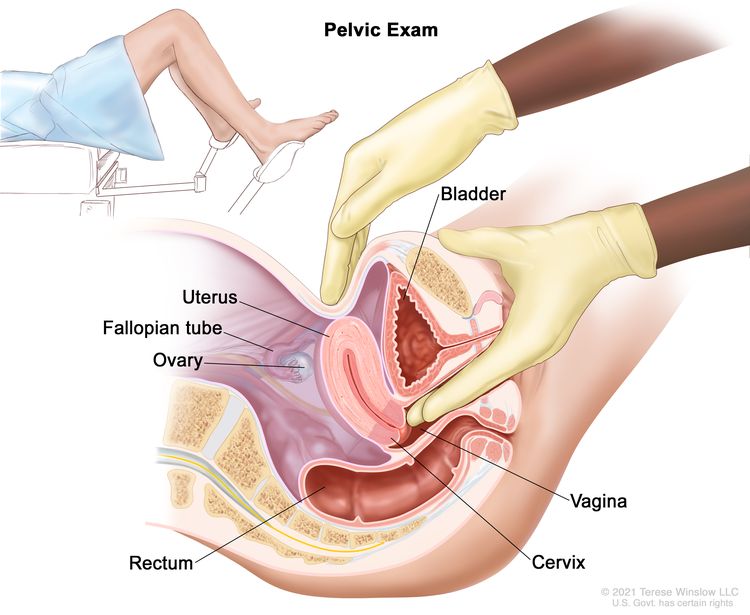
Transvaginal ultrasound
Transvaginal ultrasound (TVU) to screen for ovarian cancer has not been shown to decrease the number of deaths from the disease. TVU is a procedure used to examine the vagina, uterus, fallopian tubes, ovaries, and bladder. An ultrasound transducer (probe) is inserted into the vagina and used to bounce high-energy sound waves off internal tissues or organs in the pelvis. These sound waves make echoes that form a picture of body tissues called a sonogram.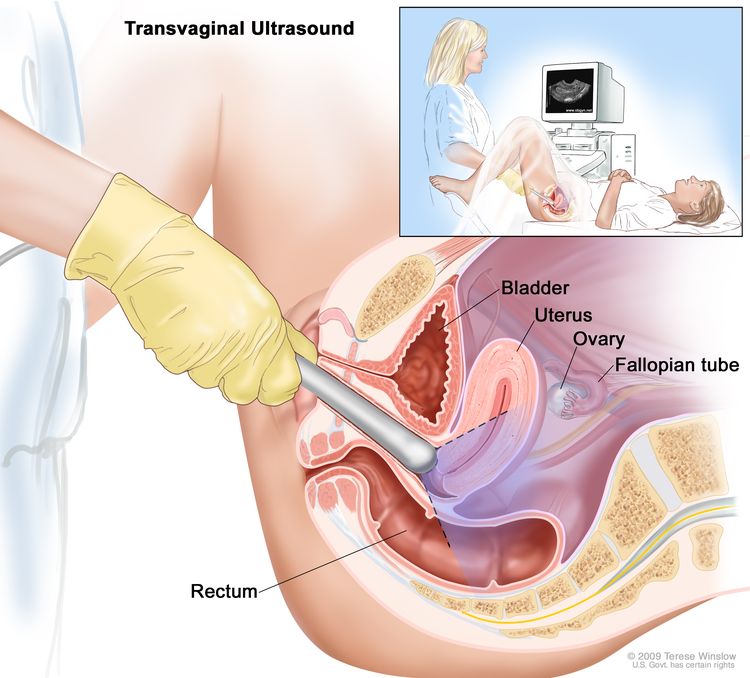
CA-125 blood test
A CA-125 blood test measures the level of CA-125, a substance released by cells into the bloodstream. An increased CA-125 level may be a sign of certain types of cancer, including ovarian cancer, or other conditions.
Studies have also shown that using CA-125 levels and TVU together to screen for ovarian cancer does not decrease the number of deaths from ovarian cancer.
Screening tests for ovarian, fallopian tube, and primary peritoneal cancers are being studied in clinical trials.
Information about clinical trials supported by NCI can be found on NCI’s clinical trials search webpage. Clinical trials supported by other organizations can be found on the ClinicalTrials.gov website.
Risks of Ovarian, Fallopian Tube, and Primary Peritoneal Cancers Screening
Key Points
- Screening tests have risks.
- The risks of ovarian, fallopian tube, and primary peritoneal cancers screening tests include:
- Finding ovarian, fallopian tube, and primary peritoneal cancers may not improve health or help a woman live longer.
- False-negative test results can occur.
- False-positive test results can occur.
Screening tests have risks.
Decisions about screening tests can be difficult. Not all screening tests are helpful, and most have risks. Before having any screening test, you may want to talk about the test with your doctor. It is important to know the risks of the test and whether it has been proven to reduce the risk of dying from cancer.
The risks of ovarian, fallopian tube, and primary peritoneal cancers screening tests include:
Finding ovarian, fallopian tube, and primary peritoneal cancers may not improve health or help a woman live longer.
Screening may not improve your health or help you live longer if you have advanced ovarian cancer or if it has already spread to other places in your body.
False-negative test results can occur.
Screening test results may appear to be normal even though ovarian cancer is present. A woman who receives a false-negative test result (one that shows there is no cancer when there really is) may delay seeking medical care even if there are symptoms.
False-positive test results can occur.
Screening test results may appear to be abnormal even though no cancer is present. A false-positive test result (one that shows there is cancer when there really isn't) can cause anxiety and is usually followed by more tests and procedures (such as a laparoscopy or a laparotomy to see if cancer is present), which also have risks. Problems caused by tests used to diagnose ovarian cancer include infection, blood loss, bowel injury, and heart and blood vessel problems. A false-positive test result can also lead to an unneeded oophorectomy (removal of one or both ovaries).
About This PDQ Summary
About PDQ
Physician Data Query (PDQ) is the National Cancer Institute's (NCI's) comprehensive cancer information database. The PDQ database contains summaries of the latest published information on cancer prevention, detection, genetics, treatment, supportive care, and complementary and alternative medicine. Most summaries come in two versions. The health professional versions have detailed information written in technical language. The patient versions are written in easy-to-understand, nontechnical language. Both versions have cancer information that is accurate and up to date and most versions are also available in Spanish.
PDQ is a service of the NCI. The NCI is part of the National Institutes of Health (NIH). NIH is the federal government’s center of biomedical research. The PDQ summaries are based on an independent review of the medical literature. They are not policy statements of the NCI or the NIH.
Purpose of This Summary
This PDQ cancer information summary has current information about ovarian, fallopian tube, and primary peritoneal cancers screening. It is meant to inform and help patients, families, and caregivers. It does not give formal guidelines or recommendations for making decisions about health care.
Reviewers and Updates
Editorial Boards write the PDQ cancer information summaries and keep them up to date. These Boards are made up of experts in cancer treatment and other specialties related to cancer. The summaries are reviewed regularly and changes are made when there is new information. The date on each summary ("Updated") is the date of the most recent change.
The information in this patient summary was taken from the health professional version, which is reviewed regularly and updated as needed, by the PDQ Screening and Prevention Editorial Board.
Clinical Trial Information
A clinical trial is a study to answer a scientific question, such as whether one treatment is better than another. Trials are based on past studies and what has been learned in the laboratory. Each trial answers certain scientific questions in order to find new and better ways to help cancer patients. During treatment clinical trials, information is collected about the effects of a new treatment and how well it works. If a clinical trial shows that a new treatment is better than one currently being used, the new treatment may become "standard." Patients may want to think about taking part in a clinical trial. Some clinical trials are open only to patients who have not started treatment.
Clinical trials can be found online at NCI's website. For more information, call the Cancer Information Service (CIS), NCI's contact center, at 1-800-4-CANCER (1-800-422-6237).
Permission to Use This Summary
PDQ is a registered trademark. The content of PDQ documents can be used freely as text. It cannot be identified as an NCI PDQ cancer information summary unless the whole summary is shown and it is updated regularly. However, a user would be allowed to write a sentence such as “NCI’s PDQ cancer information summary about breast cancer prevention states the risks in the following way: [include excerpt from the summary].”
The best way to cite this PDQ summary is:
PDQ® Screening and Prevention Editorial Board. PDQ Ovarian, Fallopian Tube, and Primary Peritoneal Cancers Screening. Bethesda, MD: National Cancer Institute. Updated <MM/DD/YYYY>. Available at: https://www.cancer.gov/types/ovarian/patient/ovarian-screening-pdq. Accessed <MM/DD/YYYY>. [PMID: 26389490]
Images in this summary are used with permission of the author(s), artist, and/or publisher for use in the PDQ summaries only. If you want to use an image from a PDQ summary and you are not using the whole summary, you must get permission from the owner. It cannot be given by the National Cancer Institute. Information about using the images in this summary, along with many other images related to cancer can be found in Visuals Online. Visuals Online is a collection of more than 3,000 scientific images.
Disclaimer
The information in these summaries should not be used to make decisions about insurance reimbursement. More information on insurance coverage is available on Cancer.gov on the Managing Cancer Care page.
Contact Us
More information about contacting us or receiving help with the Cancer.gov website can be found on our Contact Us for Help page. Questions can also be submitted to Cancer.gov through the website’s E-mail Us.