
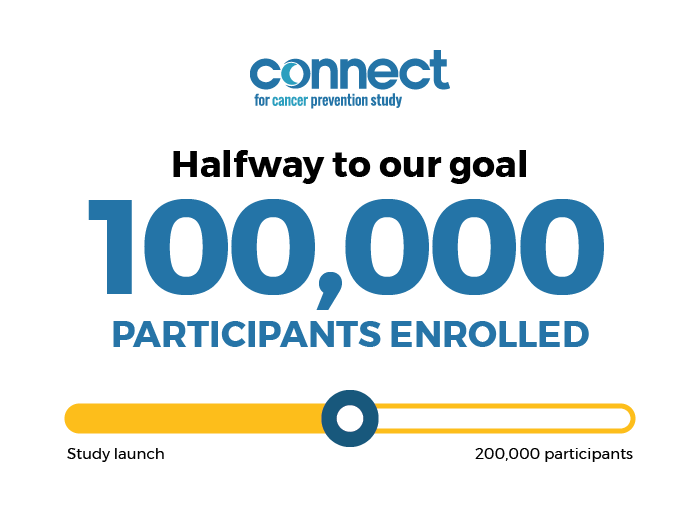
We’re halfway!
We’re excited to announce that as of this summer, we have reached 100,000 Connect participants. This is the halfway mark of recruitment! It also marks an extraordinary achievement for the entire Connect community. Thank you for being here and making this research possible. The future of cancer prevention science is looking brighter because of your commitment to this study. We appreciate you continuing to complete study activities, spreading the word in your community, and taking the time to read these newsletters!
Connect by the Numbers
It’s a perfect time to reflect on the past five years of recruitment. Connect has come a long way since its launch in the summer of 2021. Together, we are a community of participants, health care system staff, and research teams dedicated to changing the future of cancer prevention. Our partnership is what makes this work possible.
We continue to tailor recruitment and outreach strategies to include people from all walks of life; farmers and teachers, Millennials and Gen X, those living in metropolitan areas, others who call the Heartland home, and many more. We strive to include different communities so that Connect can be a resource for all, for generations to come.
At the halfway mark of our 200,000-participant recruitment goal, we want to share more about what the cohort looks like so far — who is here and whom we still need to recruit as part of the next 100,000 participants. Focusing our recruitment efforts will help us achieve a more representative study population and support scientific advancements that serve everyone.
To get a picture of Connect’s participants, we look to answers to the first Connect survey, which asks participants to report their age, sex, and race and ethnicity. Over 83,000 participants answered these demographic questions on the first Connect survey. *
*As of August 3, 2026.
Age
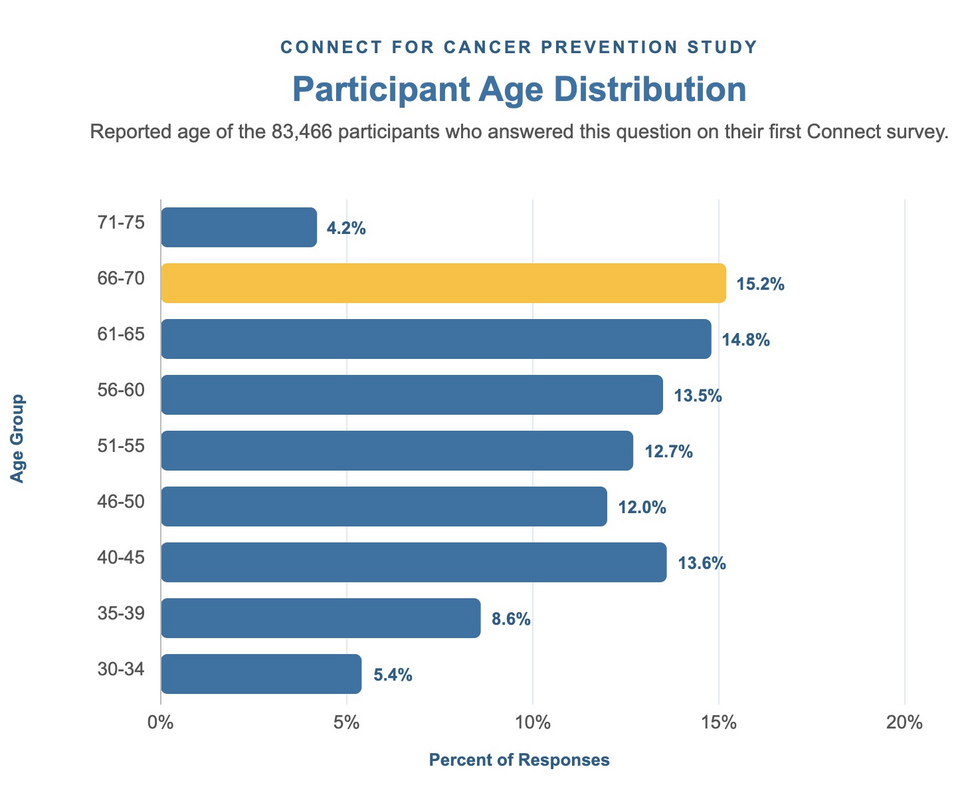
Of the more than 83,000 participants who shared their age on the first Connect survey, 66–70 year-olds represent the largest group in the study (15% of current participants). It’s important to note that Connect began recruiting participants between the ages of 40 and 65 years old when we first launched in summer 2021. In February 2024, Connect expanded the eligible age range and began recruiting participants aged 30-70 years at enrollment. Earlier research found lower study participation and engagement among younger adults compared with middle-aged and older adults. This pattern could be due to different factors, including competing time demands and the perceived relevance of taking part in research studies.1 We hope to recruit more younger participants by lowering barriers to participation and making Connect's research aims more relevant to this group.
Sex
Of the over 83,000 participants who answered this question in their first Connect survey, about 66% of participants are female, and 33% are male. We know that as a team, we need to focus on engaging men in this research study. Check out this newsletter article to learn how we are exploring ways to improve male engagement in research studies like Connect.
Race/Ethnicity
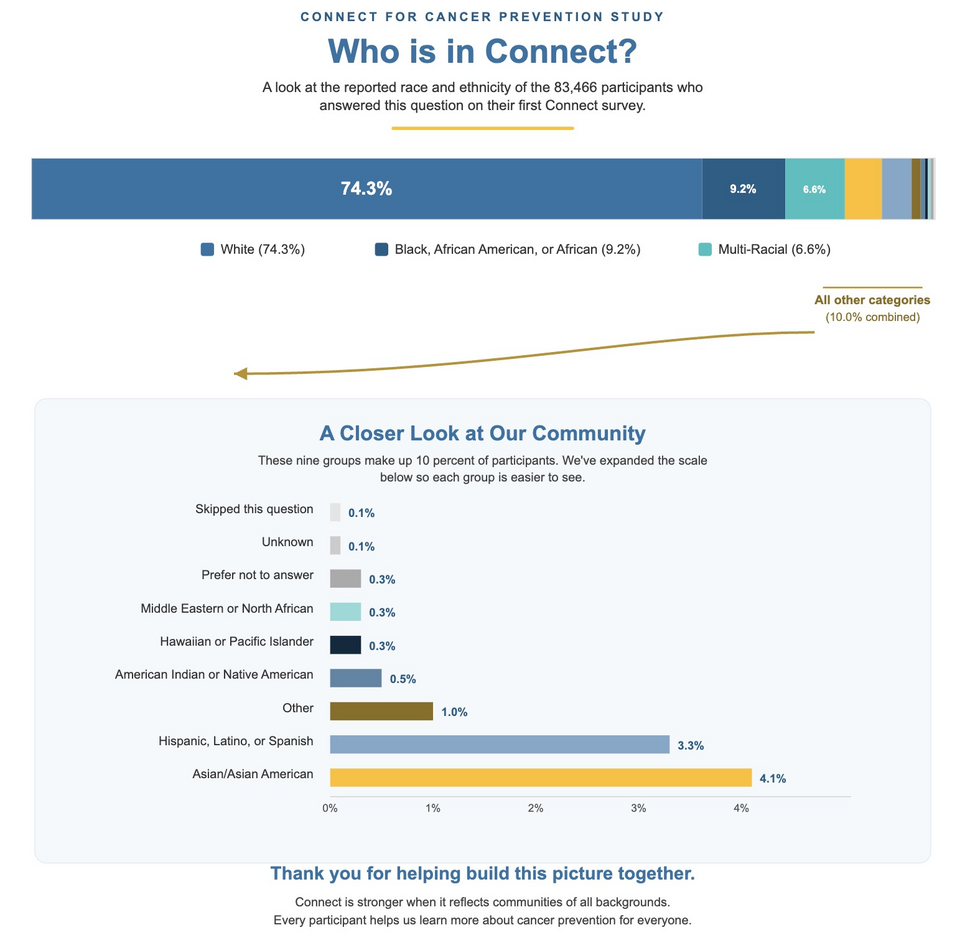
Of the more than 83,000 participants who told us their race and ethnicity in the first Connect survey, the graphic below displays the study population in more detail. We continue to look for opportunities to expand Connect into other communities and increase participation among those less represented in the study so far.
A Brief Report Out: What We Learned from Participants Who Answered the Return of Information Preferences Survey
As Connect researchers, we want a sustained relationship with participants built on trust. That means talking with you openly, being clear about what to expect, and ensuring two-way communication. One way we build trust is by sharing information back with you about the research you help make possible. But first, we want to know: what information would you like to receive?
That's why we created the Return of Information Preferences Survey. In January of this year, we shared this survey with over 75,000 participants.
Why We Asked
Connect is guided by a set of core principles, one of which is listening to participants — gathering your ideas and opinions to help shape how we do our work. We want to know what kind of information you'd like back from the study, so we can factor your preferences into our decisions about returning results. That said, some topics may be of real interest to participants but aren't ones we're able to report back on. We're always working to balance what participants want to know with what we're able to share.
The Return of Information Preferences Survey is a direct example of this guiding principle in action. Its goal was to learn what topics matter most to you: Big picture research findings? Information about your neighborhood? Your personal health risks? We asked because your answers help us decide what we can share back with you.
Who Responded
Of the participants we sent the survey to, about 1 in 3 people responded. We found that the demographics (age, sex, and race) of the participants who answered the survey were overall representative of Connect participants. That means we included voices from many different communities involved in the study, which is our goal!
We sent this survey to participants who had been in the study for at least six months, giving them time to complete their baseline study activities and become more familiar with Connect. If you didn’t get this survey, be assured that there will be more chances in the future to share your ideas with us. Please also remember that you can reach us at the Connect Support Center any time by visiting MyConnect.cancer.gov/support.
What We Asked
The Connect team and Participant Advisory Board members selected the survey topics to include a broad range of areas under study in cancer research. We asked respondents how interested they were in receiving different types of research results and study information. Information we return to participants might come as research findings and continuing education about science (e.g., through study newsletters), or as individual results available through personal reports in MyConnect.
We also asked about interest in newer exposures, such as vaping and tattoos, that are becoming more common but whose long-term effects on cancer and chronic disease risk aren'tyet fully understood. Other topics included genetic traits unrelated to health, such as whether your genes affect your sensitivity to bitter tastes (like black coffee or bitter greens), and environmental risk factors in your neighborhood.
Survey Says!
Among nearly 24,000 Connect respondents, 79% were interested in environmental risk factors in their neighborhood. This was the most popular topic among participants who answered the survey. Risk factors may include traffic-related air pollution and water quality. Connect is able get this information by linking residential zip codes to national databases such as the Environmental Protection Agency, which monitors various environmental pollutants that affect human and environmental health.
Multi-cancer early detection tests were the next most important topic to participants, with 75% of respondents saying they were interested in learning more about these tests. Multi-cancer early detection (MCED) tests, sometimes called “liquid biopsy,” are being designed to find cancer from a single blood sample. Although some tests are currently on the market, scientists are actively studying how well they work and how they could impact a person’s health care. At this time, Connect has not started running these tests because promising tests are still being developed. In the meantime, Connect can share educational information on the state of the science for MCED tests and what we aim to achieve in this study.
Overall, 68% of participants who answered the survey were interested in getting a report on simple genetic traits. At the NCI lab, your sample is being processed to extract DNA. The DNA is then run through a process called genotyping, which evaluates the tiny proportion of DNA that is different between people. The process reads the DNA bases, or “letters,” to look for the differences between people. Through this process, we are able to share back some information about your genetics that is not related to health but may be interesting to learn. For example, whether your genetics predict how cilantro tastes to you.
What Happens Next
Here's where things stand: We’re bringing participants’ top choices back to the Connect team to plan what to share with you next. In future newsletters, we look forward to giving you updates on what information we plan to return.
Returning information is not just a core principle, but key to you participants stay engaged in Connect over time. More engagement leads to higher study activity completion, which is necessary to ensure that we make Connect the most valuable scientific resource it can be. Consistent, long-term data from participants sets us up to conduct research for future discoveries in cancer prevention.
Your voice matters. The feedback we get from participants helps us build a research study that gives back to the people who make the work possible. Thank you!
1-Sigurðardóttir K, Friðriksdóttir N, Kristinsdóttir NM, Kristjánsdóttir L, Skúlason HG, Haraldsdóttir Á, Alfonsdóttir SÁ, Jóhannesdóttir AKB, Birgisson H, Tryggvadóttir H, et al. Recruitment Strategies, Response Rates, and Non-Response Patterns in a Nationwide Registry-Based PRO Survey of Cancer Survivors and the General Population: The SURV-ICE Cohort. Cancers. 2026; 18(10):1516. https://doi.org/10.3390/cancers18101516
As always, please reach out to us at the Connect Support Center if you’d like to share any ideas or suggestions for what we should share with you and how we can continue to improve the study experience for all participants.

Mia Gaudet, Ph.D.
Connect Senior Scientist
Division of Cancer Epidemiology and Genetics
National Cancer Institute