
Tests being studied to detect endometrial cancer
There is no standard or routine screening test for endometrial cancer. The following tests to detect (find) endometrial cancer are being studied:
Pap test
A Pap test is a procedure to collect cells from the surface of the cervix and vagina. A piece of cotton, a brush, or a small wooden stick is used to gently scrape cells from the cervix and vagina. The cells are viewed under a microscope to find out if they are abnormal. This procedure is also called a Pap smear.
Pap tests are not used to screen for endometrial cancer; however, Pap test results sometimes show signs of an abnormal endometrium (lining of the uterus). Follow-up tests may detect endometrial cancer.
Transvaginal ultrasound
No studies have shown that screening by transvaginal ultrasound (TVU) lowers the number of deaths caused by endometrial cancer.
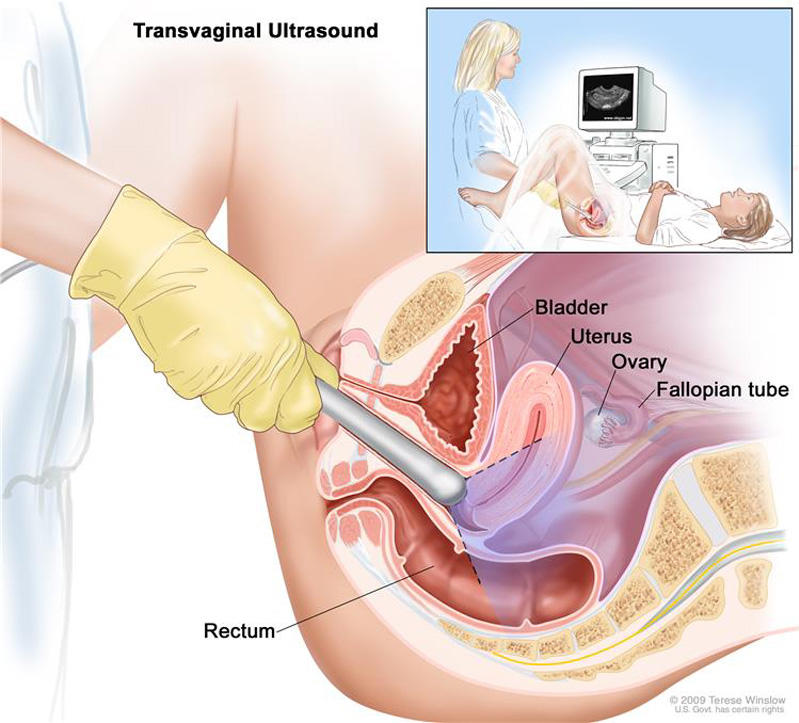
Women experiencing abnormal vaginal bleeding may undergo a transvaginal ultrasound, biopsy, or both, to determine if an endometrial tumor is the cause.
Credit: © Terese Winslow
Transvaginal ultrasound (TVU) is a procedure used to examine the vagina, uterus, fallopian tubes, and bladder. It is also called endovaginal ultrasound. An ultrasound transducer (probe) is inserted into the vagina and used to bounce high-energy sound waves (ultrasound) off internal tissues or organs and make echoes. The echoes form a picture of body tissues called a sonogram. The doctor can identify tumors by looking at the sonogram.
TVU is commonly used to examine women who have abnormal vaginal bleeding. For women who have or are at risk for hereditary nonpolyposis colon cancer, experts suggest yearly screening with transvaginal ultrasound, beginning as early as age 25.
The use of tamoxifen to treat or prevent breast cancer increases the risk of endometrial cancer. TVU is not useful in screening for endometrial cancer in women who take tamoxifen but do not have any symptoms of endometrial cancer. In women taking tamoxifen, TVU should be used in those who have vaginal bleeding.
Endometrial sampling
It has not been proven that screening by endometrial sampling (biopsy) lowers the number of deaths caused by endometrial cancer.
Endometrial sampling is the removal of tissue from the endometrium by inserting a brush, curette, or thin, flexible tube through the cervix and into the uterus. The tool is used to gently scrape a small amount of tissue from the endometrium and then remove the tissue samples. A pathologist views the tissue under a microscope to look for cancer cells. Endometrial sampling is commonly used to examine women who have abnormal vaginal bleeding. If you have abnormal vaginal bleeding, check with your doctor.
Clinical trials for endometrial cancer screening
Screening tests for endometrial cancer are being studied in clinical trials. Learn more about clinical trials, including how to find and join one, at Cancer Clinical Trial Information for Patients and Caregivers.
Risks of endometrial cancer screening
Decisions about screening tests can be difficult. Not all screening tests are helpful and most have risks. Before having any screening test, you may want to discuss the test with your doctor. It is important to know the risks of the test and whether it has been proven to reduce the risk of dying from cancer.
Finding endometrial cancer may not improve health or help a woman live longer.
Screening may not improve your health or help you live longer if you have advanced endometrial cancer or if it has already spread to other places in your body.
Some cancers never cause symptoms or become life-threatening, but if found by a screening test, the cancer may be treated. It is not known if treatment of these cancers would help you live longer than if no treatment were given, and treatments for cancer may have serious side effects.
The risks of endometrial cancer screening tests include:
False-negative test results can occur
Screening test results may appear to be normal even though endometrial cancer is present. A woman who receives a false-negative test result (one that shows there is no cancer when there really is) may delay seeking medical care even if she has symptoms.
False-positive test results can occur
Screening test results may appear to be abnormal even though no cancer is present. A false-positive test result (one that shows there is cancer when there really isn't) can cause anxiety and is usually followed by more tests (such as biopsy), which also have risks.
Side effects of tests used to screen for endometrial cancer