Different types of treatment are available for cervical cancer. You and your cancer care team will work together to decide your treatment plan, which may include more than one type of treatment. Many factors will be considered, such as the stage of the cancer, your overall health, and your preferences. Your treatment plan will include information about your cancer, the goals of treatment, the treatment options and possible side effects, and the expected length of treatment.
If you are concerned about whether treatment will affect your fertility, talk with your cancer care team before treatment begins about what to expect. To learn about fertility preservation options and ways to find support, visit Fertility Issues in Girls and Women with Cancer.
Surgery (also called an operation) is sometimes used to treat cervical cancer. The type of surgery depends on where the cancer is located. Learn more about Surgery to Treat Cancer.
The following surgical procedures may be used:
Cold knife conization
Cold knife conization uses a scalpel to remove a cone-shaped piece of tissue from the cervix and cervical canal. Sometimes all the cancer can be removed during this procedure. Cold knife conization is done in the hospital under general anesthesia.
Sentinel lymph node biopsy removes the sentinel lymph node during surgery. The sentinel lymph node is the first lymph node in a group of lymph nodes to receive lymphatic drainage from the primary tumor. It is therefore the first lymph node the cancer is likely to spread to from the primary tumor. To identify the sentinel lymph node, a radioactive substance and/or blue dye is injected near the tumor. The substance or dye flows through the lymph ducts to the lymph nodes. The first lymph node to receive the substance or dye is removed. A pathologist views the tissue under a microscope to look for cancer cells. If cancer cells are found, more lymph nodes will be removed through a separate incision (cut). This is called a lymph node dissection. After the sentinel lymph node biopsy, the surgeon removes the cancer.
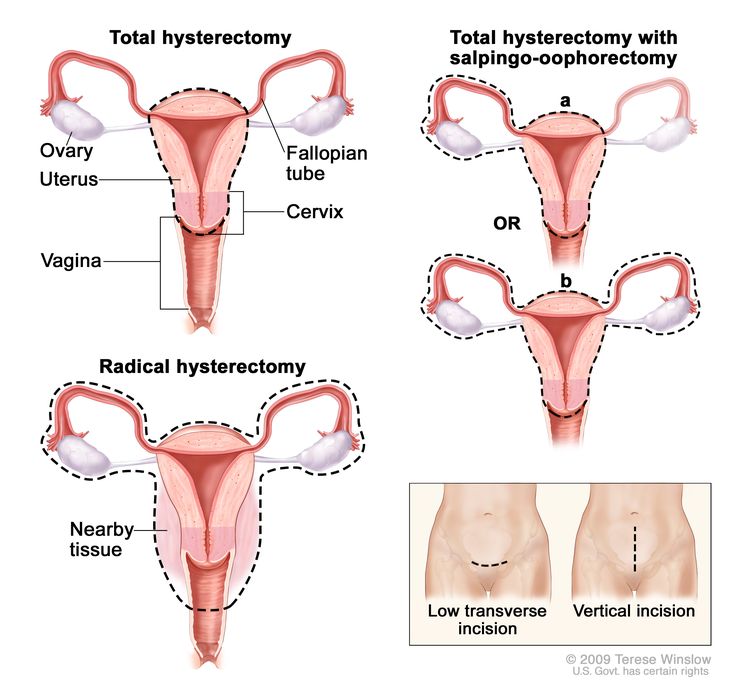
A hysterectomy is surgery to remove the uterus. As a treatment for cervical cancer, the cervix, and sometimes the surrounding structures, are removed. Several types of hysterectomy may be used to treat cervical cancer:
Total hysterectomy removes the uterus and the cervix. When the surgery is done entirely through the vagina (with no incisions on the abdomen) and the uterus and cervix are removed through the vagina, the operation is called a total vaginal hysterectomy. If the surgery is done through a large incision on the abdomen (either vertical or horizontal) and the uterus and cervix are removed through this incision, the operation is called a total abdominal hysterectomy. If the surgery is done through small incisions on the abdomen, the operation is called a total laparoscopic hysterectomy. The uterus and cervix are usually taken out through the vagina, although sometimes an abdominal incision is made to remove the uterus and cervix.EnlargeHysterectomy. The uterus is surgically removed with or without other organs or tissues. In a total hysterectomy, the uterus and cervix are removed. In a total hysterectomy with salpingo-oophorectomy, (a) the uterus plus one (unilateral) ovary and fallopian tube are removed; or (b) the uterus plus both (bilateral) ovaries and fallopian tubes are removed. In a radical hysterectomy, the uterus, cervix, both ovaries, both fallopian tubes, and nearby tissue are removed. These procedures are done using a low transverse incision or a vertical incision.
Radical hysterectomy removes the uterus, cervix, part of the vagina, and a wide area of ligaments and tissues around these organs. The ovaries, fallopian tubes, or nearby lymph nodes may also be removed.
Modified radical hysterectomy removes the uterus, cervix, upper part of the vagina, and ligaments and tissues that closely surround these organs. This type of surgery removes fewer tissues and/or organs than radical hysterectomy. The ovaries, fallopian tubes, or nearby lymph nodes may also be removed.
Radical trachelectomy
Radical trachelectomy (also called radical cervicectomy) removes the cervix, nearby tissue, and the upper part of the vagina. Lymph nodes may also be removed. After the surgeon removes the cervix, they attach the uterus to the remaining part of the vagina. A special stitch or band is placed on the uterus (in a procedure called a cerclage) to help keep the uterus closed during pregnancy. If you have this surgery, you may still be able to become pregnant.
Bilateral salpingo-oophorectomy
Bilateral salpingo-oophorectomy removes both ovaries and both fallopian tubes. This is done when the cancer has spread to these organs.
Total pelvic exenteration
Total pelvic exenteration removes the lower colon, rectum, and bladder. The cervix, vagina, ovaries, and nearby lymph nodes are also removed. Artificial openings (stoma) are made for urine and stool to flow from the body to a collection bag. Plastic surgery may be needed to make an artificial vagina after this operation.
Radiation therapy
Radiation therapy uses high-energy x-rays or other types of radiation to kill cancer cells or keep them from growing by damaging their DNA. The two main types of radiation therapy are external radiation therapy and internal radiation therapy (also called brachytherapy).
Both external and internal radiation therapy are used to treat cervical cancer and may also be used as palliative therapy to relieve symptoms and improve quality of life in people with advanced cervical cancer.
External radiation therapy
External beam radiation therapy uses a machine outside the body to send radiation toward the area of the body with cancer. Intensity-modulated radiation therapy (IMRT) is a way of giving external radiation therapy that can help keep radiation from damaging nearby healthy tissue.
IMRT is a type of 3-dimensional (3-D) radiation therapy that uses a computer to make pictures of the size and shape of the tumor. Thin beams of radiation of different intensities (strengths) are aimed directly at the tumor from many angles. IMRT is being studied for the treatment of cervical cancer.
Internal radiation therapy uses a radioactive substance sealed in needles, seeds, wires, or catheters that are placed directly into or near the cancer. Internal radiation therapy is also called brachytherapy.
Chemotherapy (also called chemo) uses drugs to stop the growth of cancer cells, either by killing the cells or by stopping them from dividing. Chemotherapy may be given alone or with other types of treatment.
Chemotherapy drugs used to treat cervical cancer include:
Combinations of these drugs may be used. Other chemotherapy drugs not listed here may also be used.
Learn more about how chemotherapy works against cancer, how it is given, common side effects, and more in Chemotherapy to Treat Cancer.
Targeted therapy
Targeted therapy uses drugs or other substances to block the action of specific enzymes, proteins, or other molecules involved in the growth and spread of cancer cells.
Targeted therapies used to treat cervical cancer include:
Pembrolizumab is an immunotherapy drug used to treat certain patients whose cervical cancer has the biomarker PD-L1.
Learn more about how immunotherapy works against cancer, how it is given, possible side effects, and more in Immunotherapy to Treat Cancer.
Clinical trials
For some people, joining a clinical trial may be an option. There are different types of clinical trials for people with cancer. For example, a treatment trial tests new treatments or new ways of using current treatments. Supportive care and palliative care trials look at ways to improve quality of life, especially for those who have side effects from cancer and its treatment.
You can use the clinical trial search to find NCI-supported cancer clinical trials accepting participants. The search allows you to filter trials based on the type of cancer, your age, and where the trials are being done. Clinical trials supported by other organizations can be found on the ClinicalTrials.gov website.
As you go through treatment, you will have follow-up tests or checkups. Some of the tests that were done to diagnose cervical cancer or to find out the stage of the cancer may be repeated to see how well the treatment is working. Decisions about whether to continue, change, or stop treatment may be based on the results of these tests.
Some of the tests will continue to be done from time to time after treatment has ended. The results of these tests can show if your condition has changed or if the cancer has recurred (come back).
Tell your doctor if you have any of the following signs or symptoms, which may mean the cancer has come back:
vaginal bleeding or discharge
pain in the abdomen, back, or leg
swelling in the leg
trouble urinating
change in your bowel movements
cough
feeling tired
For cervical cancer, follow-up tests are usually done every 3 to 4 months for the first 2 years, followed by checkups every 6 months. The checkup includes a current health history and exam of the body to check for signs and symptoms of recurrent cervical cancer and for late effects of treatment. A Pap test may or may not be done during your visits.