National Cancer Institute National Cancer Institute
U.S. National Institutes of Health National Cancer Institute
Send to Printer
Cervical Cancer Treatment (PDQ®)     
Last Modified: 09/20/2007
Patient Version
Table of Contents

General Information About Cervical Cancer
Stages of Cervical Cancer
Recurrent Cervical Cancer
Treatment Option Overview
Treatment Options by Stage
Stage 0 (Carcinoma in Situ)
Stage IA Cervical Cancer
Stage IB Cervical Cancer
Stage IIA Cervical Cancer
Stage IIB Cervical Cancer
Stage III Cervical Cancer
Stage IVA Cervical Cancer
Stage IVB Cervical Cancer
Treatment Options for Recurrent Cervical Cancer
Get More Information From NCI
Changes to This Summary (09/20/2007)
About PDQ

General Information About Cervical Cancer

Key Points for This Section


Cervical cancer is a disease in which malignant (cancer) cells form in the tissues of the cervix.

The cervix is the lower, narrow end of the uterus (the hollow, pear-shaped organ where a fetus grows). The cervix leads from the uterus to the vagina (birth canal).

Cervical cancer usually develops slowly over time. Before cancer appears in the cervix, the cells of the cervix go through changes known as dysplasia, in which cells that are not normal begin to appear in the cervical tissue. Later, cancer cells start to grow and spread more deeply into the cervix and to surrounding areas.

Cervical cancer in children is rare. For more information, see the PDQ summary on Unusual Cancers of Childhood 1.

Human papillomavirus (HPV) infection is the major risk factor for development of cervical cancer.

Infection of the cervix with human papillomavirus (HPV) is the most common cause of cervical cancer. Not all women with HPV infection, however, will develop cervical cancer. Women who do not regularly have a Pap smear to detect HPV or abnormal cells in the cervix are at increased risk of cervical cancer.

Other possible risk factors include the following:

  • Giving birth to many children.
  • Having many sexual partners.
  • Having first sexual intercourse at a young age.
  • Smoking cigarettes.
  • Oral contraceptive use ("the Pill").
  • Weakened immune system.

There are usually no noticeable signs of early cervical cancer but it can be detected early with yearly check-ups.

Early cervical cancer may not cause noticeable signs or symptoms. Women should have yearly check-ups, including a Pap smear to check for abnormal cells in the cervix. The prognosis (chance of recovery) is better when the cancer is found early.

Possible signs of cervical cancer include vaginal bleeding and pelvic pain.

These and other symptoms may be caused by cervical cancer. Other conditions may cause the same symptoms. A doctor should be consulted if any of the following problems occur:

  • Vaginal bleeding.
  • Unusual vaginal discharge.
  • Pelvic pain.
  • Pain during sexual intercourse.

Tests that examine the cervix are used to detect (find) and diagnose cervical cancer.

The following procedures may be used:

  • Pap smear: A procedure to collect cells from the surface of the cervix and vagina. A piece of cotton, a brush, or a small wooden stick is used to gently scrape cells from the cervix and vagina. The cells are viewed under a microscope to find out if they are abnormal. This procedure is also called a Pap test.
  • Colposcopy: A procedure in which a colposcope (a lighted, magnifying instrument) is used to check the vagina and cervix for abnormal areas. Tissue samples may be taken using a curette (spoon-shaped instrument) and checked under a microscope for signs of disease.
  • Biopsy: If abnormal cells are found in a Pap smear, the doctor may do a biopsy. A sample of tissue is cut from the cervix and viewed under a microscope by a pathologist to check for signs of cancer. A biopsy that removes only a small amount of tissue is usually done in the doctor’s office. A woman may need to go to a hospital for a cervical cone biopsy (removal of a larger, cone-shaped sample of cervical tissue).
  • Pelvic exam: An exam of the vagina, cervix, uterus, fallopian tubes, ovaries, and rectum. The doctor or nurse inserts one or two lubricated, gloved fingers of one hand into the vagina and places the other hand over the lower abdomen to feel the size, shape, and position of the uterus and ovaries. A speculum is also inserted into the vagina and the doctor or nurse looks at the vagina and cervix for signs of disease. A Pap test of the cervix is usually done. The doctor or nurse also inserts a lubricated, gloved finger into the rectum to feel for lumps or abnormal areas.
  • Endocervical curettage: A procedure to collect cells or tissue from the cervical canal using a curette (spoon-shaped instrument). Tissue samples may be taken and checked under a microscope for signs of cancer. This procedure is sometimes done at the same time as a colposcopy.

Certain factors affect prognosis (chance of recovery) and treatment options.

The prognosis (chance of recovery) depends on the following:

  • The stage of the cancer (whether it affects part of the cervix, involves the whole cervix, or has spread to the lymph nodes or other places in the body).
  • The type of cervical cancer.
  • The size of the tumor.

Treatment options depend on the following:

  • The stage of the cancer.
  • The size of the tumor.
  • The patient's desire to have children.
  • The patient’s age.

Treatment of cervical cancer during pregnancy depends on the stage of the cancer and the stage of the pregnancy. For cervical cancer found early or for cancer found during the last trimester of pregnancy, treatment may be delayed until after the baby is born.

Stages of Cervical Cancer

Key Points for This Section


After cervical cancer has been diagnosed, tests are done to find out if cancer cells have spread within the cervix or to other parts of the body.

The process used to find out if cancer has spread within the cervix or to other parts of the body is called staging. The information gathered from the staging process determines the stage of the disease. It is important to know the stage in order to plan treatment. The following tests and procedures may be used in the staging process:

  • Chest x-ray: An x-ray of the organs and bones inside the chest. An x-ray is a type of energy beam that can go through the body and onto film, making a picture of areas inside the body.
  • CT scan (CAT scan): A procedure that makes a series of detailed pictures of areas inside the body, taken from different angles. The pictures are made by a computer linked to an x-ray machine. A dye may be injected into a vein or swallowed to help the organs or tissues show up more clearly. This procedure is also called computed tomography, computerized tomography, or computerized axial tomography.
  • Lymphangiogram: A procedure used to x-ray the lymph system. A dye is injected into the lymph vessels in the feet. The dye travels upward through the lymph nodes and lymph vessels, and x-rays are taken to see if there are any blockages. This test helps find out whether cancer has spread to the lymph nodes.
  • Pretreatment surgical staging: Surgery (an operation) is done to find out if the cancer has spread within the cervix or to other parts of the body. In some cases, the cervical cancer can be removed at the same time. Pretreatment surgical staging is usually done only as part of a clinical trial.
  • Ultrasound exam: A procedure in which high-energy sound waves (ultrasound) are bounced off internal tissues or organs and make echoes. The echoes form a picture of body tissues called a sonogram.
  • MRI (magnetic resonance imaging): A procedure that uses a magnet, radio waves, and a computer to make a series of detailed pictures of areas inside the body. This procedure is also called nuclear magnetic resonance imaging (NMRI).

The results of these tests are viewed together with the results of the original tumor biopsy to determine the cervical cancer stage.

The following stages are used for cervical cancer:

Stage 0 (Carcinoma in Situ)

In stage 0, abnormal cells are found in the innermost lining of the cervix. These abnormal cells may become cancer and spread into nearby normal tissue. Stage 0 is also called carcinoma in situ.

Stage I

In stage I, cancer has formed and is found in the cervix only. Stage I is divided into stages IA and IB, based on the amount of cancer that is found.

  • Stage IA: A very small amount of cancer that can only be seen with a microscope is found in the tissues of the cervix. Stage IA is divided into stages IA1 and IA2, based on the size of the tumor.
  • Stage IB: In stage IB, cancer can only be seen with a microscope and is more than 5 millimeters deep or more than 7 millimeters wide, or can be seen without a microscope. Cancer that can be seen without a microscope is divided into stages IB1 and IB2, based on the size of the tumor.

Stage II

In stage II, cancer has spread beyond the cervix but not to the pelvic wall (the tissues that line the part of the body between the hips) or to the lower third of the vagina. Stage II is divided into stages IIA and IIB, based on how far the cancer has spread.

Stage III

In stage III, cancer has spread to the lower third of the vagina, may have spread to the pelvic wall, and/or has caused the kidney to stop working. Stage III is divided into stages IIIA and IIIB, based on how far the cancer has spread.

Stage IV

In stage IV, cancer has spread to the bladder, rectum, or other parts of the body. Stage IV is divided into stages IVA and IVB, based on where the cancer is found.

Recurrent Cervical Cancer

Recurrent cervical cancer is cancer that has recurred (come back) after it has been treated. The cancer may come back in the cervix or in other parts of the body.

Treatment Option Overview

Key Points for This Section


There are different types of treatment for patients with cervical cancer.

Different types of treatment are available for patients with cervical cancer. Some treatments are standard (the currently used treatment), and some are being tested in clinical trials. Before starting treatment, patients may want to think about taking part in a clinical trial. A treatment clinical trial is a research study meant to help improve current treatments or obtain information on new treatments for patients with cancer. When clinical trials show that a new treatment is better than the standard treatment, the new treatment may become the standard treatment.

Clinical trials are taking place in many parts of the country. Information about ongoing clinical trials is available from the NCI Web site 2. Choosing the most appropriate cancer treatment is a decision that ideally involves the patient, family, and health care team.

Three types of standard treatment are used:

Surgery

Surgery (removing the cancer in an operation) is sometimes used to treat cervical cancer. The following surgical procedures may be used:

  • Conization: A procedure to remove a cone-shaped piece of tissue from the cervix and cervical canal. A pathologist views the tissue under a microscope to look for cancer cells. Conization may be used to diagnose or treat a cervical condition. This procedure is also called a cone biopsy.
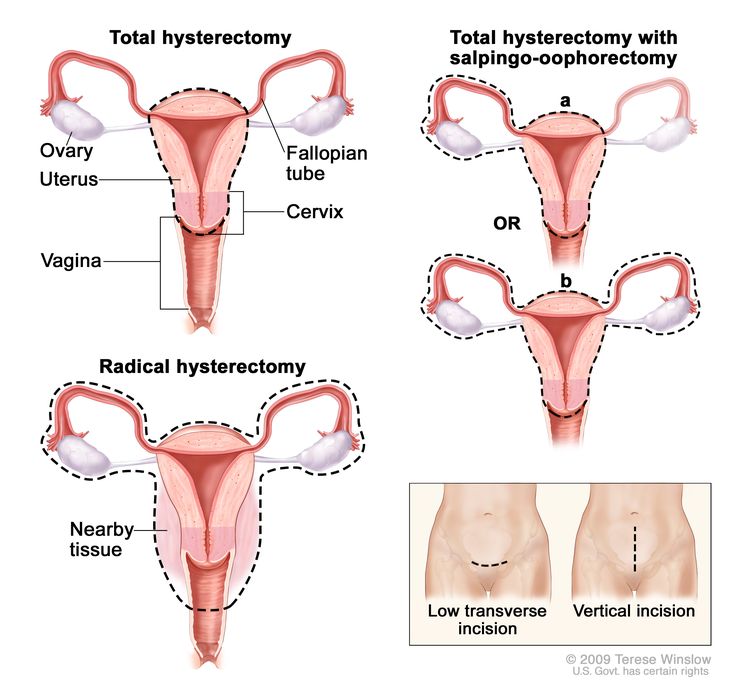
  • Total hysterectomy: Surgery to remove the uterus, including the cervix. If the uterus and cervix are taken out through the vagina, the operation is called a vaginal hysterectomy. If the uterus and cervix are taken out through a large incision (cut) in the abdomen, the operation is called a total abdominal hysterectomy. If the uterus and cervix are taken out through a small incision in the abdomen using a laparoscope, the operation is called a total laparoscopic hysterectomy.
  • Bilateral salpingo-oophorectomy: Surgery to remove both ovaries and both fallopian tubes.
  • Radical hysterectomy: Surgery to remove the uterus, cervix, and part of the vagina. The ovaries, fallopian tubes, or nearby lymph nodes may also be removed.
  • Pelvic exenteration: Surgery to remove the lower colon, rectum, and bladder. In women, the cervix, vagina, ovaries, and nearby lymph nodes are also removed. Artificial openings (stoma) are made for urine and stool to flow from the body to a collection bag. Plastic surgery may be needed to make an artificial vagina after this operation.
  • Cryosurgery: A treatment that uses an instrument to freeze and destroy abnormal tissue, such as carcinoma in situ. This type of treatment is also called cryotherapy.
  • Laser surgery: A surgical procedure that uses a laser beam (a narrow beam of intense light) as a knife to make bloodless cuts in tissue or to remove a surface lesion such as a tumor.
  • Loop electrosurgical excision procedure (LEEP): A treatment that uses electrical current passed through a thin wire loop as a knife to remove abnormal tissue or cancer.

Radiation therapy

Radiation therapy is a cancer treatment that uses high-energy x-rays or other types of radiation to kill cancer cells or keep them from growing. There are two types of radiation therapy. External radiation therapy uses a machine outside the body to send radiation toward the cancer. Internal radiation therapy uses a radioactive substance sealed in needles, seeds, wires, or catheters that are placed directly into or near the cancer. The way the radiation therapy is given depends on the type and stage of the cancer being treated.

Chemotherapy

Chemotherapy is a cancer treatment that uses drugs to stop the growth of cancer cells, either by killing the cells or by stopping them from dividing. When chemotherapy is taken by mouth or injected into a vein or muscle, the drugs enter the bloodstream and can reach cancer cells throughout the body (systemic chemotherapy). When chemotherapy is placed directly into the spinal column, an organ, or a body cavity such as the abdomen, the drugs mainly affect cancer cells in those areas (regional chemotherapy). The way the chemotherapy is given depends on the type and stage of the cancer being treated.

New types of treatment are being tested in clinical trials.

Information about ongoing clinical trials is available from the NCI Web site 2.

Treatment Options by Stage


Stage 0 (Carcinoma in Situ)

Treatment of stage 0 may include the following:

Check for clinical trials from NCI's PDQ Cancer Clinical Trials Registry that are now accepting patients with stage 0 cervical cancer 3.

Stage IA Cervical Cancer

Treatment of stage IA cervical cancer may include the following:

Check for clinical trials from NCI's PDQ Cancer Clinical Trials Registry that are now accepting patients with stage IA cervical cancer 4.

Stage IB Cervical Cancer

Treatment of stage IB cervical cancer may include the following:

This summary section refers to specific treatments under study in clinical trials, but it may not mention every new treatment being studied. Information about ongoing clinical trials is available from the NCI Web site 2.

Check for clinical trials from NCI's PDQ Cancer Clinical Trials Registry that are now accepting patients with stage IB cervical cancer 5.

Stage IIA Cervical Cancer

Treatment of stage IIA cervical cancer may include the following:

This summary section refers to specific treatments under study in clinical trials, but it may not mention every new treatment being studied. Information about ongoing clinical trials is available from the NCI Web site 2.

Check for clinical trials from NCI's PDQ Cancer Clinical Trials Registry that are now accepting patients with stage IIA cervical cancer 6.

Stage IIB Cervical Cancer

Treatment of stage IIB cervical cancer may include internal and external radiation therapy combined with chemotherapy.

Check for clinical trials from NCI's PDQ Cancer Clinical Trials Registry that are now accepting patients with stage IIB cervical cancer 7.

Stage III Cervical Cancer

Treatment of stage III cervical cancer may include internal and external radiation therapy combined with chemotherapy.

Check for clinical trials from NCI's PDQ Cancer Clinical Trials Registry that are now accepting patients with stage III cervical cancer 8.

Stage IVA Cervical Cancer

Treatment of stage IVA cervical cancer may include internal and external radiation therapy combined with chemotherapy.

Check for clinical trials from NCI's PDQ Cancer Clinical Trials Registry that are now accepting patients with stage IVA cervical cancer 9.

Stage IVB Cervical Cancer

Treatment of stage IVB cervical cancer may include the following:

This summary section refers to specific treatments under study in clinical trials, but it may not mention every new treatment being studied. Information about ongoing clinical trials is available from the NCI Web site 2.

Check for clinical trials from NCI's PDQ Cancer Clinical Trials Registry that are now accepting patients with stage IVB cervical cancer 10.

Treatment Options for Recurrent Cervical Cancer

Treatment of recurrent cervical cancer may include the following:

This summary section refers to specific treatments under study in clinical trials, but it may not mention every new treatment being studied. Information about ongoing clinical trials is available from the NCI Web site 2.

Check for clinical trials from NCI's PDQ Cancer Clinical Trials Registry that are now accepting patients with recurrent cervical cancer 11.

Get More Information From NCI

Call 1-800-4-CANCER

For more information, U.S. residents may call the National Cancer Institute's (NCI's) Cancer Information Service toll-free at 1-800-4-CANCER (1-800-422-6237) Monday through Friday from 9:00 a.m. to 4:30 p.m. Deaf and hard-of-hearing callers with TTY equipment may call 1-800-332-8615. The call is free and a trained Cancer Information Specialist is available to answer your questions.

Chat online

The NCI's LiveHelp® 12 online chat service provides Internet users with the ability to chat online with an Information Specialist. The service is available from 9:00 a.m. to 11:00 p.m. Eastern time, Monday through Friday. Information Specialists can help Internet users find information on NCI Web sites and answer questions about cancer.

Write to us

For more information from the NCI, please write to this address:

NCI Public Inquiries Office
Suite 3036A
6116 Executive Boulevard, MSC8322
Bethesda, MD 20892-8322

Search the NCI Web site

The NCI Web site 13 provides online access to information on cancer, clinical trials, and other Web sites and organizations that offer support and resources for cancer patients and their families. For a quick search, use our “Best Bets” search box in the upper right hand corner of each Web page. The results that are most closely related to your search term will be listed as Best Bets at the top of the list of search results.

There are also many other places to get materials and information about cancer treatment and services. Hospitals in your area may have information about local and regional agencies that have information on finances, getting to and from treatment, receiving care at home, and dealing with problems related to cancer treatment.

Find Publications

The NCI has booklets and other materials for patients, health professionals, and the public. These publications discuss types of cancer, methods of cancer treatment, coping with cancer, and clinical trials. Some publications provide information on tests for cancer, cancer causes and prevention, cancer statistics, and NCI research activities. NCI materials on these and other topics may be ordered online or printed directly from the NCI Publications Locator 14. These materials can also be ordered by telephone from the Cancer Information Service toll-free at 1-800-4-CANCER (1-800-422-6237), TTY at 1-800-332-8615.

Changes to This Summary (09/20/2007)

The PDQ cancer information summaries are reviewed regularly and updated as new information becomes available. This section describes the latest changes made to this summary as of the date above.

Editorial changes were made to this summary.

About PDQ

PDQ is a comprehensive cancer database available on NCI's Web site.

PDQ is the National Cancer Institute's (NCI's) comprehensive cancer information database. Most of the information contained in PDQ is available online at NCI's Web site 13. PDQ is provided as a service of the NCI. The NCI is part of the National Institutes of Health, the federal government's focal point for biomedical research.

PDQ contains cancer information summaries.

The PDQ database contains summaries of the latest published information on cancer prevention, detection, genetics, treatment, supportive care, and complementary and alternative medicine. Most summaries are available in two versions. The health professional versions provide detailed information written in technical language. The patient versions are written in easy-to-understand, nontechnical language. Both versions provide current and accurate cancer information.

The PDQ cancer information summaries are developed by cancer experts and reviewed regularly.

Editorial Boards made up of experts in oncology and related specialties are responsible for writing and maintaining the cancer information summaries. The summaries are reviewed regularly and changes are made as new information becomes available. The date on each summary ("Date Last Modified") indicates the time of the most recent change.

PDQ also contains information on clinical trials.

A clinical trial is a study to answer a scientific question, such as whether one treatment is better than another. Trials are based on past studies and what has been learned in the laboratory. Each trial answers certain scientific questions in order to find new and better ways to help cancer patients. During treatment clinical trials, information is collected about the effects of a new treatment and how well it works. If a clinical trial shows that a new treatment is better than one currently being used, the new treatment may become "standard." Patients may want to think about taking part in a clinical trial. Some clinical trials are open only to patients who have not started treatment.

Listings of clinical trials are included in PDQ and are available online at NCI's Web site 15. Descriptions of the trials are available in health professional and patient versions. Many cancer doctors who take part in clinical trials are also listed in PDQ. For more information, call the Cancer Information Service 1-800-4-CANCER (1-800-422-6237); TTY at 1-800-332-8615.


Glossary Terms

abdomen (AB-doh-men)
The area of the body that contains the pancreas, stomach, intestines, liver, gallbladder, and other organs.
abdominal
Having to do with the abdomen, which is the part of the body between the chest and the hips that contains the pancreas, stomach, intestines, liver, gallbladder, and other organs.
abnormal
Not normal. An abnormal lesion or growth may be cancerous, premalignant (likely to become cancer), or benign.
bilateral salpingo-oophorectomy (by-LA-teh-rul sal-PIN-goh-oh-oh-foh-REK-toh-mee)
Surgery to remove both ovaries and both fallopian tubes.
biopsy (BY-op-see)
The removal of cells or tissues for examination by a pathologist. The pathologist may study the tissue under a microscope or perform other tests on the cells or tissue. There are many different types of biopsy procedures. The most common types include: (1) incisional biopsy, in which only a sample of tissue is removed; (2) excisional biopsy, in which an entire lump or suspicious area is removed; and (3) needle biopsy, in which a sample of tissue or fluid is removed with a needle. When a wide needle is used, the procedure is called a core biopsy. When a thin needle is used, the procedure is called a fine-needle aspiration biopsy.
bladder (BLA-der)
The organ that stores urine.
cancer (KAN-ser)
A term for diseases in which abnormal cells divide without control. Cancer cells can invade nearby tissues and can spread to other parts of the body through the blood and lymph systems. There are several main types of cancer. Carcinoma is cancer that begins in the skin or in tissues that line or cover internal organs. Sarcoma is cancer that begins in bone, cartilage, fat, muscle, blood vessels, or other connective or supportive tissue. Leukemia is cancer that starts in blood-forming tissue such as the bone marrow, and causes large numbers of abnormal blood cells to be produced and enter the blood. Lymphoma and multiple myeloma are cancers that begin in the cells of the immune system. Central nervous system cancers are cancers that begin in the tissues of the brain and spinal cord.
carcinoma in situ (KAR-sih-NOH-muh in SY-too)
A group of abnormal cells that remain in the tissue in which they first formed. These abnormal cells may become cancer and spread into nearby normal tissue.
catheter (KA-theh-ter)
A flexible tube used to deliver fluids into or withdraw fluids from the body.
cell (sel)
The individual unit that makes up the tissues of the body. All living things are made up of one or more cells.
centimeter (SEN-tih-MEE-ter)
A measure of length in the metric system. There are 100 centimeters in a meter and 2½ centimeters in an inch.
cervical (SER-vih-kul)
Relating to the neck, or to the neck of any organ or structure. Cervical lymph nodes are located in the neck. Cervical cancer refers to cancer of the uterine cervix, which is the lower, narrow end (the “neck”) of the uterus.
cervical cancer (SER-vih-kul KAN-ser)
Cancer that forms in tissues of the cervix (the organ connecting the uterus and vagina). It is usually a slow-growing cancer that may not have symptoms but can be found with regular Pap tests (a procedure in which cells are scraped from the cervix and looked at under a microscope).
cervix (SER-viks)
The lower, narrow end of the uterus that forms a canal between the uterus and vagina.
chemotherapy (KEE-moh-THAYR-uh-pee)
Treatment with drugs that kill cancer cells.
chest x-ray
An x-ray of the structures inside the chest. An x-ray is a type of high-energy radiation that can go through the body and onto film, making pictures of areas inside the chest, which can be used to diagnose disease.
clinical trial
A type of research study that tests how well new medical approaches work in people. These studies test new methods of screening, prevention, diagnosis, or treatment of a disease. Also called a clinical study.
colon (KOH-lun)
The longest part of the large intestine, which is a tube-like organ connected to the small intestine at one end and the anus at the other. The colon removes water and some nutrients and electrolytes from partially digested food. The remaining material, solid waste called stool, moves through the colon to the rectum and leaves the body through the anus.
colposcope (KOL-puh-SKOPE)
A lighted magnifying instrument used to examine the vagina and cervix.
colposcopy (kol-POSS-koh-pee)
Examination of the vagina and cervix using a lighted magnifying instrument called a colposcope.
cone biopsy
Surgery to remove a cone-shaped piece of tissue from the cervix and cervical canal. Cone biopsy may be used to diagnose or treat a cervical condition. Also called conization.
conization (ko-nih-ZAY-shun)
Surgery to remove a cone-shaped piece of tissue from the cervix and cervical canal. Conization may be used to diagnose or treat a cervical condition. Also called cone biopsy.
cryosurgery (KRY-oh-SER-juh-ree)
A procedure in which tissue is frozen to destroy abnormal cells. This is usually done with a special instrument that contains liquid nitrogen or liquid carbon dioxide. Also called cryoablation.
CT scan
Computed tomography scan. A series of detailed pictures of areas inside the body taken from different angles; the pictures are created by a computer linked to an x-ray machine. Also called computed tomography scan, computerized tomography, computerized axial tomography scan, and CAT scan.
curette (kyoo-RET)
A spoon-shaped instrument with a sharp edge.
diagnosis
The process of identifying a disease by the signs and symptoms.
dose
The amount of medicine taken, or radiation given, at one time.
drug
Any substance, other than food, that is used to prevent, diagnose, treat or relieve symptoms of a disease or abnormal condition. Also refers to a substance that alters mood or body function, or that can be habit-forming or addictive, especially a narcotic.
dysplasia (dis-PLAY-zhuh)
Cells that look abnormal under a microscope but are not cancer.
endocervical curettage (en-do-SER-vih-kul kyoo-reh-TAHZH)
A procedure in which the mucous membrane of the cervical canal is scraped using a spoon-shaped instrument called a curette.
external radiation therapy (...RAY-dee-AY-shun THAYR-uh-pee)
A type of radiation therapy that uses a machine to aim high-energy rays at the cancer from outside of the body. Also called external-beam radiation therapy.
fallopian tube (fuh-LOH-pee-in...)
A slender tube through which eggs pass from an ovary to the uterus. In the female reproductive tract, there is one ovary and one fallopian tube on each side of the uterus.
fetus (FEET-us)
The developing offspring from 7 to 8 weeks after conception until birth.
human papillomavirus (HYOO-mun PA-pih-LOH-muh-VY-rus)
A member of a family of viruses that can cause abnormal tissue growth (for example, genital warts) and other changes to cells. Infection with certain types of human papillomavirus increases the risk of developing cervical cancer. Also called HPV.
immune system (ih-MYOON SIS-tem)