Chronic lymphocytic leukemia (CLL) is a type of cancer in which the bone marrow makes too many lymphocytes (a type of white blood cell).
Leukemia may affect red blood cells, white blood cells, and platelets.
Signs and symptoms of CLL include swollen lymph nodes and feeling tired.
Tests that examine the blood are used to diagnose CLL.
Certain factors affect prognosis (chance
of recovery) and treatment options.
Chronic lymphocytic leukemia (CLL) is a type of cancer in which the bone marrow makes too many lymphocytes (a type of white blood cell).
CLL is a cancer of the blood and bone marrow that usually gets worse slowly. CLL is one of the most common types of leukemia in adults. It often occurs during or after middle age; it rarely occurs in children.
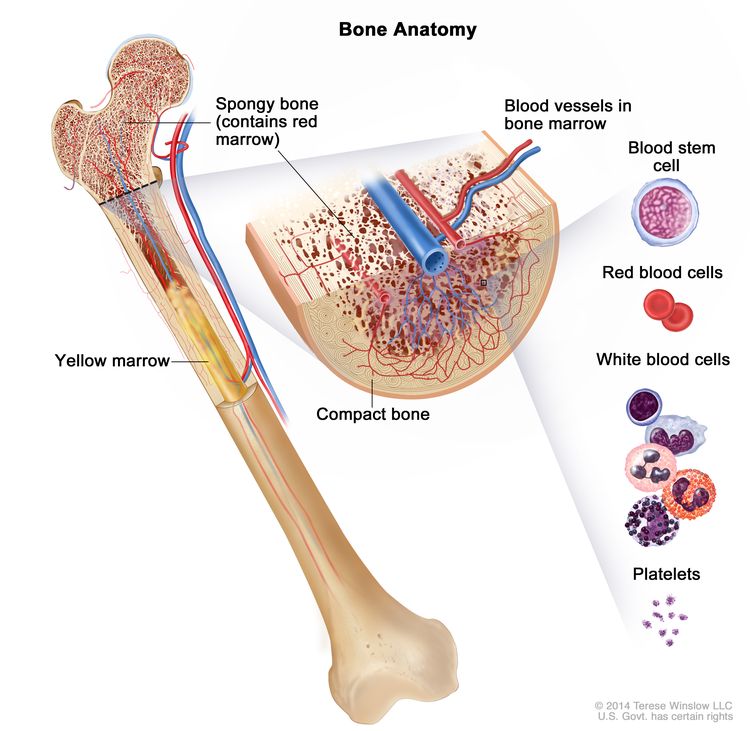
EnlargeAnatomy of the bone. The bone is made up of compact bone, spongy bone, and bone marrow. Compact bone makes up the outer layer of the bone. Spongy bone is found mostly at the ends of bones and contains red marrow. Bone marrow is found in the center of most bones and has many blood vessels. There are two types of bone marrow: red and yellow. Red marrow contains blood stem cells that can become red blood cells, white blood cells, or platelets. Yellow marrow is made mostly of fat.
Leukemia may affect red blood cells, white blood cells, and platelets.
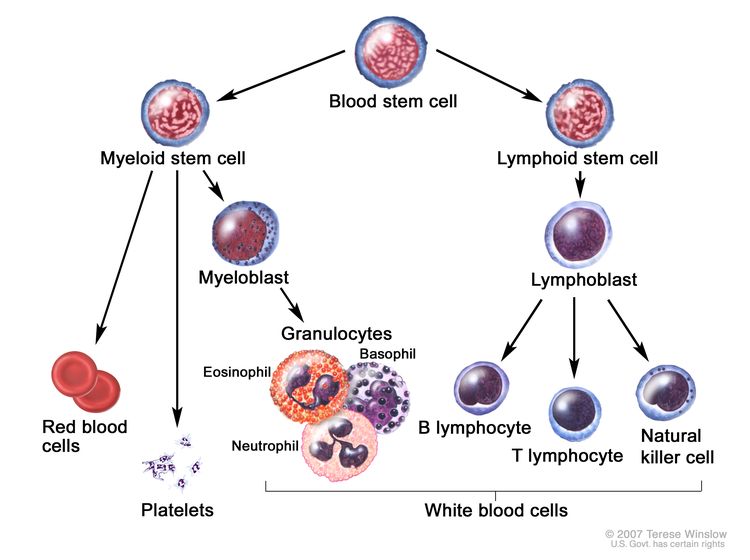
Normally, the bone marrow makes blood stem cells (immature cells) that become mature blood cells over time. A blood stem cell may become a myeloidstem cell or a lymphoid stem cell.
A myeloid stem cell becomes one of three types of mature blood cells:
EnlargeBlood cell development. A blood stem cell goes through several steps to become a red blood cell, platelet, or white blood cell.
In CLL, too many blood stem cells become abnormal lymphocytes. The abnormal lymphocytes may also be called leukemia cells. These leukemia cells are not able to fight infection very well. Also, as the number of leukemia cells increases in the blood and bone marrow, there is less room for healthy white blood cells, red blood cells, and platelets. This may lead to infection, anemia, and easy bleeding.
Signs and symptoms of CLL include swollen lymph nodes and feeling tired.
In the beginning, CLL does not cause any signs or symptoms and may be found during a routine blood test. Later, signs and symptoms may occur. Check with your doctor if you have:
The amount of hemoglobin (the protein that carries oxygen) in the red blood cells.
The portion of the blood sample made up of red blood cells.
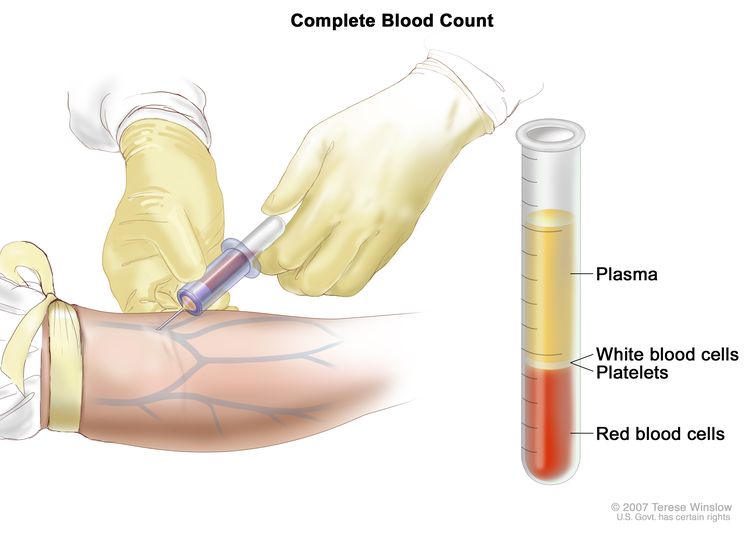
EnlargeComplete blood count (CBC). Blood is collected by inserting a needle into a vein and allowing the blood to flow into a tube. The blood sample is sent to the laboratory and the red blood cells, white blood cells, and platelets are counted. The CBC is used to test for, diagnose, and monitor many different conditions.
Blood chemistry studies: A procedure in which a blood sample is checked to measure the amounts of certain substances released into the blood by organs and tissues in the body. An unusual (higher or lower than normal) amount of a substance can be a sign of disease.
Lactate dehydrogenase testing: A laboratory test for one of a group of enzymes found in the blood and other body tissues and involved in energy production in cells. An increased amount of lactate dehydrogenase in the blood may be a sign of tissue damage and some types of cancer or other diseases.
Beta-2-microglobulin testing: A laboratory test for beta-2-microglobulin, a small protein normally found on the surface of many cells, including lymphocytes, and in small amounts in the blood and urine. An increased amount in the blood or urine may be a sign of certain diseases, including some types of cancer, such as multiple myeloma or lymphoma.
Flow cytometry: A laboratory test that measures the number of cells in a sample, the percentage of live cells in a sample, and certain characteristics of the cells, such as size, shape, and the presence of tumor (or other) markers on the cell surface. The cells from a sample of a patient’s blood, bone marrow, or other tissue are stained with a fluorescent dye, placed in a fluid, and then passed one at a time through a beam of light. The test results are based on how the cells that were stained with the fluorescent dye react to the beam of light. This test is used to help diagnose and manage certain types of cancers, such as leukemia and lymphoma.
FISH (fluorescence in situ hybridization): A laboratory test used to look at and count genes or chromosomes in cells and tissues. Pieces of DNA that contain fluorescent dyes are made in the laboratory and added to a sample of a patient’s cells or tissues. When these dyed pieces of DNA attach to certain genes or areas of chromosomes in the sample, they light up when viewed under a fluorescent microscope. The FISH test is used to help diagnose cancer and help plan treatment.
Genetic testing: A laboratory test in which cells or tissue are analyzed to look for changes in the TP53 or IGH gene. These changes may be helpful to determine the patient's prognosis.
Serumimmunoglobulin testing: A laboratory test that measures specific types of immunoglobulins (antibodies) in the blood. This may help diagnose cancer or find out how well treatment is working or if cancer has come back.
HIV testing: A test to check for HIV infection. HIV is the virus that causes AIDS. The most common type of HIV test is called the HIV antibody test, which checks for antibodies against HIV in a sample of blood, urine, or fluid from the mouth.
Certain factors affect prognosis (chance
of recovery) and treatment options.
Stage Information for Chronic Lymphocytic Leukemia
Key Points
After chronic lymphocytic leukemia (CLL) has been diagnosed, tests
are done to find out whether the cancer has spread.
The following stages are used for CLL:
Stage 0
Stage I
Stage II
Stage III
Stage IV
CLL is described as asymptomatic, symptomatic or progressive, recurrent, or refractory.
After chronic lymphocytic leukemia (CLL) has been diagnosed, tests
are done to find out whether the cancer has spread.
Staging is the process used to find out how far the cancer has spread. In CLL, the leukemia cells may spread from the blood and bone marrow to other parts of the body, such as the lymph nodes, liver, and spleen. It is important to know whether the leukemia cells have spread in order to plan the best treatment.
The following tests may be used to find out how far the cancer has spread:
Chest x-ray: An x-ray of the organs and bones inside the chest. An x-ray is a type of energy beam that can go through the body and onto film, making a picture of areas inside the body, such as the lymph nodes.
CT scan (CAT scan): A procedure that makes a series of detailed pictures of areas inside the body, such as the neck, chest, abdomen, pelvis, and lymph nodes, taken from different angles. The pictures are made by a computer linked to an x-ray machine. A dye may be injected into a vein or swallowed to help the organs or tissues show up more clearly. This test is used in patients with many swollen lymph nodes throughout the body. This procedure is also called computed tomography, computerized tomography, or computerized axial tomography. If a PET-CT scan is not available, a CT scan alone may be done.
PET-CT scan: A procedure that combines the pictures from a positron emission tomography (PET) scan and a computed tomography (CT) scan. The PET and CT scans are done at the same time on the same machine. The pictures from both scans are combined to make a more detailed picture than either test would make by itself. A PET scan is a procedure to find malignant tumor cells in the body. A small amount of radioactive glucose (sugar) is injected into a vein. The PET scanner rotates around the body and makes a picture of where glucose is being used in the body. Malignant tumor cells show up brighter in the picture because they are more active and take up more glucose than normal cells do. This test is done in patients with fever, drenching night sweats, weight loss, or fast-growing lymph nodes to check whether CLL has become an aggressive form of lymphoma.
The following stages are used for CLL:
Stage 0
In stage 0 CLL, there are too many
lymphocytes in the blood, but there are no other signs or symptoms of leukemia.
Stage 0 CLL is indolent (slow-growing).
Symptomatic or progressive CLL: The leukemia has caused significant changes to blood counts or other serious symptoms.
Recurrent CLL: The leukemia has recurred (come back) after a period of time in which the cancer could not be detected.
Refractory CLL: The leukemia does not get better with treatment.
Treatment Option Overview
Key Points
There are different types of treatment for patients with
chronic lymphocytic leukemia (CLL).
The following types of treatment are used:
Watchful waiting
Targeted therapy
Chemotherapy
Radiation therapy
Immunotherapy
Chemotherapy with bone marrow or peripheral blood stem cell transplant
New types of treatment are being tested in clinical trials.
Treatment for chronic lymphocytic leukemia may cause side effects.
Patients may want to think about taking part in a clinical trial.
Patients can enter clinical trials before, during, or after starting their cancer treatment.
Follow-up care may be needed.
There are different types of treatment for patients with
chronic lymphocytic leukemia (CLL).
Different types of treatment are available for patients with CLL.
Some treatments are standard (the currently used treatment), and some are being
tested in clinical trials. A treatment clinical trial is a research study meant to help improve
current treatments or obtain information on new treatments for patients with
cancer. When clinical trials show that a new treatment is better than the
standard treatment, the new
treatment may become the standard treatment. Patients may want to think about taking part in a clinical trial. Some clinical trials are open only to patients who have not started treatment.
The following types of treatment are used:
Watchful waiting
Watchful waiting
is closely monitoring a patient's condition without giving any treatment until signs or symptoms appear or change. This is also called observation. Watchful waiting is used to treat asymptomatic and symptomatic or progressiveCLL.
Targeted therapy
Targeted therapy is a type of treatment that uses drugs or other substances to identify and attack specific cancer cells. Different types of targeted therapy are used to treat CLL:
BCL2 inhibitor therapy: This treatment blocks a protein called BCL2, which is found on some leukemia cells. This may kill leukemia cells and make them more sensitive to other anticancer drugs. Venetoclax is a type of BCL2 therapy used to treat symptomatic or progressive, recurrent, or refractory CLL.
Monoclonal antibody therapy: Monoclonal antibodies are immune system proteins made in the laboratory to treat many diseases, including cancer. As a cancer treatment, these antibodies can attach to a specific target on cancer cells or other cells that may help cancer cells grow. The antibodies are able to then kill the cancer cells, block their growth, or keep them from spreading. Monoclonal antibodies are given by infusion. They may be used alone or to carry drugs, toxins, or radioactive material directly to cancer cells. Rituximab, ofatumumab, obinutuzumab, and alemtuzumab alone and in combination with chemotherapy are used to treat symptomatic or progressive, recurrent, or refractory CLL.
How do monoclonal antibodies work to treat cancer? This video shows how monoclonal antibodies, such as trastuzumab, pembrolizumab, and rituximab, block molecules cancer cells need to grow, flag cancer cells for destruction by the body’s immune system, or deliver harmful substances to cancer cells.
Chemotherapy is a cancer treatment that uses drugs to stop the growth of cancer cells, either by killing the cells or by stopping them from dividing. When chemotherapy is taken by mouth or injected into a vein or muscle, the drugs enter the bloodstream and can reach cancer cells throughout the body (systemic chemotherapy). Combination chemotherapy is treatment using more than one anticancer drug.
Radiation therapy is a cancer treatment that uses high-energy x-rays or other types of radiation to kill cancer cells or keep them from growing. External radiation therapy uses a machine outside the body to send radiation toward the area of the body with cancer, such as a group of lymph nodes or the spleen. This treatment may be used to reduce pain related to a swollen spleen or lymph nodes.
Immunotherapy
Immunotherapy is a treatment that uses the patient's immune system to fight cancer. Substances made by the body or made in a laboratory are used to boost, direct, or restore the body's natural defenses against cancer.
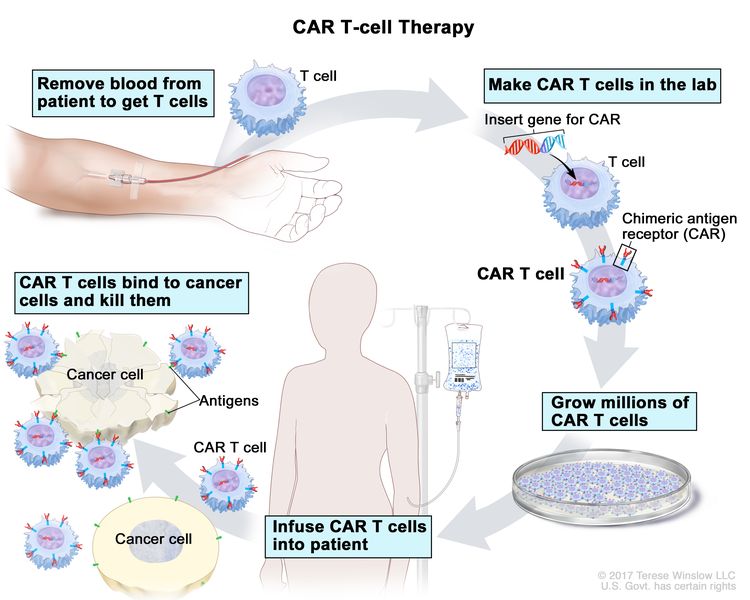
CAR T-cell therapy: This treatment changes the patient's T cells (a type of immune system cell) so they will attack certain proteins on the surface of cancer cells. T cells are taken from the patient and special receptors are added to their surface in the laboratory. The changed cells are called chimeric antigen receptor (CAR) T cells. The CAR T cells are grown in the laboratory and given to the patient by infusion. The CAR T cells multiply in the patient's blood and attack cancer cells. CAR T-cell therapy is being studied in the treatment of recurrent or refractory CLL.EnlargeCAR T-cell therapy. A type of treatment in which a patient’s T cells (a type of immune cell) are changed in the laboratory so they will bind to cancer cells and kill them. Blood from a vein in the patient’s arm flows through a tube to an apheresis machine (not shown), which removes the white blood cells, including the T cells, and sends the rest of the blood back to the patient. Then, the gene for a special receptor called a chimeric antigen receptor (CAR) is inserted into the T cells in the laboratory. Millions of the CAR T cells are grown in the laboratory and then given to the patient by infusion. The CAR T cells are able to bind to an antigen on the cancer cells and kill them.
Chemotherapy with bone marrow or peripheral blood stem cell transplant
Chemotherapy is given to kill cancer cells. Healthy cells, including blood-forming cells, are destroyed by the cancer treatment. A bone marrow or peripheral blood stem cell transplant are treatments to replace the blood-forming cells. Stem cells (immature blood cells) are removed from the blood or bone marrow of the patient or a donor and are frozen and stored. After the patient completes chemotherapy, the stored stem cells are thawed and given back to the patient through an infusion. These reinfused stem cells grow into (and restore) the body's blood cells.
New types of treatment are being tested in clinical trials.
Information about clinical trials is available from the
NCI website.
Treatment for chronic lymphocytic leukemia may cause side effects.
Patients may want to think about taking part in a clinical trial.
For some patients, taking part in a clinical trial may be the best treatment choice. Clinical trials are part of the cancer research process. Clinical trials are done to find out if new cancer treatments are safe and effective or better than the standard treatment.
Many of today's standard treatments for cancer are based on earlier clinical trials. Patients who take part in a clinical trial may receive the standard treatment or be among the first to receive a new treatment.
Patients who take part in clinical trials also help improve the way cancer will be treated in the future. Even when clinical trials do not lead to effective new treatments, they often answer important questions and help move research forward.
Patients can enter clinical trials before, during, or after starting their cancer treatment.
Some clinical trials only include patients who have not yet received treatment. Other trials test treatments for patients whose cancer has not gotten better. There are also clinical trials that test new ways to stop cancer from recurring (coming back) or reduce the side effects of cancer treatment.
Clinical trials are taking place in many parts of the country. Information about clinical trials supported by NCI can be found on NCI’s clinical trials search webpage. Clinical trials supported by other organizations can be found on the ClinicalTrials.gov website.
Follow-up care may be needed.
As you go through treatment, you will have follow-up tests or check-ups. Some tests that were done to diagnose or stage the cancer may be repeated to see how well the treatment is working. Decisions about whether to continue, change, or stop treatment may be based on the results of these tests.
Some of the tests will continue to be done from time to time after treatment has ended. The results of these tests can show if your condition has changed or if the cancer has recurred (come back).
Treatment of Asymptomatic Chronic Lymphocytic Leukemia
All of these treatments may be used for patients being treated for the first time and those who have been treated before. Because these treatments have not been compared in studies, it is not possible to know if one treatment is better than another. The choice of treatment is made based on test results, the patient's age and general health, and the desire to minimize short-term and long-term side effects.
Treatment of Recurrent or Refractory Chronic Lymphocytic Leukemia
Physician Data Query (PDQ) is the National Cancer Institute's (NCI's) comprehensive cancer information database. The PDQ database contains summaries of the latest published information on cancer prevention, detection, genetics, treatment, supportive care, and complementary and alternative medicine. Most summaries come in two versions. The health professional versions have detailed information written in technical language. The patient versions are written in easy-to-understand, nontechnical language. Both versions have cancer information that is accurate and up to date and most versions are also available in Spanish.
PDQ is a service of the NCI. The NCI is part of the National Institutes of Health (NIH). NIH is the federal government’s center of biomedical research. The PDQ summaries are based on an independent review of the medical literature. They are not policy statements of the NCI or the NIH.
Purpose of This Summary
This PDQ cancer information summary has current information about the treatment of chronic lymphocytic leukemia. It is meant to inform and help patients, families, and caregivers. It does not give formal guidelines or recommendations for making decisions about health care.
Reviewers and Updates
Editorial Boards write the PDQ cancer information summaries and keep them up to date. These Boards are made up of experts in cancer treatment and other specialties related to cancer. The summaries are reviewed regularly and changes are made when there is new information. The date on each summary ("Updated") is the date of the most recent change.
The information in this patient summary was taken from the health professional version, which is reviewed regularly and updated as needed, by the PDQ Adult Treatment Editorial Board.
Clinical Trial Information
A clinical trial is a study to answer a scientific question, such as whether one treatment is better than another. Trials are based on past studies and what has been learned in the laboratory. Each trial answers certain scientific questions in order to find new and better ways to help cancer patients. During treatment clinical trials, information is collected about the effects of a new treatment and how well it works. If a clinical trial shows that a new treatment is better than one currently being used, the new treatment may become "standard." Patients may want to think about taking part in a clinical trial. Some clinical trials are open only to patients who have not started treatment.
Clinical trials can be found online at NCI's website. For more information, call the Cancer Information Service (CIS), NCI's contact center, at 1-800-4-CANCER (1-800-422-6237).
Permission to Use This Summary
PDQ is a registered trademark. The content of PDQ documents can be used freely as text. It cannot be identified as an NCI PDQ cancer information summary unless the whole summary is shown and it is updated regularly. However, a user would be allowed to write a sentence such as “NCI’s PDQ cancer information summary about breast cancer prevention states the risks in the following way: [include excerpt from the summary].”
The best way to cite this PDQ summary is:
PDQ® Adult Treatment Editorial Board. PDQ Chronic Lymphocytic Leukemia Treatment. Bethesda, MD: National Cancer Institute. Updated <MM/DD/YYYY>. Available at: https://www.cancer.gov/types/leukemia/patient/cll-treatment-pdq. Accessed <MM/DD/YYYY>. [PMID: 26389485]
Images in this summary are used with permission of the author(s), artist, and/or publisher for use in the PDQ summaries only. If you want to use an image from a PDQ summary and you are not using the whole summary, you must get permission from the owner. It cannot be given by the National Cancer Institute. Information about using the images in this summary, along with many other images related to cancer can be found in Visuals Online. Visuals Online is a collection of more than 3,000 scientific images.
Disclaimer
The information in these summaries should not be used to make decisions about insurance reimbursement. More information on insurance coverage is available on Cancer.gov on the Managing Cancer Care page.
Contact Us
More information about contacting us or receiving help with the Cancer.gov website can be found on our Contact Us for Help page. Questions can also be submitted to Cancer.gov through the website’s E-mail Us.