
Vulvar cancer forms in a woman's external genitalia, called the vulva. It occurs when cells in the vulva start to grow out of control. The vulva includes:
- the inner and outer lips of the vagina
- the clitoris (the sensitive tissue above the lips of the vagina)
- the opening of the vagina and its glands
- the mons pubis (the rounded area in front of the pubic bones that becomes covered with hair at puberty)
Vulvar cancer most often affects the outer vaginal lips. Less often, cancer affects the inner vaginal lips, clitoris, or vaginal glands.
Vulvar cancer usually forms slowly over many years. Abnormal cells can grow on the surface of the vulvar skin for a long time. This condition is called vulvar intraepithelial neoplasia (VIN). Because it is possible for VIN to become vulvar cancer, it is important to get treatment.
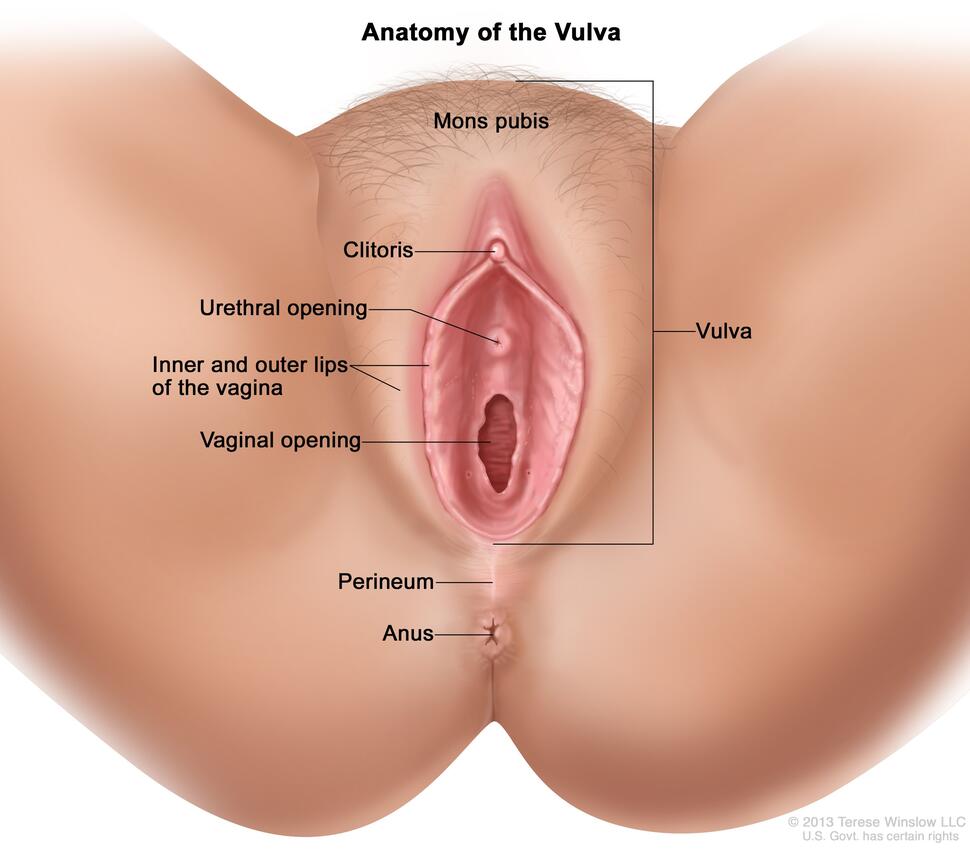
Anatomy of the vulva. The vulva includes the mons pubis, clitoris, inner and outer lips of the vagina, and the openings of the urethra and vagina.
Credit: © Terese Winslow