
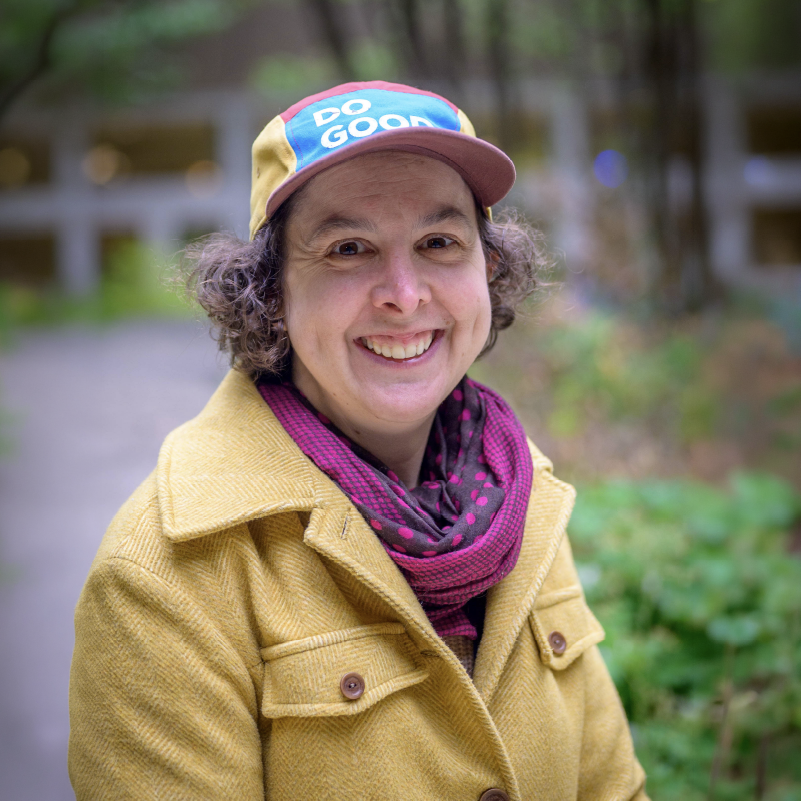
One night in 2013, Olivia bit her tongue while sleeping. When she awoke, she was talking uncontrollably – a frightening symptom that sent her immediately to the hospital. There, doctors explained she had had a seizure, and scans revealed a golf ball-sized mass in her brain that needed to be removed. She underwent surgery and learned that the mass was a grade 2/3 astrocytoma.
Astrocytomas are a type of glioma (a common type of brain cancer) and hers is considered a high-grade tumor because it tends to grow and spread quickly within the brain and spinal cord. To further treat the tumor following surgery, Olivia enrolled in a clinical trial in Belgium, where she lived at the time, and received radiation. After this treatment, her cancer was no longer detectable, and she was monitored by MRI scans every few months.
Seeking options for a recurrent cancer
Eight years later in 2021, Olivia had a routine MRI and found out her cancer had returned. She had another surgery to remove the tumor, followed by chemotherapy. In the years since her first cancer diagnosis, Olivia had attended graduate school and moved to the United States, where she works for the World Bank in the Washington, D.C. area. Because traveling to Belgium every few months for scans and treatment was unrealistic, she sought care at an NCI-Designated Cancer Center near her home.
Despite continuing chemotherapy for a year, her tumor grew rapidly, and she had two more surgeries. Her care team considered other treatments and ultimately connected her with Dr. Jing Wu, an NCI researcher and a neuro-oncologist at the NIH Clinical Center. Dr. Wu was testing the immunotherapy nivolumab as a treatment for certain types of gliomas. Nivolumab works by blocking inhibitory signals on T cells, which allows them to attack cancer cells.
Olivia enrolled in the trial and initially responded well. Unfortunately, her tumor stopped responding on the last dose of the trial and she underwent a fifth surgery, this time at NIH.
This setback didn’t stop Olivia. She’s never had any hesitations about joining a clinical trial; she sees it as a necessary part of her life and a way to personally contribute to future lifesaving treatments. She feels very lucky to be in the U.S. and have access to multiple trials. Whereas in Belgium, there was only one clinical trial option for her type of cancer, NCI-supported research provided more options and opportunities for hope, especially for patients with rare cancers. Broad participation in clinical trials remains important; it can take a long time for researchers to complete trials focused on rare cancers because of the limited number of patients available to enroll.
Then, another opportunity presented itself to Olivia through Dr. Wu’s research: a new clinical trial testing a drug called zotiraciclib in high-grade gliomas with mutations in the genes IDH1 or IDH2. Olivia’s tumor had one of these mutations. Zotiraciclib affects cancer cells in multiple ways, including by disrupting gene transcription – the process cells use to turn genetic instructions into proteins – and by interfering with mitochondrial function, which helps limit the energy cancer cells can use to grow. By targeting these genetically heterogeneous glioma tumors from multiple angles, researchers hope the drug will elicit a stronger response and make it harder for tumors to find new ways to evade treatment.
Moving rare disease treatments from the bench into the clinic
Dr. Wu’s earlier work on brain cancer found that IDH-mutant gliomas were especially susceptible to zotiraciclib. “We came to the conclusion that in these specific gliomas, there is a vulnerability to this drug treatment, and it doesn’t require a very high dose. A lower dose means less toxicity,” Dr. Wu commented, “while still delivering the better clinical outcome.”
Thanks to the work of Dr. Wu and her research team, zotiraciclib was granted orphan drug status1 for use in glioma patients by the U.S. Food and Drug Administration (FDA) in 2019. The drug also received a Fast Track FDA designation2 in 2025 for treatment of patients with recurrent high-grade gliomas with IDH1 or IDH2 mutations, getting zotiraciclib one step closer to approval for broader clinical use.
The clinical trial on which Olivia is currently enrolled is evaluating zotiraciclib in patients with recurrent high-grade IDH-mutant gliomas to determine optimal dosing. It also aims to find out whether the treatment leads to 12 months of progression-free survival during which the disease remains stable or shrinks. Because IDH-mutant glioma patients tend to be younger (in their 30s and 40s), Dr. Wu hopes that they can maintain a regular routine while they receive the treatment. Younger cancer patients are often going through major physical, social, and emotional changes in parallel with navigating the hardships of cancer and have unique needs compared to other groups.
Obtaining full FDA approval for zotiraciclib would give this patient population an additional option since these aggressive brain tumors have no established standard of care, limited treatment options, and poor prognoses. “This is the next promising drug for this patient population with higher grade gliomas; we have nothing for them right now,” says Dr. Wu. “There’s certainly a need and there’s a gap that we can fill to improve their outcomes and quality of life.”
Living with cancer and embracing life
Since enrolling in the phase 1 trial of the zotiraciclib in 2024, Olivia visits the NIH Clinical Center monthly. She takes zotiraciclib orally on set days each week for a 28-day cycle and has an MRI scan every eight weeks. This has continued for 18 cycles, and she is currently on her last cycle. Once her treatment is finished, she’ll continue to be monitored.
Olivia remains cautiously optimistic about her response and glad that she has been able to continue working, traveling, and leading a relatively normal life while on the trial. Her motto of “I don’t want it to impact my life, so essentially, I live with it” helped her enjoy a recent work trip to Cusco, Peru. Over the past 13 years, cancer has taken away some of her favorite hobbies like field hockey and biking, but she is resilient and continues to find the joy in life. She hopes to get back into running soon and is part of a French-speaking improv group. If you ask her how she’s doing, she’ll say “I’m good, if not great.”
Footnotes
- Orphan drug designation is given to therapies that treat, prevent, or diagnose rare diseases, such as IDH-mutant gliomas, and incentivizes drug developers to research and develop these designated therapies.
- Fast Track designation highlights the urgent need for new therapeutic approaches and provides an expedited regulatory pathway to accelerate the development and review of zotiraciclib for full FDA approval.