
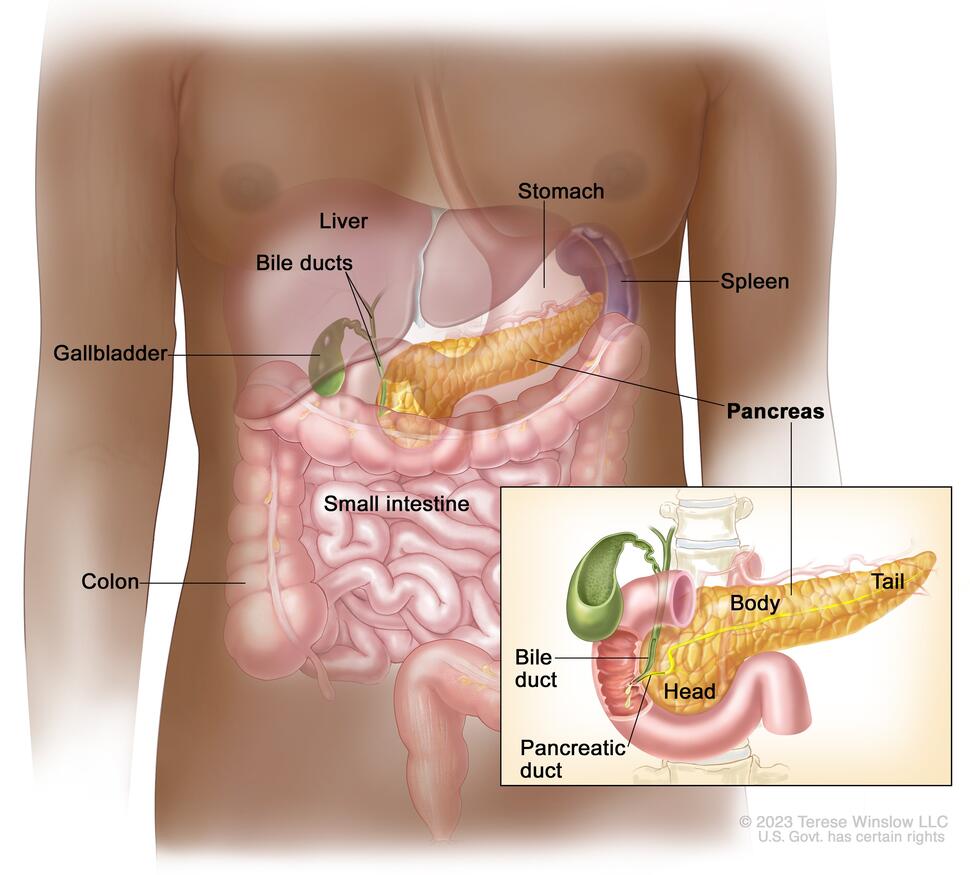
Pancreatic cancer begins in the pancreatic gland, a pear-shaped organ in your abdomen that lies behind the lower part of your stomach and stretches from the left to the right of the abdomen. The pancreas is in close contact with the colon, small intestine, and bile duct and major blood vessels that flow to the liver, intestines, stomach, and spleen.
The pancreas releases enzymes that aid digestion and produces hormones, including insulin, that help manage your blood sugar. These enzymes and hormones are released via the pancreatic duct, which runs through the center of the gland and empties into the duodenum, the first part of the small intestine.
Types of pancreatic cancer
Pancreatic cancer can occur in exocrine pancreas cells, which produce digestive juices, or in endocrine pancreas cells, which produce hormones. About 95% of pancreatic cancers begin in exocrine cells.
Pancreatic cancers that form in endocrine cells are called pancreatic neuroendocrine tumors, or islet cell tumors. They are much less common than exocrine pancreatic cancers, and they have very different causes, risk factors, treatments, and prognoses. Learn more about Pancreatic Neuroendocrine Tumors (Islet Cell Tumors).
Types of pancreatic cancers that form in exocrine cells include:
Pancreatic ductal adenocarcinoma
Pancreatic ductal adenocarcinoma (PDAC) is the most common type of pancreatic cancer, making up about 90% of cases. Most of the time, when you find information about pancreatic cancer, it’s referring to this type.
Squamous cell carcinoma and adenosquamous carcinoma
Pancreatic squamous cell and adenosquamous carcinoma are very rare types of pancreatic cancer. They are sometimes considered subtypes of PDAC. While not much is known about them because they are so rare, they are treated with the same therapies as PDAC. They are usually diagnosed at an advanced stage and have a poor prognosis.
Acinar cell carcinoma
Acinar cell carcinoma is a rare type of pancreatic cancer that forms in acinar cells, which produce digestive enzymes. This tumor occurs more often in men. This type of cancer may have a better prognosis than pancreatic ductal adenocarcinoma.
Colloid carcinoma
Colloid carcinoma, also called mucinous noncystic carcinoma, is a rare type of pancreatic cancer that produces large amounts of mucin. Colloid carcinoma of the pancreas has a better prognosis than pancreatic ductal adenocarcinoma.
Solid pseudopapillary tumor
Solid pseudopapillary tumor is a rare type of pancreatic cancer found more often in women than in men, and it often occurs at a younger age. Solid pseudopapillary tumor is slow-growing, rarely spreads to other organs, and usually has a good prognosis.
Pancreatoblastoma
Pancreatoblastoma is a rare type of pancreatic cancer that can happen at any age but occurs most often in children younger than 10 years. Children and adults with familial adenomatous polyposis and Beckwith-Wiedemann syndrome may be at increased risk of developing pancreatoblastoma. Learn more at Childhood Pancreatic Cancer.