
Tests to diagnose pituitary tumors
In addition to asking about your personal and family health history and doing a physical exam, your doctor may perform the following tests and procedures:
- Eye exam: An exam to check vision and the general health of the eyes.
- Visual field exam: An exam to check a person’s field of vision (the total area in which objects can be seen). This test measures both central vision (how much a person can see when looking straight ahead) and peripheral vision (how much a person can see in all other directions while staring straight ahead). The eyes are tested one at a time. The eye not being tested is covered.
- Neurological exam: A series of questions and tests to check the brain, spinal cord, and nerve function. The exam checks a person’s mental status, coordination, and ability to walk normally, and how well the muscles, senses, and reflexes work. This may also be called a neuro exam or a neurologic exam.
- MRI (magnetic resonance imaging) with gadolinium: A procedure that uses a magnet, radio waves, and a computer to make a series of detailed pictures of areas inside the brain and spinal cord. A substance called gadolinium is injected into a vein. The gadolinium collects around the cancer cells so they show up brighter in the picture. This procedure is also called nuclear magnetic resonance imaging (NMRI).
- Blood chemistry study: A procedure in which a blood sample is checked to measure the amounts of certain substances, such as glucose (sugar), released into the blood by organs and tissues in the body. An unusual (higher or lower than normal) amount of a substance can be a sign of disease.
- Blood tests: Tests to measure the levels of testosterone or estrogen in the blood. A higher- or lower-than-normal amount of these hormones may be a sign of pituitary tumor.
- Twenty-four-hour urine test: A test in which urine is collected for 24 hours to measure the amounts of certain substances. An unusual (higher or lower than normal) amount of a substance can be a sign of disease in the organ or tissue that makes it. A higher-than-normal amount of the hormone cortisol may be a sign of a pituitary tumor and Cushing syndrome.
- High-dose dexamethasone suppression test: A test in which one or more high doses of dexamethasone are given. The level of cortisol is checked from a sample of blood or from urine that is collected for three days. This test is done to check if the adrenal gland is making too much cortisol or if the pituitary gland is telling the adrenal glands to make too much cortisol.
- Low-dose dexamethasone suppression test: A test in which one or more small doses of dexamethasone are given. The level of cortisol is checked from a sample of blood or from urine that is collected for three days. This test is done to check if the adrenal gland is making too much cortisol.
- Venous sampling for pituitary tumors: A procedure in which a sample of blood is taken from veins coming from the pituitary gland. The sample is checked to measure the amount of adrenocorticotropic hormone (ACTH) released into the blood by the gland. Venous sampling may be done if blood tests show there is a tumor making ACTH, but the pituitary gland looks normal in the imaging tests.
- Biopsy: The removal of cells or tissues so they can be viewed under a microscope by a pathologist to check for signs of cancer.
The following tests may be done on the sample of tissue that is removed:
- Immunohistochemistry: A laboratory test that uses antibodies to check for certain antigens (markers) in a sample of a patient’s tissue. The antibodies are usually linked to an enzyme or a fluorescent dye. After the antibodies bind to a specific antigen in the tissue sample, the enzyme or dye is activated, and the antigen can then be seen under a microscope. This type of test is used to help diagnose cancer and to help tell one type of cancer from another type of cancer.
- Immunocytochemistry: A laboratory test that uses antibodies to check for certain antigens (markers) in a sample of a patient’s cells. The antibodies are usually linked to an enzyme or a fluorescent dye. After the antibodies bind to the antigen in the sample of the patient’s cells, the enzyme or dye is activated, and the antigen can then be seen under a microscope. This type of test is used to help diagnose cancer and to help tell one type of cancer from another type of cancer.
- Light microscope and electron microscopy: A laboratory test in which cells in a sample of tissue are viewed under regular and high-powered microscopes to look for certain changes in the cells.
Do pituitary tumors have stages?
Once a pituitary tumor has been diagnosed, tests are done to find out if it has spread within the central nervous system (brain and spinal cord) or to other parts of the body.
The extent or spread of cancer is usually described as stages. There is no standard staging system for pituitary tumors. Once a pituitary tumor is found, tests are done to find out if the tumor has spread into the brain or to other parts of the body. The following test may be used:
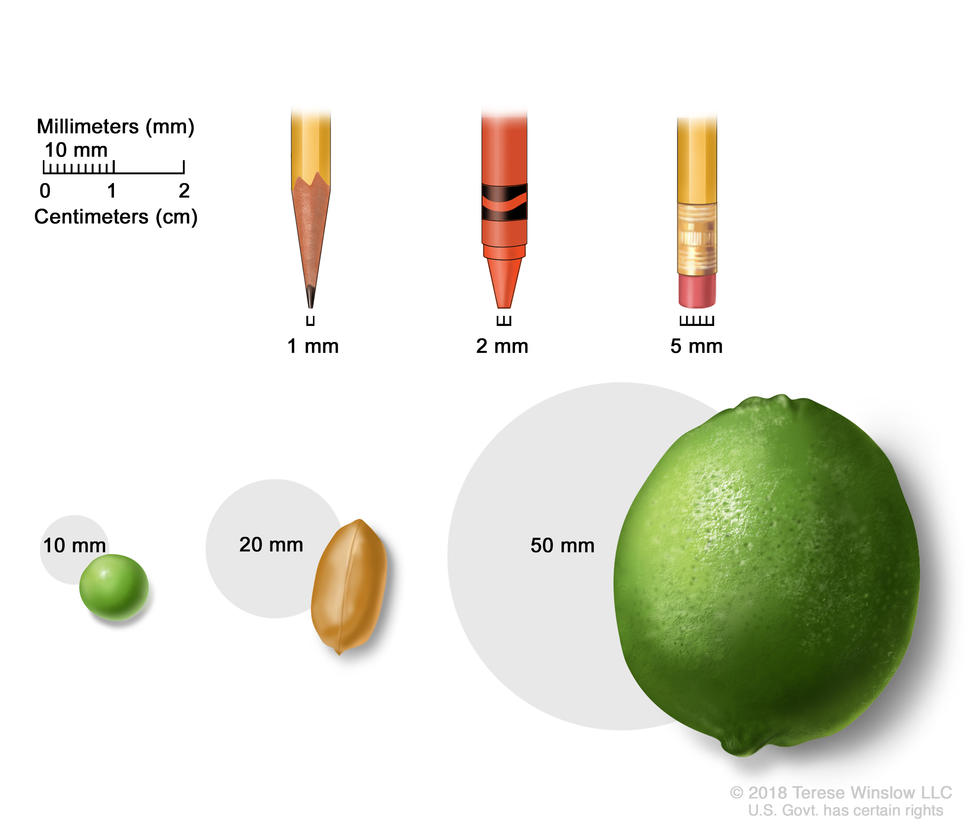
Tumor size is often measured in millimeters (mm) or centimeters. Common items that can be used to show tumor size in mm include: a sharp pencil point (1 mm), a new crayon point (2 mm), a pencil-top eraser (5 mm), a pea (10 mm), a peanut (20 mm), and a lime (50 mm).
Credit: © Terese Winslow
- MRI (magnetic resonance imaging): A procedure that uses a magnet, radio waves, and a computer to make a series of detailed pictures of areas inside the body. This procedure is also called nuclear magnetic resonance imaging (NMRI).
Pituitary tumors are described by their size and grade, whether or not they make extra hormones, and whether the tumor has spread to other parts of the body.
The following sizes are used:
- Microadenoma: The tumor is smaller than 1 centimeter.
- Macroadenoma: The tumor is 1 centimeter or larger.
Most pituitary adenomas are microadenomas.
The grade of a pituitary tumor is based on how far it has grown into the surrounding area of the brain, including the sella (the bone at the base of the skull, where the pituitary gland sits).
Recurrent pituitary tumors
Pituitary tumors can recur (come back) after they have been treated. The cancer may come back in the pituitary gland or in other parts of the body.
Pituitary tumors prognosis
Certain factors affect prognosis (chance of recovery) and treatment options. The prognosis depends on the type of tumor and whether the tumor has spread into other areas of the central nervous system (brain and spinal cord) or outside of the central nervous system to other parts of the body.
The prognosis and treatment options depend on:
- The type and size of the tumor.
- Whether the tumor is making hormones.
- Whether the tumor is causing problems with vision or other signs or symptoms.
- Whether the tumor has spread into the brain around the pituitary gland or to other parts of the body.
- Whether the tumor has just been diagnosed or has recurred (come back).