
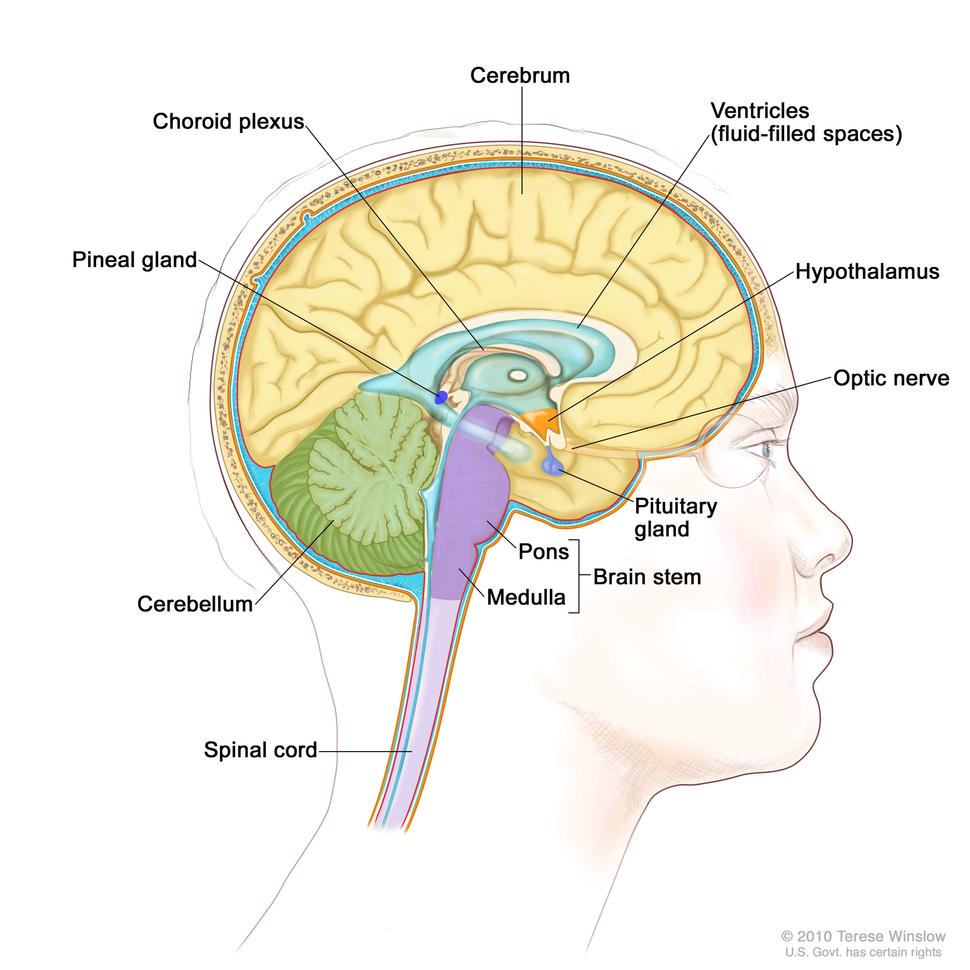
A pituitary tumor is a growth of abnormal cells in the tissues of the pituitary gland.
Pituitary tumors form in the pituitary gland, a pea-sized organ in the center of the brain, just above the back of the nose. The pituitary gland is sometimes called the "master endocrine gland" because it makes hormones that affect the way many parts of the body work. It also controls hormones made by many other glands in the body.
Pituitary tumors are divided into three groups:
- Benign pituitary adenomas: Tumors that are not cancer. These tumors grow very slowly and do not spread from the pituitary gland to other parts of the body.
- Invasive pituitary adenomas: Benign tumors that may spread to bones of the skull or the sinus cavity below the pituitary gland.
- Pituitary carcinomas: Tumors that are malignant (cancer). These pituitary tumors spread into other areas of the central nervous system (brain and spinal cord) or outside of the central nervous system. Very few pituitary tumors are malignant.
Pituitary tumors may be either nonfunctioning or functioning.
- Nonfunctioning pituitary tumors do not make extra amounts of hormones.
- Functioning pituitary tumors make more than the normal amount of one or more hormones. Most pituitary tumors are functioning tumors. The extra hormones made by pituitary tumors may cause certain signs or symptoms of disease.
What hormones are produced by the pituitary gland?
The pituitary gland hormones control many other glands in the body. Hormones made by the pituitary gland include:
- Prolactin: A hormone that causes a woman’s breasts to make milk during and after pregnancy.
- Adrenocorticotropic hormone (ACTH): A hormone that causes the adrenal glands to make a hormone called cortisol. Cortisol helps control the use of sugar, protein, and fats in the body and helps the body deal with stress.
- Growth hormone: A hormone that helps control body growth and the use of sugar and fat in the body. Growth hormone is also called somatotropin.
- Thyroid-stimulating hormone: A hormone that causes the thyroid gland to make other hormones that control growth, body temperature, and heart rate. Thyroid-stimulating hormone is also called thyrotropin.
- Luteinizing hormone (LH) and follicle-stimulating hormone (FSH): Hormones that control the menstrual cycle in women and the making of sperm in men.
Risk factors for pituitary tumors
Having certain genetic conditions increases the risk of developing a pituitary tumor. Anything that increases a person's chance of getting a disease is called a risk factor. Not every person with one or more of these risk factors will develop pituitary tumors, and they will develop in some people who don't have any known risk factors. Talk with your doctor if you think you may be at risk. Hereditary syndromes that increase a person's risk for pituitary tumors include:
- Multiple endocrine neoplasia type 1 (MEN1) syndrome.
- Carney complex.
- Isolated familial acromegaly.