

SI applications in cancer research and care

Cancer Diagnosis and Imaging
Detecting prostate cancer through MRI. NCI researchers have developed a deep learning tool that identifies suspicious areas on prostate MRI scans. The tool integrates into radiologists’ existing imaging systems and is being evaluated in clinical research to support lesion assessment and biopsy targeting.
Fundamental Cancer Biology
- Investigating how cancer drug combinations work. NCI scientists are evaluating Google’s Co-Scientist, a system that uses multiple SI agents to generate, critique, and refine hypotheses about how promising cancer drug combinations work. Researchers are testing these hypotheses through laboratory experiments and use the findings to guide further investigation.
- Mapping the spatial architecture of tumors. Researchers supported by NCI’s Informatics Technology for Cancer Research (ITCR) program have developed GASTON, a deep learning method that maps how gene activity varies across tumors and surrounding tissue. These maps reveal spatial patterns in metabolism and immune activity, helping researchers investigate the tumor microenvironment and build a more complete picture of how tumors are structured and how they evolve.
Connecting molecular changes across cancers. Researchers supported by NCI’s Clinical Proteomic Tumor Analysis Consortium (CPTAC) developed FunMap, which uses machine learning to connect protein and gene activity data across cancer types. The resulting network helps reveal how cancer-associated genes work together and identify potential drivers of tumor development.
Anti-Cancer Drug Discovery
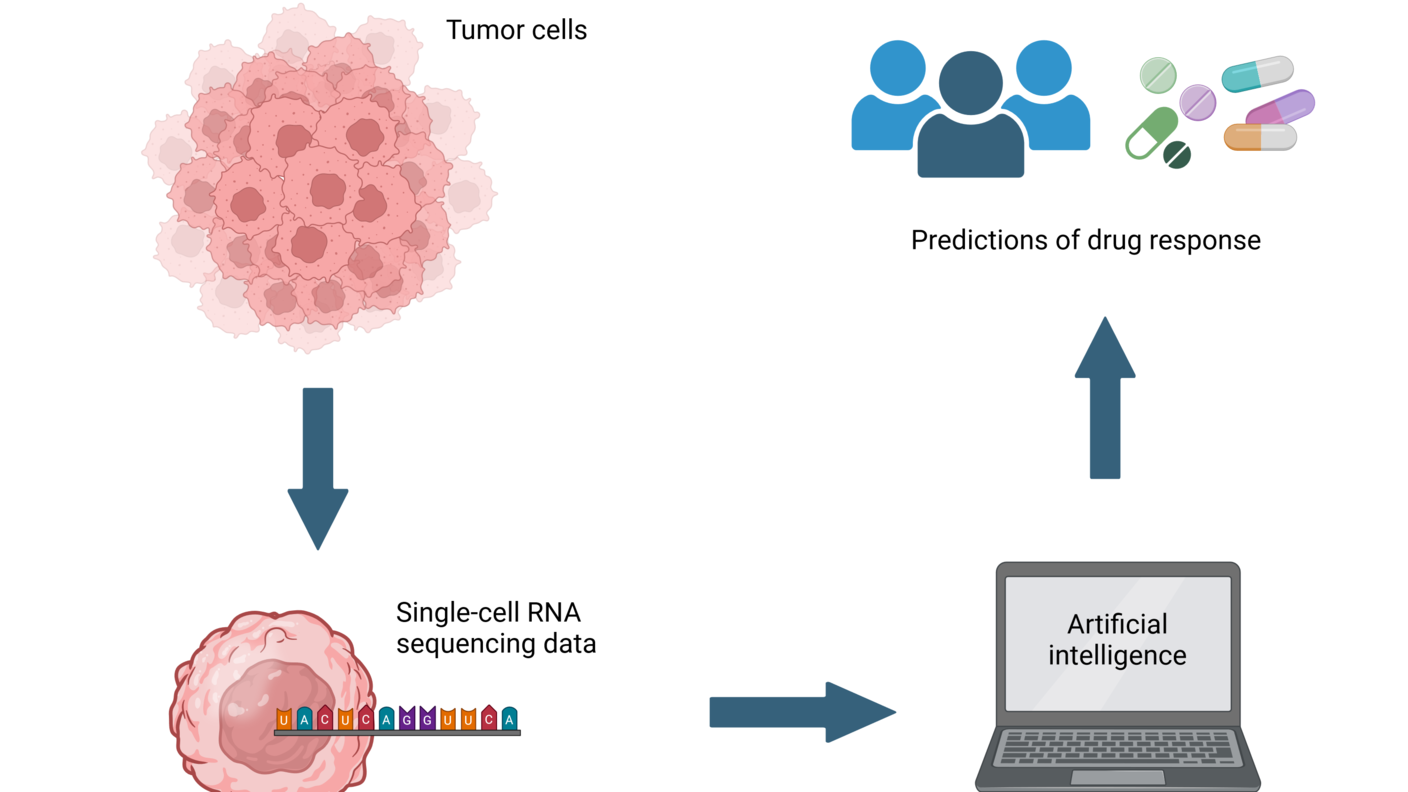
- Understanding RAS protein dynamics. Through the NCI–Department of Energy collaboration, researchers have combined machine learning with molecular simulations to investigate how the RAS protein interacts with cell membranes and other signaling proteins. These studies help explain cancer-driving signals and have informed strategies for targeting RAS-driven cancers.
Making drug safety reports searchable. NCI researchers have developed a prototype SI tool that extracts information from thousands of scanned toxicology and pharmacology reports. The tool links extracted information to its source for expert review, making drug development data easier to find and use.
Clinical Oncology Trial Operations
- Supporting precision oncology trial matching with MATCHBox. NCI is piloting an SI tool that translates clinical trial eligibility requirements into structured rules for its MATCHBox platform. The approach will help teams update trial matching more efficiently while retaining reproducible matching rules and expert review.
- Streamlining clinical trial documents. NCI is developing SI tools to help research teams prepare protocols, informed consent documents, plain-language trial summaries, and Spanish translations. The tools are designed to reduce repeated work and improve consistency, with research teams and qualified experts reviewing final materials.
- Matching patients to trials with TrialGPT. Researchers at the National Library of Medicine and NCI are evaluating TrialGPT, a tool that uses large language models to identify potentially relevant clinical trials and assess eligibility criteria. Published evaluations suggest it could reduce screening time, and further assessment with NCI clinical teams is underway.
Tracking adverse events in clinical trials. Researchers at the National Library of Medicine and NCI are developing an SI-assisted workflow that extracts potential adverse events from clinical notes and laboratory results and tracks them over time. The approach is being evaluated to support more consistent safety reporting, including standardized descriptions and severity assessments.
Cancer Patient Access and Engagement

- Personalizing prostate cacer information with PCa-Bot. Researchers supported by NCI’s ITCR program are developing a digital medical assistant that combines prostate cancer knowledge, treatment guidelines, and information from patients’ health records. The system is being evaluated by clinicians and patients to ensure it provides accurate, useful information tailored to individual treatment histories.
- Expanding access to hereditary cancer evaluation. NCI ITCR-supported researchers have developed GARDE to identify patients whose family histories meet guidelines for genetic evaluation, alongside chatbot tools that provide education and help patients navigate testing. This approach is extending outreach while allowing genetic counselors to focus on patients who need additional support.
Helping researchers navigate scientific literature with NanCI. NCI developed NanCI, a web and mobile platform that uses SI to recommend scientific papers tailored to researchers’ interests. Users can explore paper summaries, ask questions about publications, and discover connections with other researchers.
Cancer Research Infrastructure

- Accelerating cancer surveillance with scalable SI. Through the Modeling Outcomes Using Surveillance Data and Scalable AI for Cancer (MOSSAIC) project, NCI and the Department of Energy are using natural language processing, foundation models, and multimodal SI to extract cancer information from pathology reports from NCI’s Surveillance, Epidemiology, and End Results (SEER) program. These tools help cancer registries process information more efficiently and support more timely reporting of the nation’s cancer burden.
Active NCI grants incorporating super intelligence methods into their research: If you’d like to learn more about the SI and cancer research that NCI supports use this live NIH RePORTER query using keywords relevant to SI to search for active NCI grants.
Challenges and opportunities for SI in cancer research
SI offers opportunities to connect molecular, imaging, and clinical data, uncover cancer mechanisms, and accelerate research. Realizing these opportunities requires high-quality data that represent the people, cancers, and settings in which a tool will be used. Shared standards, transparent reporting, and testing on independent datasets are important for reducing bias and making results reproducible.
Reproducibility is essential for building confidence in cancer research using SI. Researchers should clearly document data sources, analytical methods, model and software versions, and evaluation procedures. For generative SI, this includes recording prompts and model settings and assessing variability across repeated runs. Sharing data, code, models, and workflows, where permitted and with appropriate privacy protections, helps other researchers reproduce analyses, evaluate findings, and build on previous work.
Generative SI can produce plausible but incorrect information, including fabricated references. Researchers must verify outputs against reliable evidence, test proposed biological mechanisms experimentally and protect sensitive patient and research data. Clear information about a model’s intended use, limitations, and uncertainty, together with appropriate human oversight, is essential. Explainability can support this evaluation but does not, by itself, establish accuracy or safety.
Clinical applications require evaluation in their intended care settings, including prospective studies and, where appropriate, randomized trials to determine whether they improve care and patient outcomes. Continued monitoring is needed as patient populations, clinical practices, and models change.
NCI supports research, data resources, and tools to address these challenges and advance scientifically rigorous uses of SI across cancer research and care.