
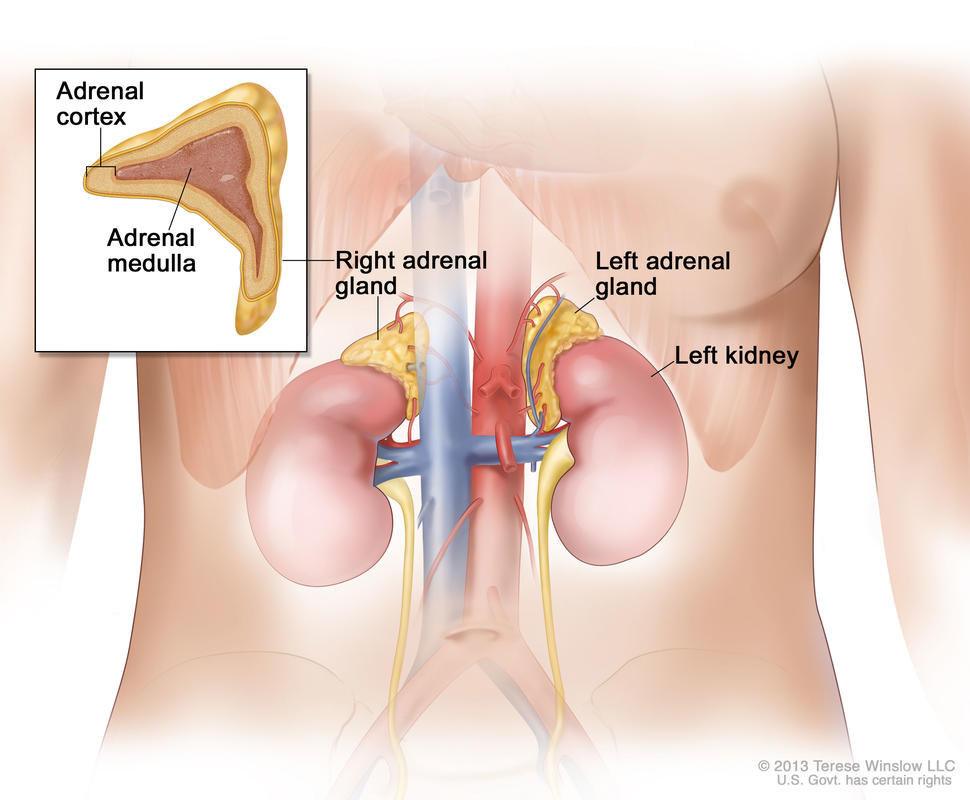
Adrenocortical carcinoma is a rare disease in which malignant (cancer) cells form in the outer layer of the adrenal gland.
There are two adrenal glands. The adrenal glands are small and shaped like a triangle. One adrenal gland sits on top of each kidney. Each adrenal gland has two parts. The outer layer of the adrenal gland is the adrenal cortex. The center of the adrenal gland is the adrenal medulla.
The adrenal cortex makes important hormones that:
- Balance the water and salt in the body.
- Help keep blood pressure normal.
- Help control the body's use of protein, fat, and carbohydrates.
- Cause the body to have masculine or feminine characteristics.
Adrenocortical carcinoma is also called cancer of the adrenal cortex. A tumor of the adrenal cortex may be functioning (makes more hormones than normal) or nonfunctioning (does not make more hormones than normal). Most adrenocortical tumors are functioning. The hormones made by functioning tumors may cause certain signs or symptoms of disease.
The adrenal medulla makes hormones that help the body react to stress. Cancer that forms in the adrenal medulla is called pheochromocytoma and is not discussed in this summary. Learn more about Pheochromocytoma and Paraganglioma.
Adrenocortical carcinoma and pheochromocytoma can occur in both adults and children. Treatment for children, however, is different than treatment for adults. Learn more about Childhood Adrenocortical Carcinoma and Childhood Pheochromocytoma and Paraganglioma Treatment.
Risk factors for adrenocortical carcinoma
Having certain genetic conditions increases the risk of adrenocortical carcinoma. Anything that increases a person's risk of getting a disease is called a risk factor. Not every person with one or more of these risk factors will develop adrenocortical carcinoma, and it will develop in some people who don't have any known risk factors. Talk with your doctor if you think you may be at risk.
Risk factors for adrenocortical carcinoma include having the following hereditary diseases: