
This report provides a summary of the distribution of the Fiscal Year 2025 budget among the various National Cancer Institute (NCI) research programs and funding mechanisms. It also presents funding policies influencing grant awards and comparisons with prior year allocations. Additional information on the NCI budget is accessible from the NCI home page.
Fiscal Year 2025 Highlights
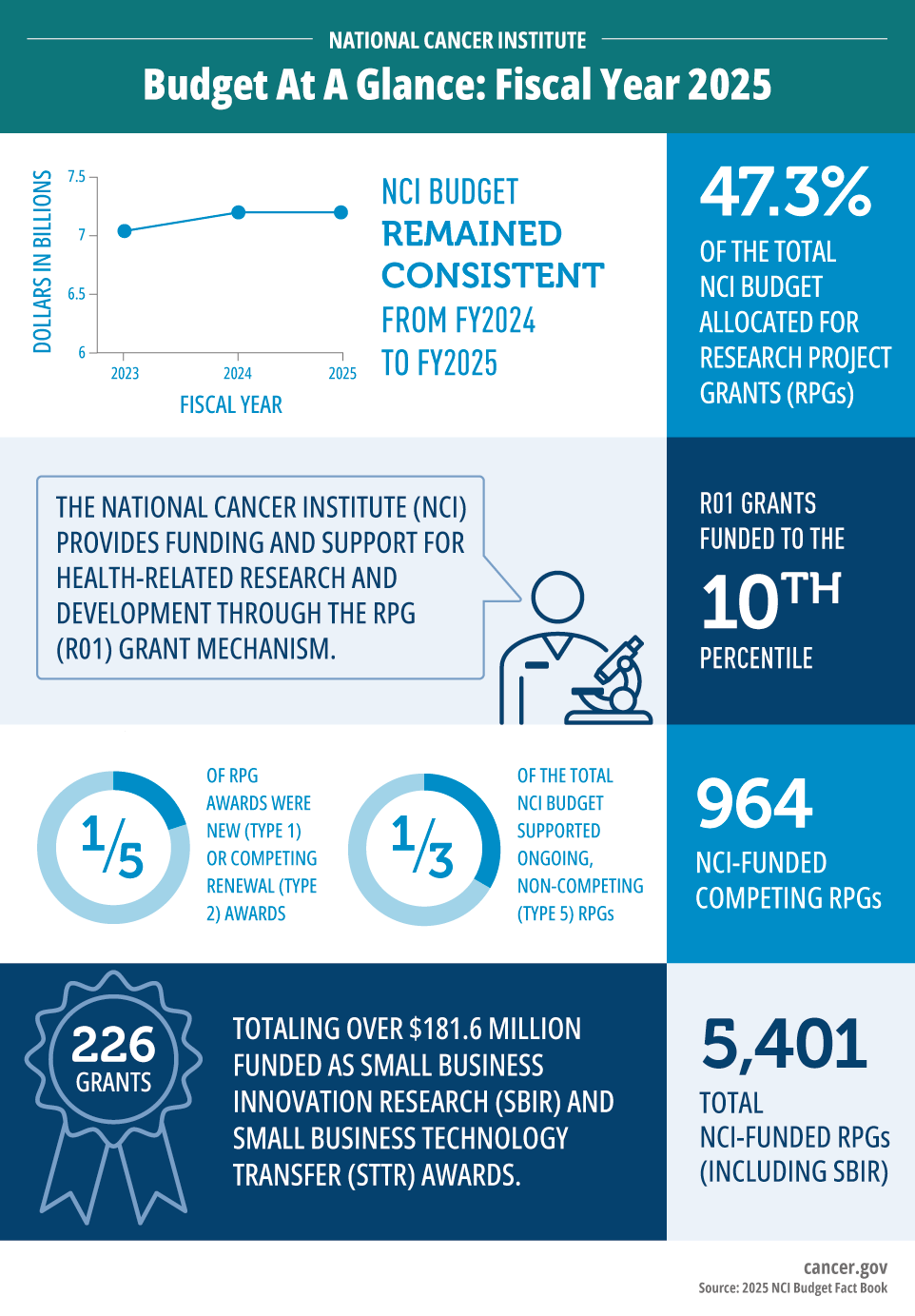
Funds available to the NCI totaled $7.2 billion, after inter-departmental and intra-NIH transfers, including $50 million for the Childhood Cancer Data Initiative and $28 million for Childhood Cancer Survivorship, Treatment, Access, and Research (STAR) Act. This reflects no increase from the previous fiscal year.
Fiscal year highlights include:
- The Childhood Cancer Data Initiative (CCDI) facilitates a connected data infrastructure and integrates multiple data sources to make data work better for patients, clinicians, and researchers.
- The Childhood Cancer Survivorship, Treatment, Access, and Research (STAR) Act, which was signed into law in June 2018, authorized funds for NCI to expand existing biorepositories for childhood cancer patients enrolled in NCI-sponsored clinical trials, which collect and maintain relevant clinical, biological, and demographic information on children, adolescents, and young adults. They allow NCI to continue to conduct and support pediatric cancer survivorship research.
- Of the total NCI budget obligated, 47.3% of the funds were allocated for Research Project Grants (RPGs).
- The total number of RPGs funded was 5,401, including grants funded through the Small Business Innovation Research (SBIR) & Small Business Technology Transfer (STTR) programs.
- Approximately one fifth of the RPGs awarded were new (“Type 1”) or competing renewal (“Type 2” or “Type 4”) awards.
- A total of 964 competing RPGs were funded (excluding grants funded through SBIR & STTR).
- One third of the total NCI budget supported ongoing, non-competing (“Type 5”) RPGs.
- The R01 grants were funded to the 10th percentile for Experienced and New Investigators; the Early-Stage Investigators were funded to the 17th percentile.
- R01 Early-Stage Investigators between the 1st and 9th percentiles were converted to R37 awards, giving them the opportunity to extend their research an additional 2 years.
- SBIR & STTR awards funded 226 grants totaling $181.6 million.
- Intramural Research comprised 17.5% of the total NCI budget.
The dollar amounts displayed in the NCI Budget Fact Book represent direct appropriated funds only, unless otherwise denoted.
NCI Budget Summary Data
This section provides detailed data about funds available to NCI and information on how NCI obligated its funding.
Extramural Programs
NCI uses most of its budget to fund extramural grants and contracts. This section provides information about extramural funding by grant activity, institution, state, and country.
Historical Trends
This section contains information about the history of NCI appropriations and the Professional Judgment (Bypass) Budget, as well as data on funding trends and staffing levels.
Cancer Moonshot - Recent Fiscal Year Funding
This section covers Cancer Moonshot, funded with $1.8 billion over 7 years through the 21st Century Cures Act, signed in December 2016.
About NCI Budget Fact Book
NCI's Office of Budget and Finance conducts financial analyses and develops financial data and information related to the NCI budget. Created using this data, the NCI Budget Fact Book is an annual report that provides information and data from the previous fiscal year, ranging from NCI program structure to research project grant numbers to extramural programs and historical trends.
Email the Office of Budget and Finance at nciobfInquiries@mail.nih.gov with any questions about the NCI Budget Fact Book.
Previous NCI Budget Fact Books
Archives of NCI Budget Fact Books back to 1971 are available.
Information provided in previous NCI Budget Fact Books can now be found online.