
Is iCURE for Me?
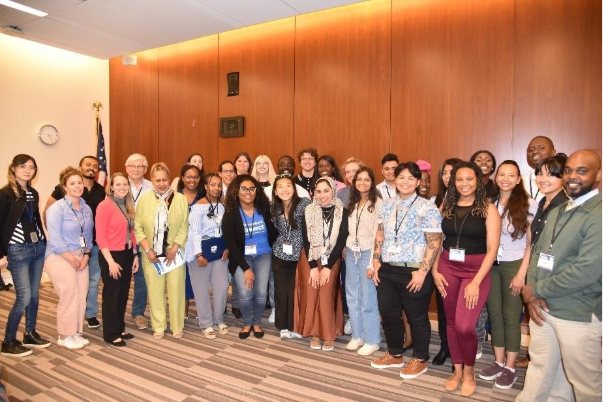
iCURE leadership and scholars gather together to celebrate at the 2024 iCURE Year End Gathering
Review the following statements to see whether iCURE is for you (see full eligibility):
- I am a citizen or non-citizen national, or legal permanent resident of the United States.
- By program start date, I will be eligible as a:
- Postbaccalaureate;
- Graduate Student (who is currently enrolled, in good standing, and has reached candidacy in a PhD program); or,
- Postdoctoral fellow (with no more than five years of relevant research experience since receipt of their most recent doctoral degree (PhD, MD, DDS, or the equivalent))
- If accepted, I am committed to conducting cancer research at one of the NCI campuses in Maryland (Bethesda, Rockville, Frederick) for the duration of the iCURE program.
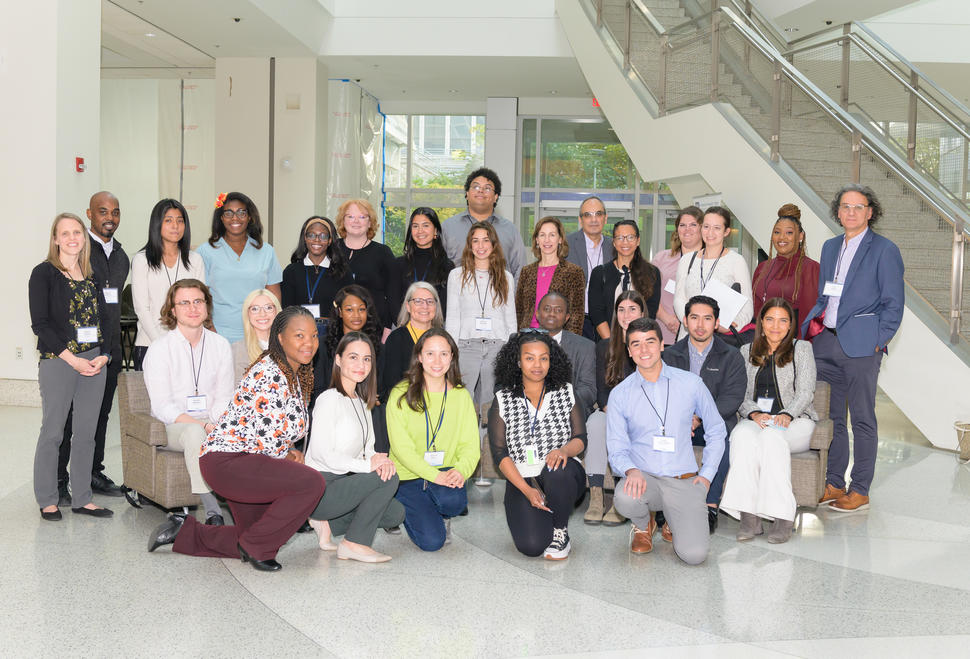
NCI leadership and iCURE scholars and team members gather following the 2022 iCURE Welcome Ceremony.
The iCURE Program Experience
Participants in the iCURE program, or iCURE scholars, will enjoy research opportunities in the Center for Cancer Research (CCR), the Center for Global Health (CGH), the Division of Cancer Epidemiology and Genetics (DCEG), or the Division of Cancer Control and Population Sciences (DCCPS). iCURE provides opportunities for the following candidates:
- Post-baccalaureate (including post-master’s) individuals
- Graduate students
- Postdoctoral fellows
The iCURE program will provide the following:
- Up to two-year research experience fellowships for post-baccalaureate (including post-master’s)
- Up to two-year research experience fellowships for graduate students
- Up to three-year research experience fellowships for postdoctoral fellows
- iCURE research experience awards are paid. iCURE scholars receive a monthly stipend that is determined by their education level and relevant experience. For details on stipends refer to the NIH Intramural Research Program Stipend Tables on the OITE Website.
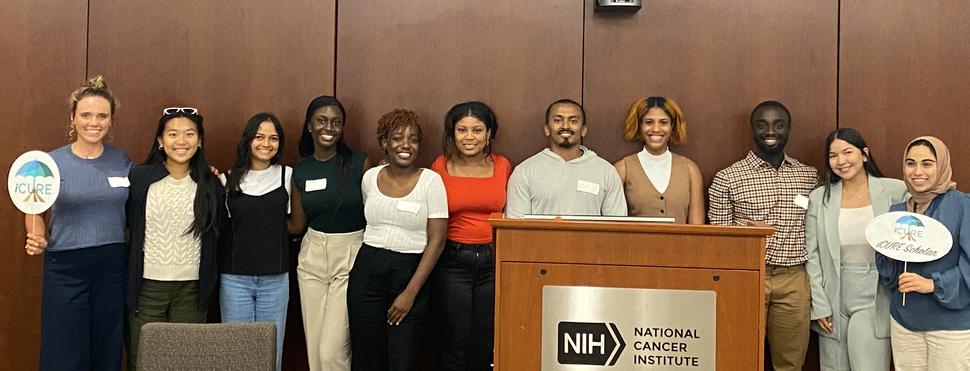
The 2023 iCURE NCI Shady Grove Campus Orientation was held in person. Scholars learned about NCI resources from various speakers and networked with each other.
Continuous opportunities, after one year, are contingent on various factors including:
- Demonstrated progress by mutual agreement among scholar, Principal Investigator the Research Group/Branch Director and the iCURE program.
- Availability of funds.
- Compliance with NIH duration policy for fellowships.
Each iCURE scholar will also enjoy professional and career support such as:
- Opportunities to work closely with world-class biomedical research scientists at the NCI
- Support by NCI program staff as well as information and resources on intramural and extramural funding opportunities
- Professional and career development activities
- Connection to an extensive and sustaining mentoring network
This ecosystem of support will help prepare iCURE scholars for the next steps in their academic and research careers.
Research Experience
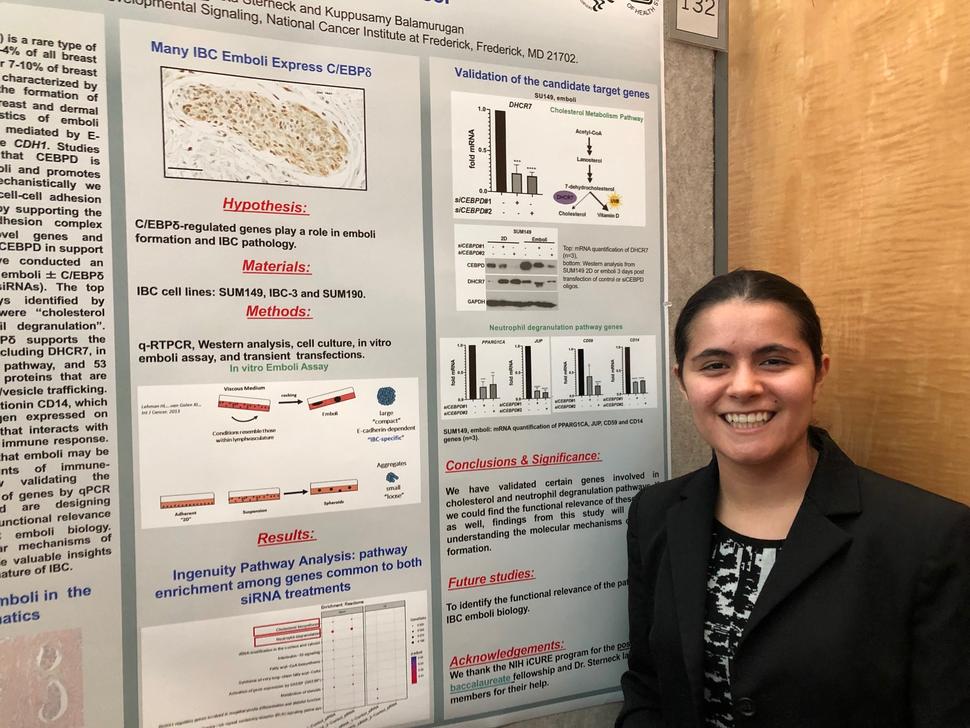
Standing alongside her poster on 2019 NIH Postbac Poster Day, former iCURE postbac scholar Ariana Vitale worked in Dr. Esta Sterneck's group.
The NCI is comprised of two components: intramural and extramural. The Intramural Research Program (IRP) supports projects conducted by scientists located at NCI whereas extramural refers to grants and contracts provided to other institutions. The majority of training opportunities can be found within the IRP, which includes the Center for Cancer Research (CCR) and the Division of Cancer Epidemiology and Genetics (DCEG). Additional opportunities can be found in select extramural divisions, including but not limited to the Center for Global Health (CGH) and the Division of Cancer Control and Population Science (DCCPS).
- Center for Cancer Research (CCR)
The Center for Cancer Research (CCR) is home to more than 250 scientists and clinicians leading intramural research at NCI. CCR is organized into over 50 branches and laboratories, each one grouping scientists with complementary interests. CCR's investigators are basic, clinical, and translational scientists who work together to advance our knowledge of cancer and AIDS and to develop new therapies against these diseases. CCR investigators collaborate with scientists at the more than 20 other Institutes and Centers of the National Institutes of Health (NIH), as well as with extramural scientists in academia and industry. CCR is committed to supporting and training the next generation of cancer researchers, helping launch careers in basic/translational and clinical cancer research. The CCR and NCI offer a research environment that is second-to-none in quality of science and quality of life. All fellowships are intended to increase the number of scientists and physicians who specialize in basic, translational, or clinical biomedical research. Fellows will receive strong mentoring, work with multidisciplinary teams, and have access to world class technology, as well as over 40 cores and other resources.
Investigators within CCR are located on the Bethesda or the Frederick campuses. Learn more about CCR’s research.
- Center for Global Health (CGH)
The Center for Global Health (CGH) supports NCI's mission to improve cancer control worldwide. CGH contributes by advancing global cancer research and training and coordinating NCI engagement in global cancer control. CGH also represents NCI in international research partnerships, playing a key role in coordinating multinational research efforts for global benefit.
Fellows can expect to work on specific research projects, gaining valuable experience and establishing meaningful connections in the field of cancer research. Fellows will support strategic communications projects across the Center with a focus on communications planning and implementation, website management, and social media strategy to increase access to NCI research resources for global audiences.
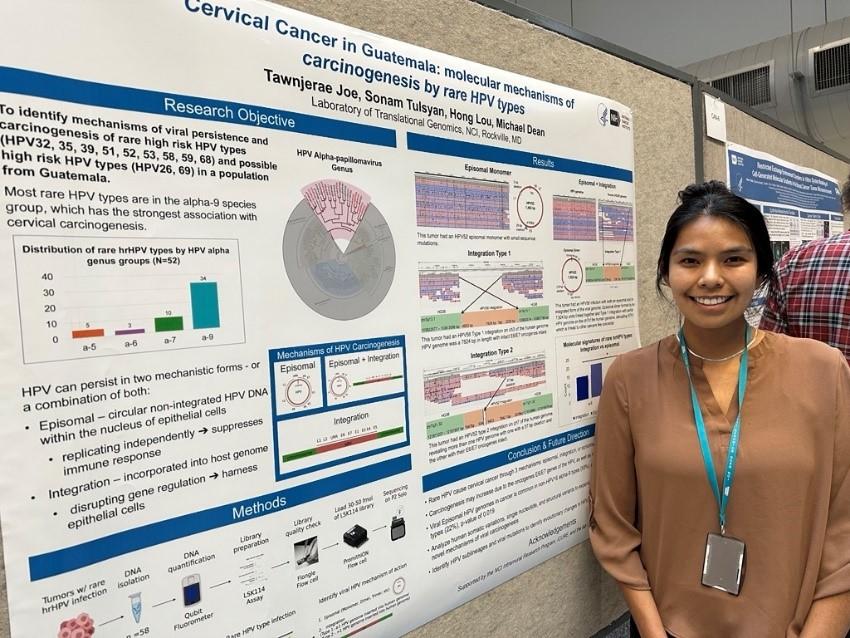
Standing alongside her poster at 2025 NIH Research Festival, iCURE graduate student scholar Tawnjerae Joe who works in Drs. Michael Dean and Lisa Marabello’s group.
Division of Cancer Control and Population Sciences (DCCPS)
The Division of Cancer Control and Population Sciences (DCCPS) aims to reduce risk, incidence, and deaths from cancer as well as enhance the quality of life for cancer survivors. The division conducts and supports an integrated program of the highest quality genetic, epidemiological, behavioral, social, applied, and surveillance cancer research. DCCPS-funded research aims to understand the causes and distribution of cancer in populations, support the development and delivery of effective interventions, and monitor and explain cancer trends in all segments of the population. Central to these activities is the process of synthesis and decision making that aids in evaluating what has been learned, identifying new priorities and strategies, and effectively applying research discoveries to reduce the cancer burden. Fellows will work with a mentor on research projects, literature reviews, data analyses, presentations, and/or manuscript preparation.Scientists within DCCPS are located at the Shady Grove (Rockville) campus. Learn more about DCCPS.
Division of Cancer Epidemiology and Genetics (DCEG)
The Division of Cancer Epidemiology and Genetics (DCEG) conducts population and multidisciplinary research to discover the genetic and environmental determinants of cancer and new approaches to cancer prevention.
DCEG's multidisciplinary research covers most types of cancer and many exposures in a variety of populations. Our cadre of in-house scientists - epidemiologists, geneticists, biostatisticians, and clinicians - form interdisciplinary teams to study complex questions. DCEG forms collaborative partnerships within the NIH/NCI intramural research program and with scientists at academic and medical institutions around the world, which enables it to carry out its research. Fellows will receive world-class training in epidemiological methods, statistical analysis, study design, genetic susceptibility, functional studies, etiology, exposure assessment, and more.
Investigators within DCEG are located at the Shady Grove (Rockville) campus. Learn more about DCEG’s research.
Apply to be an iCURE Scholar
If you are interested in becoming an iCURE scholar:
- Read the eligibility requirements at Train at NCI. Note: iCURE is not accepting applications for Graduate Students this year.
- Register with Login.gov to obtain a username and password.
- Submit an iCURE scholar application.
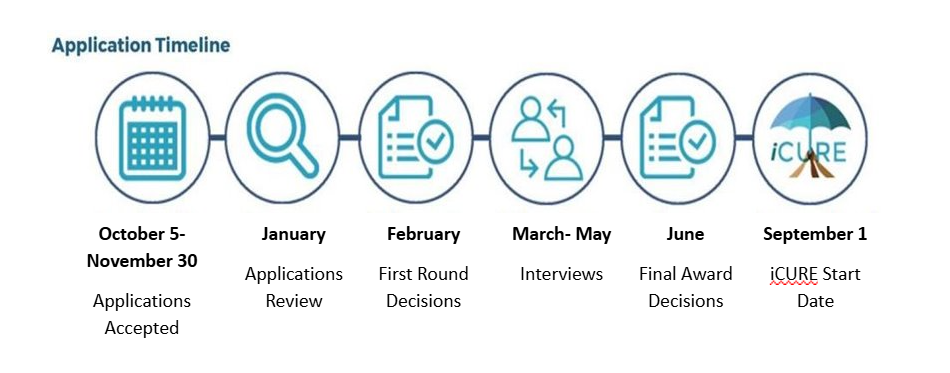
The Fiscal Year 2026 application period is opened through February 16, 2026. Applicants should expect to be informed of their status between March and April. The target start date will be September 1, 2026.
iCURE Eligibility
iCURE scholars must be a citizen or non-citizen national of the United States or an individual who has been lawfully admitted for permanent residence in the United States. Non-citizen national describes individuals that are native to an American territorial possession and have been lawfully admitted for permanent residence in the United States. Please refer to the US Department of State for additional clarification.
Post-baccalaureate (including post-master’s) individuals must either be a college graduate who received a bachelor's degree within three years of beginning the program; or have received a master's degree within six months before beginning the program
Graduate students enrolled in Ph.D., M.D., D.D.S., D.M.D, D.V.M, or equivalent degree programs (which involves dissertation research). Students must have completed course requirements, passed qualifiers, and be formally recognized by the university as a doctoral degree candidate. The NCI research experience is undertaken to engage in a research project for the purpose of developing and writing a doctoral dissertation.
Postdoctoral fellows must have acquired a Ph.D., M.D., D.D.S., D.M.D., D.V.M. or equivalent degree by the proposed iCURE start time and should have completed no more than five years of relevant research experience since receipt of the most recent doctoral degree.
In order to be approved for logical and physical access to NIH facilities and systems, candidates must be able to pass a federal background check.
Contact
If you have questions about the program or application process, please contact iCURE@nih.gov.