
TCGA Outcomes and Impact
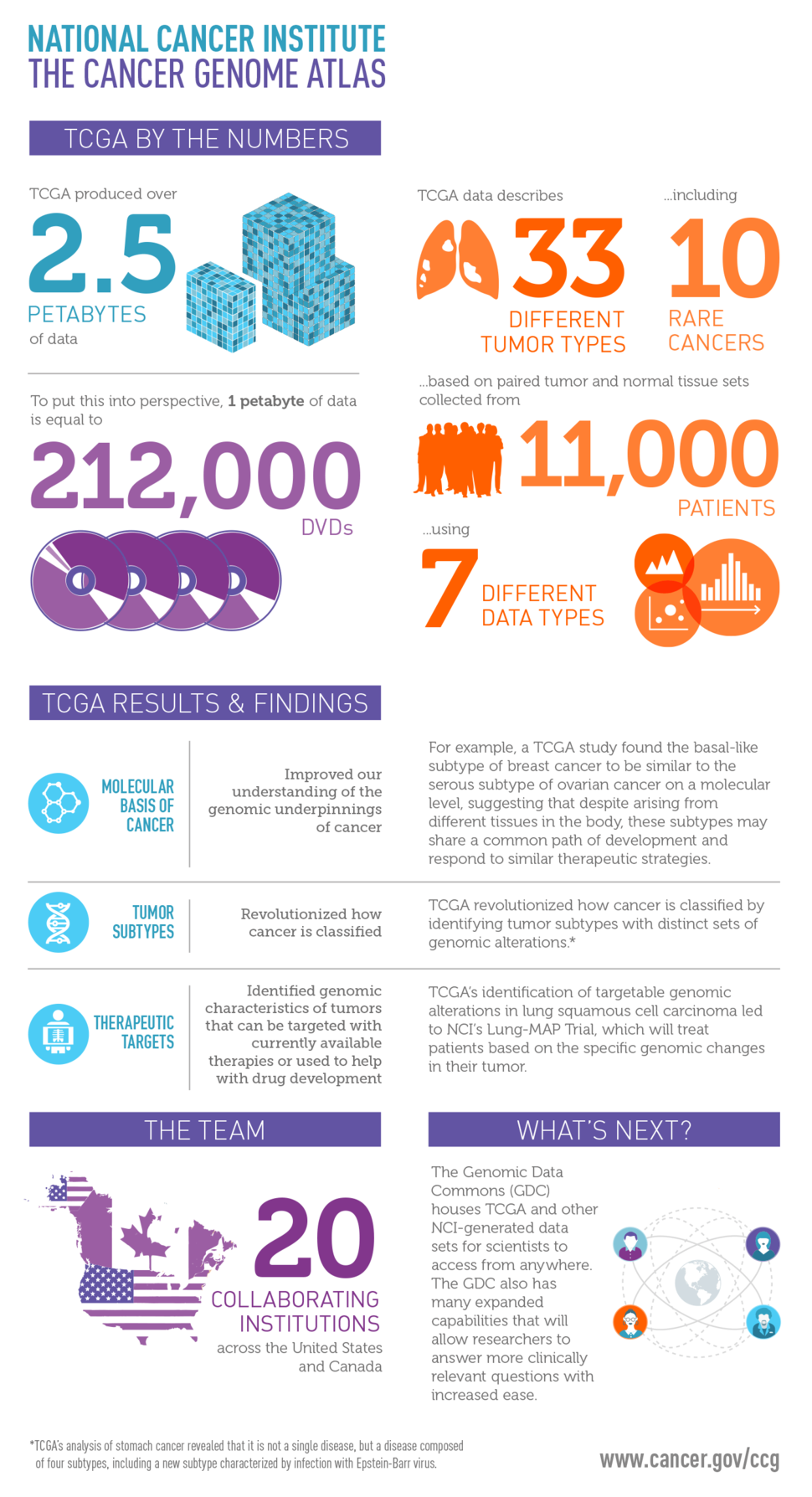
Deepened our understanding of cancer through molecular characterizations
- In addition to canonical substitutions and indels, DNA alterations can occur as various other types (e.g., fusions, copy number alterations, and other complex structural variations).
- Researchers detected aberrations in DNA sequence, gene expression, and epigenetics, as well as protein expression and structure, with each implicating different functional consequences.
- While thousands of alterations have been identified, they can be better understood in the context of functional pathways or assembled together as distinct mutation signatures.
- Cancers of different tissues can share the same alterations and be biologically more similar to each other than to other tumors of the same tissue of origin.
- Tumors are different populations of cells composed of cancer clones and immune cells of varying heterogeneity.
- Generated the Pan-Cancer Atlas, which provides a comprehensive understanding of how, where, and why tumors arise.
Established a rich genomics data resource for the broad research community
- Scientists studying metagenomics, immunology, and other diseases/topics continue to mine and learn from TCGA data.
Bolstered the computational biology field
- The vast amount of data and many data types produced by TCGA have spurred tremendous growth in the computational biology field.
- Researchers developing tools for a wide range of purposes, such as calling somatic and germline mutations, predicting genes of prognostic significance, constructing regulatory networks, batch analysis and correction, and automated analysis of cancer images routinely make use of TCGA data.
Helped advance health and science technologies
- The pursuit of TCGA's mission helped lead to substantial improvements in data quality and reductions in cost for DNA and RNA sequencing.
- Reverse phase protein arrays, formalin-fixed paraffin-embedded sample analyte extraction, and other molecular technologies also saw substantial growth and development.
Changed the way cancer patients are treated in the clinic
- More accurate stratification and prognosis of disease can now be provided through molecular and clinical data, particularly in the case of low grade gliomas and gastric cancer.
- Many molecular subtypes of cancer may be treated by available drugs or have potential targets to investigate.
A reflection on the creation of TCGA and how the program made major impacts in cancer research and beyond can be found in a YouTube video.
TCGA Data and Computational Tools
All data collected and processed by TCGA is available at the Genomic Data Commons (GDC).
Researchers may also consult the GDC's resources for TCGA users, which contains guidance for navigating various data types and transitioning to the GDC from other data repositories.
Summary of TCGA Data Types
| Data Type | Data Subtype | Cancer Types Applicable |
|---|---|---|
| Clinical | Clinical data | All |
| Biospecimen data | All | |
| Pathology Reports | All | |
| Copy Number | SNP microarray | All |
| Copy number microarray | GBM, OV, LUSC | |
| Low-Pass DNA Sequencing | Some tumor types | |
| DNA | Whole exome | All |
| Whole genome | All | |
| SNP microarray | All | |
| Sequence traces | GBM, OV | |
| Imaging | Diagnostic image | All |
| Tissue image | All | |
| Radiological image | Some | |
| Methylation | Bisulfite sequencing | Some tumor types |
| Bead array | All | |
| Microsatellite Instability | N/A | COAD, READ, UCEC |
| miRNA | miRNA Sequencing | All except GBM |
| Array-based | GBM, OV | |
| mRNA Expression | mRNA sequencing | All |
| Total RNA Sequencing | Some tumor types | |
| Microarray | BRCA, COAD, GBM, KIRC, KIRP, LAML, LGG, LUAD, LUSC, OV, READ, UCEC | |
| Protein Expression | Reverse-Phase Protein Array | All |
Citing TCGA in Publications and Presentations
TCGA requests that authors who use any data from TCGA (including clinical, molecular, and imaging data) acknowledge the TCGA Research Network in the acknowledgements section of their work. An example of a proper acknowledgement:
"The results <published or shown> here are in whole or part based upon data generated by the TCGA Research Network."
Citation of original TCGA marker papers producing the data utilized is optional.
Authors are encouraged to recognize the contribution of the appropriate specimen donors and research groups.
Contacts for TCGA
For additional information about the TCGA, please contact Dr. Liming Yang.