
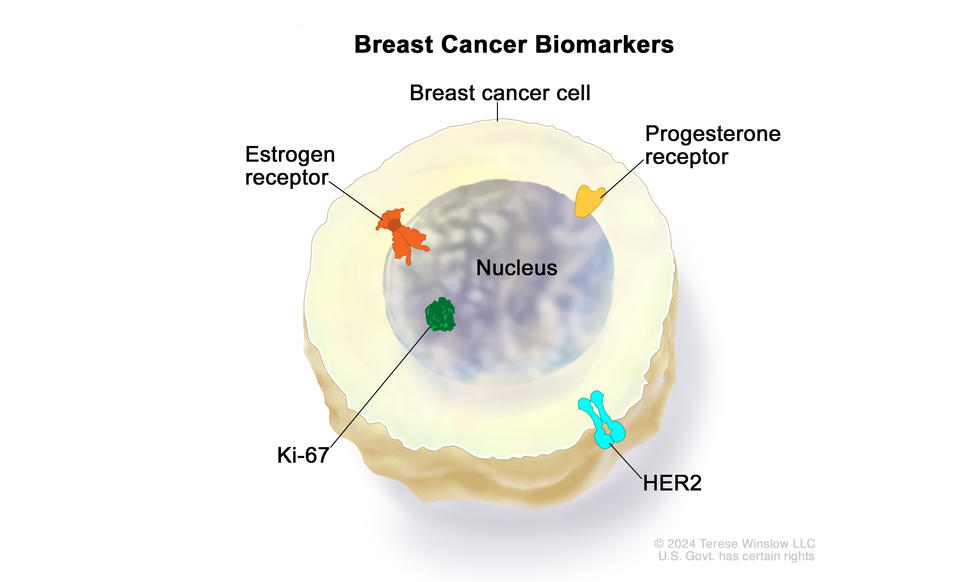
Once breast cancer is diagnosed, breast cancer cells are tested for certain biomarkers and tumor features. To check for biomarkers, samples of tissue containing breast cancer cells are removed during a biopsy or surgery. Then the samples are tested in a lab. In most cases, the sample that was used to diagnose the cancer will also be used for biomarker testing. Learn more about tests to diagnose and stage breast cancer at How Breast Cancer Is Diagnosed.
Biomarker tests give information about:
- how quickly the cancer may grow
- how likely it is that the cancer will spread through the body
- how well certain treatments might work
There are many types of biomarker tests for breast cancer. Tests used most often include:
- estrogen receptor (ER) and progesterone receptor (PR) tests (known together as hormone receptor tests)
- HER2 test
- Ki-67 score
Breast cancer hormone receptor status
Healthy cells in many parts of the body, including the breast, and some breast cancer cells, have receptors that attach to the hormones estrogen and progesterone. These receptors tell cells to grow when estrogen and progesterone are present. When your cancer cells have hormone receptors, it means that one or both of these hormones can fuel cancer growth.
Breast cancer cells that contain estrogen receptors are called estrogen receptor positive (ER positive or ER+). Those that contain progesterone receptors are called progesterone receptor positive (PR positive, PgR positive, or PR+). Most ER-positive breast cancers are also PR positive. Breast cancers with one or both of these receptors are sometimes called hormone receptor positive (HR positive or HR+).
HR-positive breast cancer is often treated with hormone therapy. Some hormone therapies slow or stop the growth of HR-positive cancer by blocking the body’s ability to produce hormones. Others work by interfering with effects of hormones on breast cancer cells.
Breast cancer cells that don’t have estrogen receptors are called estrogen receptor negative (ER negative or ER-). Those that don’t have progesterone receptors are called progesterone receptor negative (PR negative or PR-). When breast cancer cells do not have hormone receptors, they are sometimes called hormone receptor negative (HR negative or HR-).
HR-negative breast cancer probably won’t respond to treatments that block hormones in the body. In these cases, other treatment options, such as chemotherapy, are available.
Hormone receptor status can change over time. So another biopsy to test the cancer for hormone receptors may be needed if your cancer comes back after treatment.
Breast cancer HER2 status
HER2 is a protein that helps control breast cell growth. Some breast cancers have too much HER2, which causes the breast cells to grow and divide more quickly than normal. This is called HER2-positive breast cancer. HER2-positive breast cancer is more likely to be fast-growing than cancers with less HER2 (HER2 negative or HER2 low). HER2 status helps determine whether drugs that target HER2 will help treat the cancer.
Ki-67 score
Ki-67 is a protein that is found only in cells that are dividing. If your tumor has a high number of cancer cells with the Ki-67 protein, it means the cancer cells are dividing quickly. The results of this test may predict how well your cancer will respond to certain treatments, such as chemotherapy.
Biomarker test results and molecular subtypes of breast cancer
Your doctor may use biomarker test results to assign your breast cancer to one of the following groups or subtypes. These groups help show what treatment options may be most effective for you. They also help your doctor estimate the chances that your cancer will come back after treatment.
| Subtype of breast cancer | Defining features | Treatment options |
|---|---|---|
| Luminal A |
Most breast cancers are luminal A. |
|
| Luminal B |
|
|
| HER2-enriched |
|
|
| HER2-low |
|
|
| Basal-like (also called triple-negative) |
|
|