
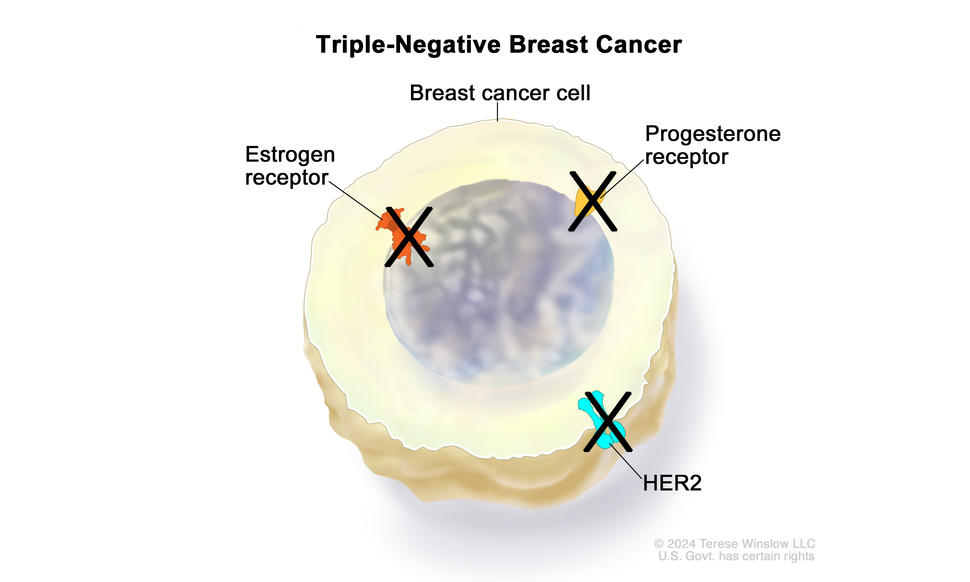
What is triple-negative breast cancer?
When breast cancer is triple negative, it lacks hormone receptors for estrogen and progesterone, and it makes little or none of the protein HER2. In other words, it is negative for all three biomarkers.
Triple-negative breast cancer (TNBC) makes up about 15% of all breast cancers. It is usually diagnosed at a later stage, grows more quickly, and is more likely to come back than other types of invasive breast cancer. Because TNBC grows quickly, it is rarely diagnosed as ductal carcinoma in situ (stage 0) and is almost always invasive.
What are the risk factors for triple-negative breast cancer?
TNBC is more common in certain age groups and populations. TNBC is:
- often diagnosed at a younger age
- more common and diagnosed at a younger age in Black women than in White women
- more common in women with certain gene changes, including changes in BRCA1 or BRCA2 genes
The cause of TNBC is unknown, and other risk factors are the same as for other types of breast cancer. For more information, visit Breast Cancer Causes and Risk Factors.
What are the symptoms of triple-negative breast cancer?
Symptoms of TNBC are the same as for most other breast cancers (except inflammatory breast cancer). However, TNBC does not always cause symptoms.
Learn more about Breast Cancer Symptoms.
How is triple-negative breast cancer diagnosed?
If you have symptoms or screening test results that suggest breast cancer, your doctor will need to find out if they are due to cancer or another condition. Your doctor may:
- do a physical exam, including a clinical breast exam
- ask about your personal and family medical history to learn more about your symptoms and risk factors for breast cancer
- do imaging tests, such as a mammogram, breast ultrasound, or breast MRI
- do a breast biopsy
If it is cancer, additional tests may include:
- Biomarker tests. These will reveal if the cancer is triple negative. Triple negative means the results of biomarker tests showed that the cancer cells do not have hormone receptors and make little or no HER2 protein. Learn more about Tests for Breast Cancer Biomarkers.
- PET scan or CT scan. These imaging tests will determine the extent of spread of the cancer.
Your doctor will assign a stage to the cancer based on a combination of the extent of spread, triple-negative status, and other tumor features, such as tumor grade.
Learn more about tests used to diagnose breast cancer and the different stages of breast cancer at How Breast Cancer Is Diagnosed and Breast Cancer Stages.
How is triple-negative breast cancer treated?
TNBC can be more difficult to treat than other types of breast cancer because the cancer cells lack hormone receptors and do not make much or any of the protein HER2. This means therapies that target those biomarkers don't work for people with TNBC. However, chemotherapy and other treatments, including immunotherapy, are available.
For information about how TNBC is treated, visit Triple-Negative Breast Cancer Treatment.
What is the survival rate and prognosis for people with triple-negative breast cancer?
People with TNBC generally have a less favorable prognosis and survival rate than people with other types of breast cancer. That is because TNBC grows more quickly and is more likely to come back than other types of breast cancer. If you are diagnosed with TNBC, your prognosis will depend on many factors, including the stage of the cancer when it is diagnosed and your age and general health.
Survival rates for triple-negative breast cancer
Doctors estimate TNBC prognosis by using statistics collected over many years from people with TNBC. One statistic that is commonly used in making a prognosis is the 5-year relative survival rate. The 5-year relative survival rate tells you what percent of people with the same type and stage of breast cancer are alive 5 years after their cancer was diagnosed, compared with people in the overall population.
The 5-year relative survival rates for TNBC are:
- 91% for localized TNBC (cancer is in the breast only)
- 66% for regional TNBC (cancer has spread beyond the breast to nearby lymph nodes or organs)
- 12% for metastatic TNBC (cancer has spread beyond the breast to a distant part of the body)
To learn more about factors that affect breast cancer prognosis, visit Breast Cancer Prognosis and Survival Rates.