
How breast cancer stage is determined
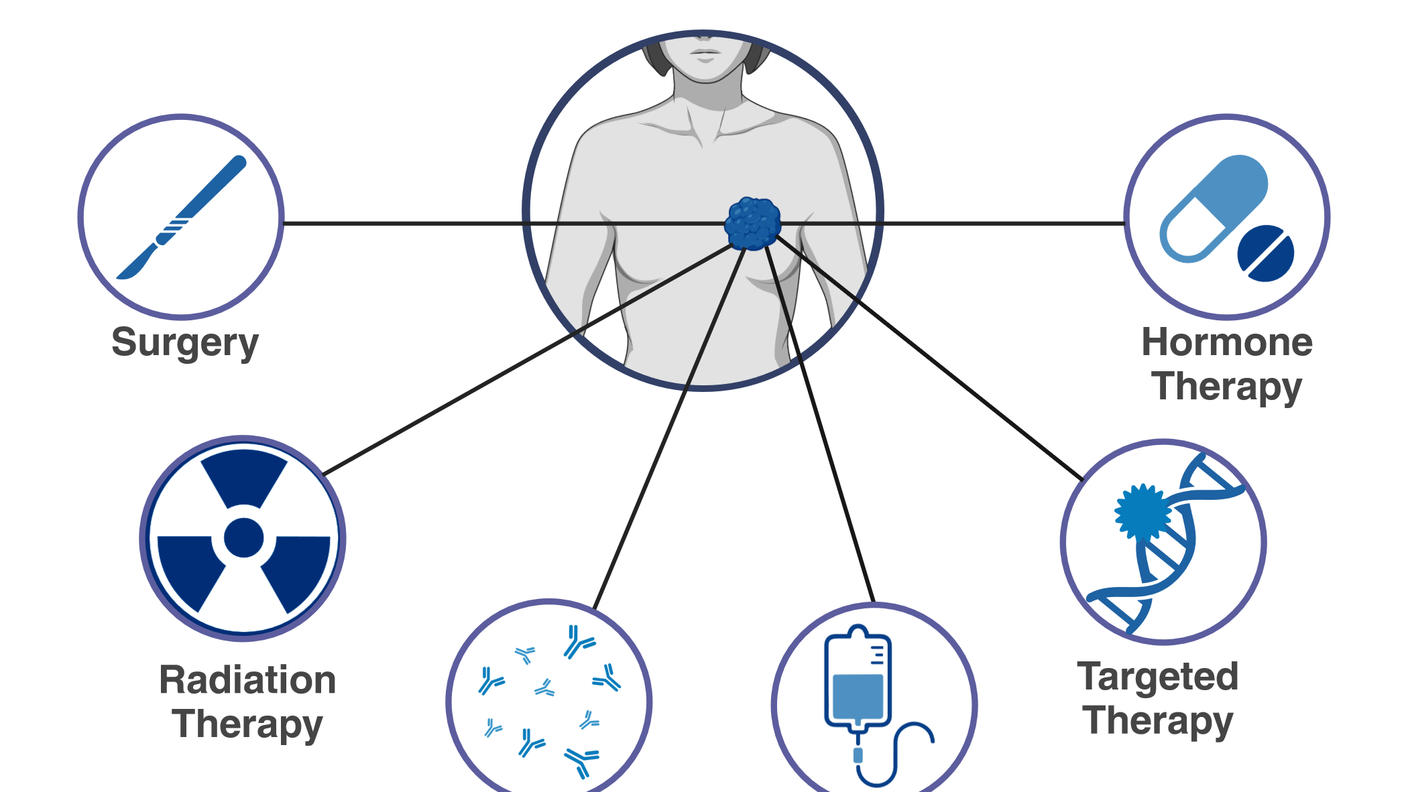
There are two types of staging for breast cancer. Staging done before surgery is called clinical prognostic staging, and staging done after surgery is called pathological prognostic staging.
- Clinical prognostic stage is used first to assign a stage for anyone diagnosed with breast cancer. It is based on health history, physical examination, imaging tests (including mammography or ultrasound examination of the lymph nodes), and biopsy findings.
- Pathological prognostic stage is used only for people who have surgery as their first treatment for breast cancer. The pathological prognostic stage is based on all clinical information, biomarker status, and laboratory test results from breast tissue and lymph nodes removed during surgery.
In both types of staging, a number between 0 and IV (4) is assigned. This number is determined by a combination of three factors: TNM (tumor node metastasis) value, grade, and biomarker status (whether the tumor has certain hormone receptors or high levels of HER2). Results from multigene tests may be used to help stage some breast cancers. Generally, the lower the stage number, the less the cancer has spread.
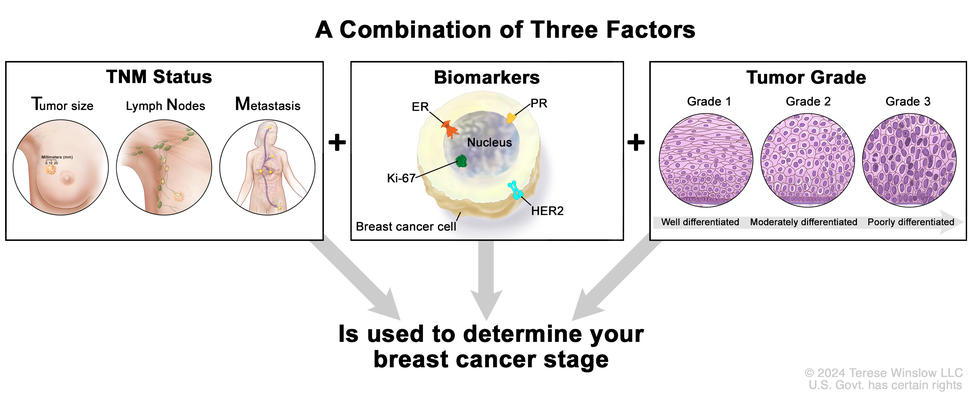
In breast cancer, stage is based on the TNM status (the size and location of the primary tumor and the spread of cancer to nearby lymph nodes or other parts of the body), the presence of certain biomarkers, and the grade of the tumor.
Credit: © Terese Winslow
TNM staging
TNM staging uses T, N, and M categories to describe the size of the primary tumor and whether the cancer has spread to nearby lymph nodes or other parts of the body.
- Tumor (T): The size and location of the tumor.
- Lymph node (N): The location of the lymph nodes where cancer has spread and the size of the cancer in the lymph nodes.
- Metastasis (M): The spread of cancer to other parts of the body.
The numbers or letters after T, N, and M provide more details about the cancer. Higher numbers generally mean the cancer is more advanced.
To learn more, review the full TNM staging descriptions for breast cancer.
The grading system
Tumor grade describes how abnormal the cancer cells and tissue look under a microscope and how quickly the cancer cells are likely to grow and spread. Low-grade cancer cells look more like normal cells and tend to grow and spread more slowly than high-grade cancer cells. To describe how abnormal the cancer cells and tissue are, the pathologist will assess the following three features:
- how much of the tumor tissue has normal breast ducts
- the size and shape of the nuclei in the tumor cells
- how many dividing cells are present, which is a measure of how fast the tumor cells are growing and dividing
For each feature, the pathologist assigns a score of 1 to 3. A score of 1 means the cells and tumor tissue look the most like normal cells and tissue, and a score of 3 means the cells and tissue look the most abnormal. The scores for each feature are added together to get a total score between 3 and 9.
Three grades are possible:
- total score of 3 to 5: G1 (low grade or well differentiated)
- total score of 6 to 7: G2 (intermediate grade or moderately differentiated)
- total score of 8 to 9: G3 (high grade or poorly differentiated)
Biomarker testing
Biomarker testing is used to find out whether breast cancer cells have certain receptors (biomarkers), including:
- Estrogen receptor (ER). If the breast cancer cells have estrogen receptors, the cancer cells are called ER positive (ER+). If the breast cancer cells do not have estrogen receptors, the cancer cells are called ER negative (ER-).
- Progesterone receptor (PR). If the breast cancer cells have progesterone receptors, the cancer cells are called PR positive (PR+). If the breast cancer cells do not have progesterone receptors, the cancer cells are called PR negative (PR-).
- Human epidermal growth factor type 2 receptor (HER2/neu or HER2). If the breast cancer cells have more than the normal amount of HER2 receptors on their surface, the cancer cells are called HER2 positive (HER2+). If the breast cancer cells have a normal amount of HER2 on their surface, the cancer cells are called HER2 negative (HER2-). HER2+ breast cancer is more likely to grow and divide faster than HER2- breast cancer.
Learn more about Tests for Breast Cancer Biomarkers.
Stage 0 breast cancer
Stage 0 is a noninvasive breast cancer, such as ductal carcinoma in situ (DCIS). In stage 0, abnormal cells are found in the breast, but there is no evidence that these cells have spread from where they first formed. Stage 0 breast cancers can be any grade and have any biomarker (HER2, ER, PR) status.
Learn about treatment for DCIS at Ductal Carcinoma in Situ in the section, “How is DCIS treated?”
Stage I (1) breast cancer
In stage I breast cancer, the cancer is small and only in the breast tissue, or it might be found in lymph nodes close to the breast. Stage I can be divided into stage IA and stage IB. The difference is determined by the size of the tumor and whether there are any lymph nodes with cancer.
Learn about treatment of stage I breast cancer.
Stage IA
Stage IA breast cancer generally has a TNM score of T0 or T1, N0 or N1, and M0. It can be any grade and different combinations of HER2, ER, and PR status. To learn more about the different staging factors, visit TNM Staging for Breast Cancer.
| TNM | Grade | HER2 Status | ER Status | PR Status |
|---|---|---|---|---|
| T1, N0, M0 | G1 | Positive | Positive | Any |
| T0, N1mi, M0 | G1 | Positive | Negative | Any |
| T1, N1mi, M0 | G1 or G2 | Negative | Positive | Any |
| T1, N1mi, M0 | G1 or G2 | Negative | Negative | Positive |
| T1, N1mi, M0 | G2 or G3 | Positive | Any | Any |
| T1, N1mi, M0 | G3 | Negative | Positive | Positive |
Abbreviations: T = tumor N = lymph node M = metastasis, HER2 = human epidermal growth factor type 2 receptor, ER = estrogen receptor, PR = progesterone receptor.
Stage IB
Stage IB breast cancer generally has a TNM score of T0 or T1, N0 or N1, and M0. It can be any grade and different combinations of HER2, ER, and PR status. To learn more about the different staging factors, visit TNM Staging for Breast Cancer.
| TNM | Grade | HER2 Status | ER Status | PR Status |
|---|---|---|---|---|
| T1, N1mi, M0 | G1 or G2 | Negative | Negative | Negative |
| T0, N1, M0 T1, N1, M0 T2, N0, M0 | G1 or G2 | Any | Positive | Positive |
| T0, N1, M0 T1, N1, M0 T2, N0, M0 | G3 | Positive | Positive | Positive |
| T2, N1, M0 T3, N0, M0 | Any | Positive | Positive | Positive |
| T1, N1mi, M0 | G3 | Negative | Positive | Negative |
| T1, N1mi, M0 | G3 | Negative | Negative | Any |
| T0, N1, M0 T1, N1, M0 T2, N0, M0 | G3 | Positive | Positive | Positive |
Stage II (2) breast cancer
In stage II breast cancer, there is cancer in the breast or nearby lymph nodes or both. This stage is divided into groups: Stage IIA and Stage IIB. The difference is determined by the size of the tumor and whether the breast cancer has spread to the lymph nodes.
Learn about treatment of stage II breast cancer.
Stage IIA
Stage IIA breast cancer generally has a TNM score of T0, T1, or T2; N0 or N1; and M0. It can be any grade and different combinations of HER2, ER, and PR status. To learn more about the different staging factors, visit TNM Staging for Breast Cancer.
| TNM | Grade | HER2 Status | ER Status | PR Status |
|---|---|---|---|---|
| T0, N1, M0 T1, N1, M0 T2, N0, M0 | G1 or G2 | Positive | Positive | Negative |
| T0, N1, M0 T1, N1, M0 T2, N0, M0 | G1 or G2 | Positive | Negative | Any |
| T0, N1, M0 T1, N1, M0 T2, N0, M0 | G1 or G2 | Negative | Positive | Negative |
| T0, N1, M0 T1, N1, M0 T2, N0, M0 | G1 | Negative | Negative | Any |
| T0, N1, M0 T1, N1, M0 T2, N0, M0 | G2 | Negative | Negative | Positive |
Stage IIB
Stage IIB breast cancer generally has a TNM score of T0, T1, or T2; N0 or N1; and M0. It can be any grade and different combinations of HER2, ER, and PR status. To learn more about the different staging factors, visit TNM Staging for Breast Cancer.
| TNM | Grade | HER2 Status | ER Status | PR Status |
|---|---|---|---|---|
| T0, N1, M0 T1, N1, M0 T2, N0, M0 | G2 | Negative | Negative | Negative |
| T0, N1, M0 T1, N1, M0 T2, N0, M0 | G3 | Negative | Positive | Negative |
| T0, N1, M0 T1, N1, M0 T2, N0, M0 | G3 | Negative | Negative | Any |
| T2, N1, M0 T3, N0, M0 | G1 or G2 | Positive | Negative | Negative |
| T2, N1, M0 T3, N0, M0 | G1 or G2 | Negative | Positive | Negative |
| T2, N1, M0 T3, N0, M0 | G1 or G2 | Negative | Negative | Any |
| T2, N1, M0 T3, N0, M0 | G3 | Positive | Positive | Negative |
| T2, N1, M0 T3, N0, M0 | G3 | Positive | Negative | Any |
| T2, N1, M0 T3, N0, M0 | G3 | Negative | Positive | Positive |
| T0, N2, M0 T1, N2, M0 T2, N2, M0 T3, N1, M0 T3, N2, M0 | G3 | Positive | Positive | Positive |
Stage III (3) breast cancer
In stage III breast cancer, the cancer is found in the lymph nodes close to the breast, the skin of the breast, or the chest wall.
Learn about treatment of stage III breast cancer.
Stage IIIA
Stage IIIA breast cancer generally has a TNM score of any T, any N, and M0. It can be any grade and different combinations of HER2, ER, and PR status. To learn more about the different staging factors, visit TNM Staging for Breast Cancer.
| TNM | Grade | HER2 Status | ER Status | PR Status |
|---|---|---|---|---|
| T2, N1, M0 T3, N0, M0 | G3 | Negative | Positive | Negative |
| T2, N1, M0 T3, N0, M0 | G3 | Negative | Negative | Positive |
| T0, N2, M0 T1, N2, M0 T2, N2, M0 T3, N1, M0 T3, N2, M0 | Any | Positive | Positive | Negative |
| T0, N2, M0 T1, N2, M0 T2, N2, M0 T3, N1, M0 T3, N2, M0 | Any | Positive | Negative | Any |
| T0, N2, M0 T1, N2, M0 T2, N2, M0 T3, N1, M0 T3, N2, M0 | G1 or G2 | Negative | Positive | Negative |
| T0, N2, M0 T1, N2, M0 T2, N2, M0 T3, N1, M0 T3, N2, M0 | G2 | Negative | Negative | Positive |
| T0, N2, M0 T1, N2, M0 T2, N2, M0 T3, N1, M0 T3, N2, M0 | G3 | Negative | Positive | Positive |
| T4, N0, M0 T4, N1, M0 T4, N2, M0 Any T, N3, M0 | G1 or G2 | Positive | Positive | Positive |
Stage IIIB
Stage IIIB breast cancer generally has a TNM score of any T, any N, and M0. It can be any grade and different combinations of HER2, ER, and PR status. To learn more about the different staging factors, visit TNM Staging for Breast Cancer.
| TNM | Grade | HER2 Status | ER Status | PR Status |
|---|---|---|---|---|
| T2, N1, M0 T3, N0, M0 | G2 or G3 | Negative | Negative | Negative |
| T0, N2, M0 T1, N2, M0 T2, N2, M0 T3, N1, M0 T3, N2, M0 | G1 or G2 | Negative | Negative | Negative |
| T0, N2, M0 T1, N2, M0 T2, N2, M0 T3, N1, M0 T3, N2, M0 | G3 | Negative | Positive | Negative |
| T0, N2, M0 T1, N2, M0 T2, N2, M0 T3, N1, M0 T3, N2, M0 | G3 | Negative | Negative | Positive |
| T4, N0, M0 T4, N1, M0 T4, N2, M0 Any T, N3, M0 | G1 or G2 | Positive | Positive | Negative |
| T4, N0, M0 T4, N1, M0 T4, N2, M0 Any T, N3, M0 | G1 or G2 | Positive | Negative | Any |
| T4, N0, M0 T4, N1, M0 T4, N2, M0 Any T, N3, M0 | G1 or G2 | Negative | Positive | Any |
| T4, N0, M0 T4, N1, M0 T4, N2, M0 Any T, N3, M0 | G1 or G2 | Negative | Negative | Positive |
| T4, N0, M0 T4, N1, M0 T4, N2, M0 Any T, N3, M0 | G3 | Positive | Any | Any |
| T4, N0, M0 T4, N1, M0 T4, N2, M0 Any T, N3, M0 | G3 | Negative | Positive | Positive |
Stage IIIC
Stage IIIC breast cancer generally has a TNM score of any T, any N, and M0. It can be any grade and different combinations of HER2, ER, and PR status. To learn more about the different staging factors, visit TNM Staging for Breast Cancer.
| TNM | Grade | HER2 Status | ER Status | PR Status |
|---|---|---|---|---|
| T0, N2, M0 T1, N2, M0 T2, N2, M0 T3, N1, M0 T3, N2, M0 | G3 | Negative | Negative | Negative |
| T4, N0, M0 T4, N1, M0 T4, N2, M0 Any T, N3, M0 | G1 or G2 | Negative | Negative | Negative |
| T4, N0, M0 T4, N1, M0 T4, N2, M0 Any T, N3, M0 | G3 | Negative | Positive | Negative |
| T4, N0, M0 T4, N1, M0 T4, N2, M0 Any T, N3, M0 | G3 | Negative | Negative | Any |
Stage IV (4) or metastatic breast cancer
Stage IV breast cancer means that the cancer has spread to other parts of the body, such as the bones, liver, or lungs. This stage is also called metastatic breast cancer.
Stage IV breast cancer generally has a TNM score of any T, any N, and M1. It can be any grade and different combinations of HER2, ER, and PR status. To learn more about the different staging factors, visit TNM Staging for Breast Cancer.
| TNM | Grade | HER2 Status | ER Status | PR Status |
|---|---|---|---|---|
| Any T, Any N, M1 | Any | Any | Any | Any |
Learn about treatment for metastatic breast cancer at Metastatic Breast Cancer in the section, “How is metastatic breast cancer treated?”
Recurrent breast cancer
Recurrent breast cancer is cancer that has recurred (come back) after it has been treated. Breast cancer may come back in the breast (local recurrence); nearby lymph nodes, chest, or skin (regional recurrence); or other parts of the body, such as the liver, lung, or bone (distant or metastatic recurrence).
To figure out the type of recurrence you have, you will have many of the same tests you had when your cancer was first diagnosed, such as lab tests and imaging procedures. These tests help determine where in your body the cancer has returned, if it has spread, and how far. Your doctor may refer to this new assessment of your cancer as “restaging.”
After these tests, the doctor may assign a new stage to the cancer. A letter “r” will be added to the beginning of the new stage to reflect the restaging.
Learn about how recurrent breast cancer is treated at Breast Cancer Recurrence in the section, “How is recurrent breast cancer treated?”