
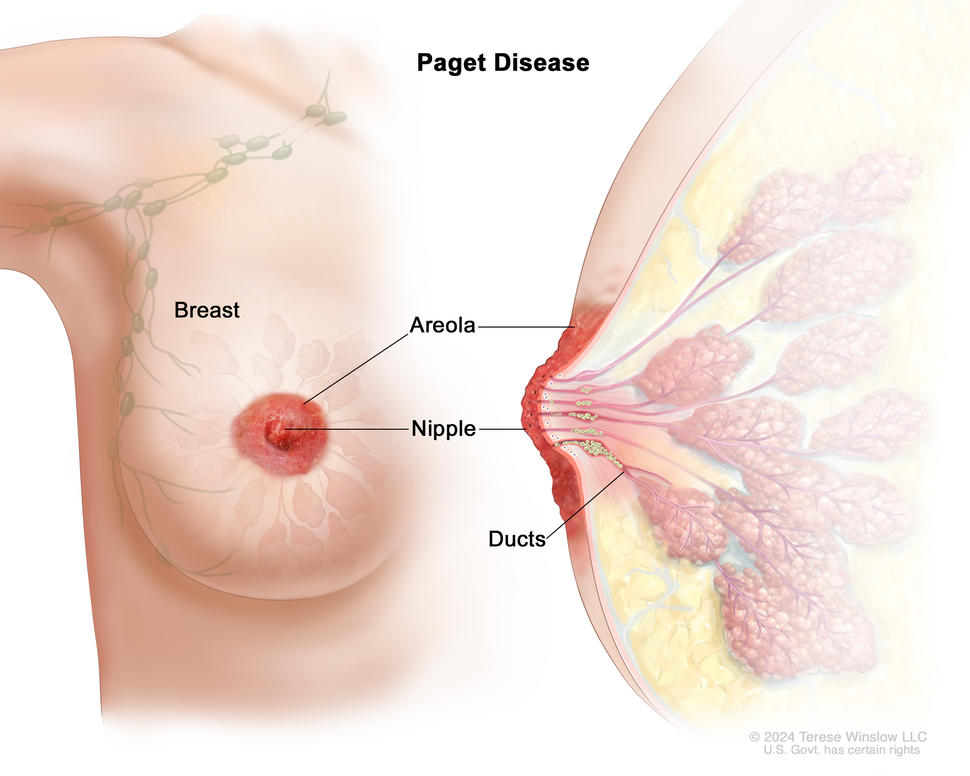
What is Paget disease of the breast?
Paget disease of the breast is a rare type of cancer involving the nipple and usually the areola (the darker circle of skin around the nipple). About 1%–3% of all breast cancers are Paget disease of the breast.
What are the causes of and risk factors for Paget disease of the breast?
Scientists do not fully understand what causes Paget disease of the breast. Cancer cells from a tumor inside the breast may travel through the milk ducts to the nipple and areola, or the cancer may begin in the nipple and spread from there.
Risk factors for Paget disease of the breast are the same as those for other types of breast cancer. Learn more at Breast Cancer Causes and Risk Factors.
What are the symptoms of Paget disease of the breast?
Paget disease of the breast can look similar to skin conditions such as dermatitis and eczema. Symptoms of Paget disease of the breast may include:
- itching, tingling, or redness in the nipple and/or areola
- flaking, crusty, or thickened skin on or around the nipple
- a flattened nipple
- discharge from the nipple that may be yellowish or bloody
People with Paget disease may also have a tumor or lump in the same breast.
How is Paget disease of the breast diagnosed?
If you have symptoms of Paget disease of the breast, your doctor will need to find out if they are due to Paget disease or another condition. They may:
- do a physical exam, including a clinical breast exam
- ask about your personal and family medical history to learn more about your symptoms and risk factors for breast cancer
- do imaging tests, such as a mammogram, breast ultrasound, or breast MRI, to see if a tumor or abnormal area is present inside the breast
- do a skin biopsy; types of skin biopsies include:
- surface biopsy: a glass slide or other tool is used to gently scrape cells from the surface of the skin
- shave biopsy: a razor-like tool is used to remove the top layer of skin
- punch biopsy: a circular cutting tool, called a punch, is used to remove a disk-shaped piece of tissue
- wedge biopsy: a scalpel is used to remove a small wedge of tissue
If a skin biopsy shows you have Paget disease but imaging does not reveal an abnormal area inside the breast, you will likely be diagnosed with stage 0 breast cancer (ductal carcinoma in situ). However, some people with Paget disease and no abnormal area inside the breast also have invasive breast cancer.
If imaging reveals an abnormal area inside the breast, you will have a biopsy of the area to see if it is cancer. If cancer is found, you will have biomarker tests. These will check the cancer cells for hormone receptors and HER2 protein that may help plan treatment. Learn more about Tests for Breast Cancer Biomarkers.
Also, your doctor may order imaging tests like a PET or CT scan to see if the cancer has spread.
Your doctor will assign a stage to the cancer based on a combination of the extent of spread, hormone receptor- and HER2-status, and other tumor features, such as tumor grade.
Learn more about imaging and tests used to diagnose breast cancer at How Breast Cancer Is Diagnosed.
How is Paget disease of the breast treated?
If tests show that you have Paget disease and ductal carcinoma in situ (DCIS), your treatment will be like that of someone with DCIS. However, you may have more extensive surgery to the nipple to remove Paget cells. Learn about how DCIS is treated at Ductal Carcinoma in Situ.
If you are diagnosed with Paget disease and invasive breast cancer, meaning the cancer has spread beyond where it first formed, Paget disease will be treated as invasive breast cancer based on the extent of spread and other molecular features. Learn more at Breast Cancer Treatment by Stage.
What is the prognosis for people with Paget disease of the breast?
The prognosis for people with Paget disease of the breast depends on:
- whether a tumor is present in the affected breast
- whether the tumor, if present, is ductal carcinoma in situ or invasive breast cancer
- the stage of the cancer, if it is invasive
Survival rates for Paget disease of the breast
Paget disease of the breast tends to have a slightly less favorable prognosis and survival rate than other types of breast cancer. Your doctor is in the best position to discuss your prognosis with you. Some people like to have a loved one or friend with them for the conversation. Learn more about factors that affect breast cancer prognosis at Breast Cancer Prognosis and Survival Rates.
Ongoing research will increase our understanding of how Paget disease of the breast begins and progresses, which could lead to new treatments and better outcomes for people with this disease. If you have been diagnosed with Paget disease of the breast, you may want to talk with your doctor about the possibility of participating in a clinical trial. Learn more about clinical trials at Cancer Clinical Trial Information for Patients and Caregivers.