
Development of Cancer Tissue Engineered Models and Platforms
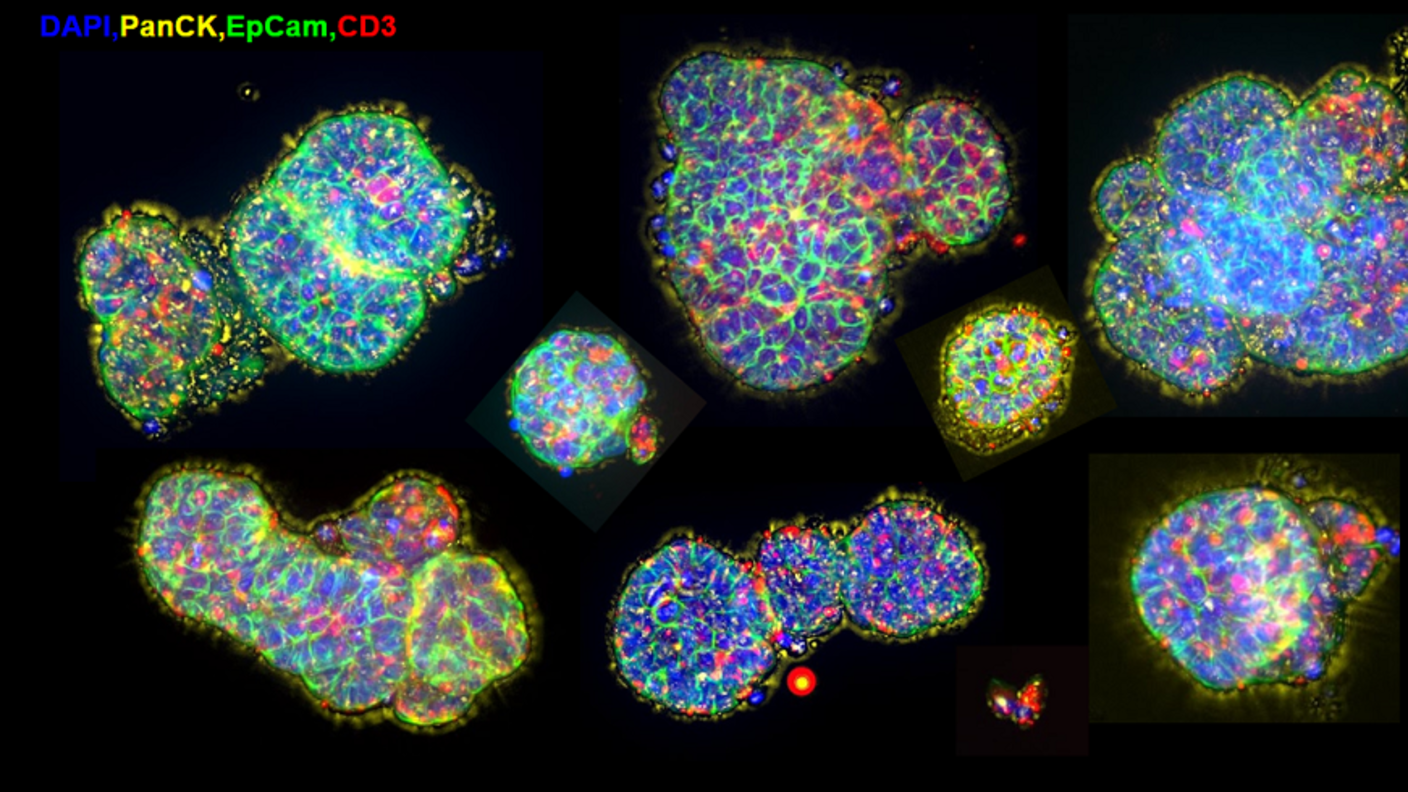
Investigators with the Brigham and Women’s Hospital TEC Project developed a cancer-on-a-chip model to examine tumor-immune interactions and test responses to immunotherapy.
Dr. Shannon Mumenthaler et al. with the Ellison Institute/USC TEC Project developed a colorectal cancer-on-chip model that recapitulates the tumor microenvironment. Using this platform, they identified factors that play a role in early metastatic spread.
Researchers with the Auburn TEC Project developed a 3D tissue engineered model of colorectal cancer, which recapitulates features of individual patients’ tumors and cancer heterogeneity.
Dr. Brendan Harley et al. with the University of Illinois at Urbana-Champaign TEC Project engineered a hydrogel microdroplet-based glioblastoma drug screening platform. According to the authors of the study, this work "suggests cell-laden microgels offer a valuable system for high-dimensional studies of drug efficacy with cells maintained in well-defined matrix microenvironments."
Development of New Approaches and Methods for Cancer Tissue Engineering
Blood vessels play an important role in the tumor microenvironment and its response to treatments. Researchers with the MIT TEC Project developed a new method to improve vascularization (i.e., blood vessel growth) in tumor spheroids, which enables immunotherapy studies.
Investigators with the Brigham and Women's Hospital TEC Project developed a machine learning–guided 3D bioprinting method that can create tiny, branching blood vessel networks similar in size and structure to natural capillaries.
Biological Discoveries with Cancer Tissue Engineered Models
Using 3D microtumor models, Dr. Shilpa Sant et al. with the University of Pittsburgh TEC Project revealed how microenvironmental factors promote collective cell migration in breast cancer.
Using 3D models and an organ-on-a-chip system, Dr. Joanna Burdette et al. with the University of Illinois – Chicago TEC Project found that versican (an ovary secreted protein during ovulation) enhances the migration and invasion of fallopian tube epithelial cells, including cancerous cells. This finding suggests that versican may play a role in ovarian cancer metastasis.
Using an engineered microtumor, investigators with the Boston University TEC Project revealed that adipose stroma influences breast cancer cell invasion via the secretion of factors.
Dr. Pilar de la Puente et al. with the Sanford TEC Project developed 3D patient-derived models of high-grade serous carcinoma, which recapitulate physiological oxygen levels, tumor microenvironment remodeling, and interactions with immune cells. Using these models, they found that hypoxia (i.e., low oxygen) can both strengthen T-cell activity and impair immune infiltration into tumors, as well as showed that targetingTGF-β signaling reduces hypoxia-driven immune exclusion in tumors.
Investigators with the Rice University TEC Project showed that fluid shear stress acts as a co-stimulatory cue to enhance T cell priming and restore activation in cancer patient T cells.