
Your NCI: Top Priorities from AACR 2026
, by Anthony Letai, M.D., Ph.D.
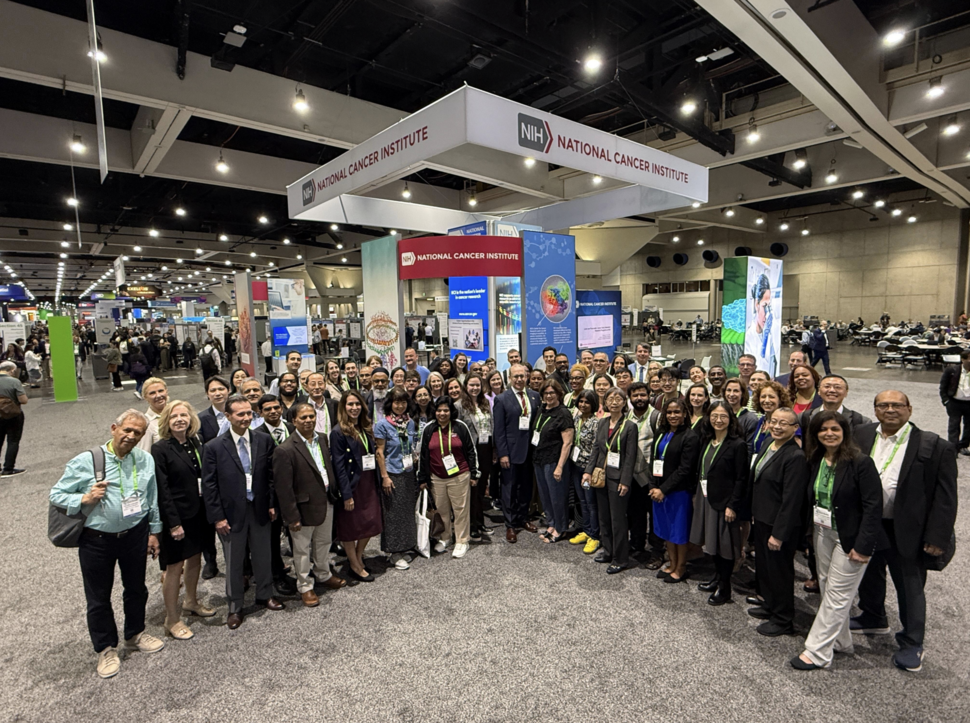
The NCI team at AACR 2026.
Greetings, Cancer Currents readers. After nearly a year, the National Cancer Institute is ready to resume our blog posts communicating the latest in cancer research. We look forward to once again serving as your trusted source of cancer research news and updates. Our first post is a message from NCI Director Anthony Letai, M.D., Ph.D., on his reflections from the 2026 American Association of Cancer Research Annual Meeting held in San Diego, April 19–22.
I’ve attended the AACR Annual Meeting many times, but doing so in the capacity of NCI Director last week was an honor I never imagined. I appreciated the warm welcome in San Diego from AACR and the many positive interactions with a community that is truly unmatched in science.
The full chain of cancer research was there—from early-stage investigators new to their careers, to basic scientists studying how cancer works, clinicians testing new therapies, industry partners scaling them, and advocates reminding us why this work matters. And that chain is critical, because breakthroughs happen only through collaboration, built step by step on the progress of the work of scientists who laid the groundwork long before.
I was inspired not only by the formal presentations but also by the conversations that unfolded between workshops and sessions, at poster sessions, and at the NCI exhibit booth. AACR once again showed how those exchanges create momentum and lay the foundation for real progress.
Science that stood out at AACR
Several research areas drew significant attention and will continue to shape our work moving forward:
- Immuno-oncology. We’ve seen meaningful success with immune checkpoint inhibitors and cellular therapies, but important questions remain. Across sessions, I saw a continued focus on why some people with cancer respond to these therapies while others do not, and how to translate those insights into a more consistent benefit. Some of this involves the type of exciting new ideas we need to test more rapidly in human studies. These discussions are far from settled, but they are moving in a productive direction.
- Cancer therapeutic vaccines. Cancer vaccine research is gaining momentum, and AACR provided a valuable opportunity to highlight how NCI is advancing this field based on early research that suggests vaccines could help prevent recurrence, particularly in cancers where relapse is common. The question now is how to test these vaccines rigorously and at scale. NCI’s partnership with the Foundation for the National Institutes of Health will do that. Later this year, we’re targeted to unveil a plan to conduct several well-structured trials that will help us rapidly and decisively uncover the most promising therapeutic vaccine avenues to pursue.
- Functional precision medicine. The idea is simple: if you want to know whether a drug will work, test it directly on a person’s tumor cells. In an overflowing session, work presented at AACR showed that new technologies and data increasingly support this approach. The next step is figuring out how to ensure these approaches are reliable and can be widely used in everyday research and care settings. That’s why we’re convening the community—first through a workshop this summer—to define how NCI can bolster progress in functional precision medicine.
- Artificial intelligence. As expected, AI was a focus of several sessions, highlighting this technology and its range of uses in cancer research. AI is here. I believe the challenge now is not just developing tools but enabling the research community to work together—so we can build useful tools faster and ensure they work across systems. I want NCI to help foster an environment where AI solutions are shared and interoperable.
Priorities moving forward
AACR also reinforced several priorities that remain central to NCI’s work.
One is the need to improve the efficiency of clinical trials—especially early-phase trials. Right now, too many barriers slow down the path from a promising idea to testing it in humans. Other countries move faster, and we need to learn from them while maintaining our standards. These efforts were well received at AACR, and NCI looks forward to helping speed the path to first-in-human trials.
We also remain focused on prevention and access. Better cancer treatments have limited impact if people can’t access care, and discoveries presented at AACR reminded me how advances sometimes outpace our ability to deliver them equitably. We’re leading an effort involving the major U.S. health agencies called the Prevention, Screening, and Early Detection Initiative, or PSEDI, to enhance access to health screening and care, starting in the nation’s underserved areas. This project, still in early planning, aims to expand access to evidence-based health prevention and screening strategies from a pilot phase of several U.S. counties to wider reach across the country.
Another area of emphasis is on the importance of use of human-based models in cancer research, which I discussed in my keynote address at AACR. Animal models have taught us a tremendous amount, and they to continue to play a critical role in cancer research. But modern technologies let us more directly study human tumors. We should take full advantage of these approaches. They can help us make smarter decisions earlier about what’s worth pursuing.
Your NCI
Finally, AACR provided a fitting backdrop to introduce an initiative NCI is launching to help educate the public about how taxpayer dollars lead to real cancer breakthroughs: Your NCI.
I unveiled a video at the AACR opening ceremony that traced the discovery of checkpoint inhibitors—that spawned immunotherapy—from one NCI grant awarded about 4 decades ago to today. Now, the first drug using checkpoints, pembrolizumab, is a highly effective therapy for 43 cancers.
This video got a great reception. Look for more on the Your NCI initiative this summer.
If you’re doing research, if you’re participating in a cancer clinical trial, if you’re helping deliver a therapy—you’re part of NCI. At AACR, we saw the full system, where ideas are tested, challenged, refined, and translated into better outcomes for people with cancer. I look forward to collaborating with you.