
What are dense breasts?
Breasts contain glandular tissue, fibrous connective tissue, and fatty breast tissue. Breast density is a term that describes the relative amount of these different types of breast tissue as seen on a mammogram. Dense breast tissue has relatively high amounts of glandular tissue and fibrous connective tissue and relatively low amounts of fatty breast tissue.
Are dense breasts common?
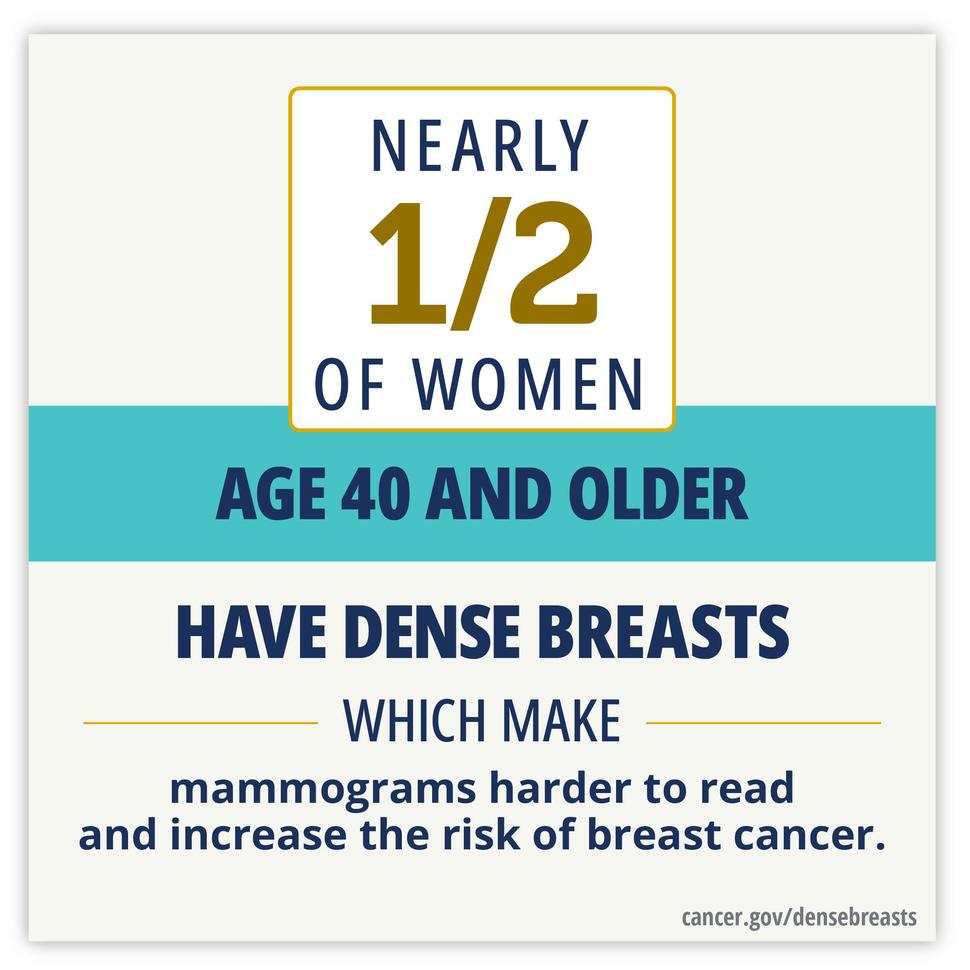
Yes, dense breasts are common. Nearly half of all women who are 40 and older who get mammograms are found to have dense breast tissue.
What factors influence breast density?
Breast density is often inherited, but other factors can influence it. Breast density can change over a woman's lifetime and may differ from one mammogram to another.
- Factors associated with higher breast density include using menopausal hormone therapy and having a low body mass index.
- Factors associated with lower breast density include increasing age and having children.
How do I know if I have dense breasts?
Dense breast tissue cannot be felt by a woman, such as during a breast self-exam, or by her doctor during a clinical breast exam. Only a radiologist looking at a mammogram can tell if a woman has dense breasts. Radiologists use different methods for assessing breast density, which may include using software devices cleared by the Food and Drug Administration (FDA) that help them interpret a mammogram. Dense breasts are sometimes called mammographically dense breasts.
FDA regulations require mammography providers to inform women if they have dense breasts.
How is breast density categorized in a mammogram report?
Doctors use the Breast Imaging Reporting and Data System (BI-RADS) to classify breast density. This system, developed by the American College of Radiology, helps doctors interpret and report back mammogram findings. Doctors who review mammograms are called radiologists. BI-RADS classifies breast density into four categories:
- Almost entirely fatty breast tissue: There is almost all fatty breast tissue. It is found in about 10% of women.
- Scattered fibroglandular breast tissue: There is mostly fatty tissue with scattered areas of dense glandular and fibrous connective tissue. It is found in about 40% of women.
- Heterogeneously dense breast tissue, which may obscure small masses: There are many areas of dense glandular and fibrous connective tissue, with some areas of fatty tissue. It is found in about 40% of women.
- Extremely dense breast tissue, which lowers the sensitivity of mammography: There is almost all dense glandular and fibrous connective tissue. It is found in about 10% of women.
If your mammogram report letter says you have dense breasts, it means that you have either heterogeneously dense breast tissue or extremely dense breast tissue.
Your mammogram report letter will include one of the following notification statements:
- Not dense: “Breast tissue can be either dense or not dense. Dense tissue makes it harder to find breast cancer on a mammogram and also raises the risk of developing breast cancer. Your breast tissue is not dense. Talk to your health care provider about breast density, risks for breast cancer, and your individual situation.”
- Dense: “Breast tissue can be either dense or not dense. Dense tissue makes it harder to find breast cancer on a mammogram and also raises the risk of developing breast cancer. Your breast tissue is dense. In some people with dense tissue, other imaging tests in addition to a mammogram may help find cancers. Talk to your health care provider about breast density, risks for breast cancer, and your individual situation.”
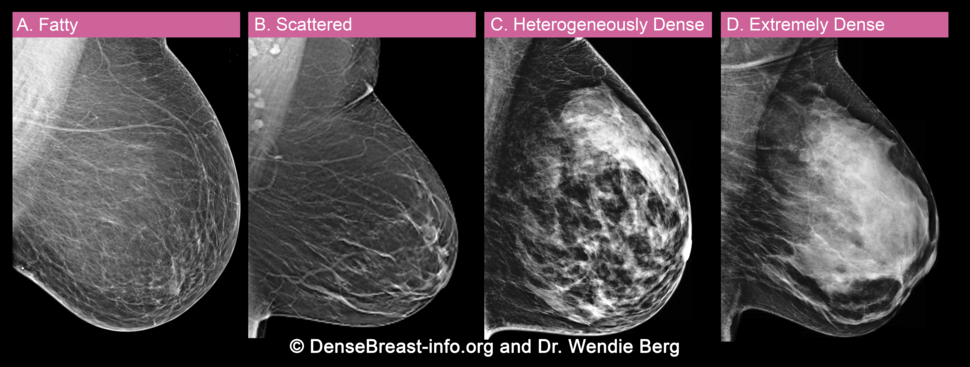
The four breast density categories are shown in this image. Breasts can be almost entirely fatty (A), have scattered areas of dense fibroglandular breast tissue (B), have many areas of glandular and connective tissue (C), or be extremely dense (D). Breasts are classified as “dense” if they fall in the heterogeneously dense (C) or extremely dense (D) categories.
Does having dense breast tissue affect a mammogram?
Dense breasts can make a mammogram more difficult to interpret. That's because dense breast tissue and some abnormal breast changes, such as calcifications and tumors, both appear as white areas in the mammogram, whereas fatty tissue appears as dark areas.
As a result, mammography is less sensitive in women with dense breasts—that is, it is more likely to miss cancer. Women with dense breasts may be called back for follow-up testing more often than women with fatty breasts.
Are dense breasts a risk factor for breast cancer?
Dense breasts are not considered an abnormal breast condition or a disease. However, dense breasts are a risk factor for breast cancer. That is, women with dense breasts have a higher risk of breast cancer than women with fatty breasts. This risk is separate from the effect of dense breasts on the ability to read a mammogram. Breast density is one of several factors affecting breast cancer risk. Learn more about other risk factors for breast cancer as well as protective factors for breast cancer.
Should women with dense breasts have additional screening for breast cancer?
Because dense breast tissue raises the risk of developing breast cancer and makes it harder to find breast cancer on a mammogram, some women with dense breasts may benefit from additional screening. MRI, contrast-enhanced mammography, and ultrasound are some of the imaging tests that may be used in addition to mammography.
Questions remain about which women are most likely to benefit from additional screening and about the long-term benefits and harms of different screening tests. Recommendations about whether women with dense breasts should have additional screening vary among professional organizations. The American College of Radiology and National Comprehensive Cancer Network support considering additional screening. The United States Preventive Services Task Force (USPSTF) concluded in 2024 that there was not yet enough evidence to determine the overall balance of benefits and harms of supplemental MRI or ultrasound after a normal mammogram.
Women with dense breasts should talk with their health care provider about their breast cancer risk and whether additional screening may be appropriate for them.
Are breast cancer patients with dense breasts more likely to die from breast cancer?
No. Research has found that breast cancer patients who have dense breasts are no more likely to die from breast cancer than breast cancer patients who have fatty breasts, after accounting for other health factors and tumor characteristics.
What questions should I consider asking my doctor or nurse?
Ask these questions to get information that’s specific to you, based on your personal medical history:
- Do I have dense breasts, based on my most recent mammogram result?
- What are my risk factors and protective factors for breast cancer? How do they affect my personal risk of breast cancer?
- Do you recommend additional screening for me? What additional screening tests are available? What are the benefits and drawbacks of these additional tests?
Are there clinical trials for women with dense breasts?
Yes, there are ongoing and completed clinical trials related to dense breasts that are studying better ways to detect breast cancer in women with dense breasts. You can also contact NCI’s Cancer Information Service to get tailored clinical trial searches related to breast density and breast cancer screening.
What questions are researchers asking about the relationship between breast density and breast cancer?
- What biomarkers or molecular markers can be identified to better characterize dense breast tissue and predict a woman's risk for breast cancer?
- Are certain patterns or areas of dense breast tissue particularly risky?
- How does the microenvironment of dense breast tissue affect the development and growth of tumors?
- What causes breast density to change over a woman’s lifetime, and do changes in breast density reflect changes in breast cancer risk?
- Can changes in breast density or other imaging features be an early indication that a breast cancer prevention strategy is working?
- Can computers and artificial intelligence identify features on mammograms, beyond conventional breast density, that improve the prediction of breast cancer risk?
- Could imaging tests such as ultrasound, contrast-enhanced mammography, MRI (such as diffusion-weighted MRI or fast MRI), or molecular breast imaging help find breast cancer in women with dense breasts?
NCI’s Division of Cancer Epidemiology and Genetics conducts research on breast density and breast cancer risk factors.
NCI's Division of Cancer Prevention supports research on cancer screening and risk factors, including breast density, to help researchers learn about the best way to find breast cancer in women who have no symptoms.
NCI’s Division of Cancer Control and Population Sciences supports research such as the Cancer Intervention and Surveillance Modeling Network (CISNET) Breast Working Group and the Breast Cancer Surveillance Consortium (BCSC). CISNET is a consortium of NCI-sponsored investigators conducting simulation modeling to improve our understanding of the impact of prevention, screening, and treatment on population trends in incidence and mortality. The BCSC is conducting research to assess and improve the delivery and quality of breast cancer screening and patient outcomes.