An official website of the United States government
Español
Email

Cancer Currents: An NCI Cancer Research Blog

A blog featuring news and research updates from the National Cancer Institute.

An illustrated banner to represent NCI's Cancer Currents research news blog. The design features interconnected scenes: a patient receiving care, a researcher in a lab, a tumor model, a laptop and mobile device displaying research articles, fitness activity, a clinical setting, and a researcher giving a scientific presentation. The background showcases rolling hills and abstract buildings.
  • A depressed Vietnam War USA military veteran has his head down while covering his face with his hand
    • By NCI Staff

    In a study of more than 50,000 veterans with lung cancer, those with mental illness who received mental health treatment—including for substance use—lived substantially longer than those who didn’t participate in such programs.

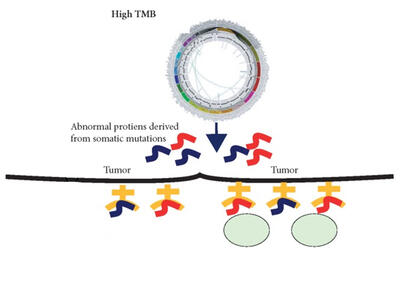
  • Diagram illustrating high tumor mutational burden (TMB) and the production of abnormal proteins from somatic mutations. At the top, a circular diagram represents genetic mutations. An arrow points downward to symbolize how these mutations lead to the creation of abnormal proteins. Below, these proteins are shown near a black line labeled "Tumor," representing their association with tumor cells.
    • By Norman E. Sharpless, M.D.

    FDA’s approval of pembrolizumab (Keytruda) to treat people whose cancer is tumor mutational burden-high highlights the importance of genomic testing to guide treatment, including for children with cancer, according to NCI Director Dr. Ned Sharpless.

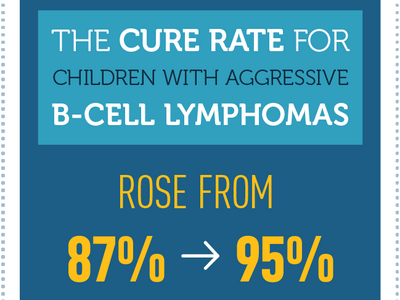
  • By adding Rituximab to standard chemotherapy the cure rate for children with aggressive b-cell lymphomas rose from 87% to 95%. Source: NEJM. June 2020. doi: 10.1056/NEJMoa1915315
    • By NCI Staff

    For children with aggressive Burkitt lymphoma and other B-cell non-Hodgkin lymphomas, adding rituximab (Rituxan, Truxima) to chemotherapy substantially increases the likelihood of the child being cured, results from a large clinical trial show.

  • A nurse at St. Jude checking a boy's temperature.
    • By NCI Staff

    In response to the COVID-19 pandemic, cancer researchers are making changes to clinical trials to ensure patient safety and protect the integrity of their work. Some changes, such as greater use of telemedicine, will likely continue into the future.

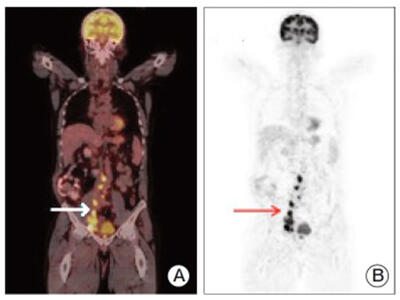
  • Two medical scans highlighting the body's interior. Scan A on the left is a colored PET/CT scan showing areas of active metabolism and potential abnormalities, with a white arrow indicating significant activity in the abdominal area. Scan B on the right is a grayscale image displaying similar metabolic activity, with a red arrow pointing to a focus of interest in the lower chest region.
    • By NCI Staff

    Results from a large study show that, for most people with advanced bladder cancer, starting immunotherapy with avelumab (Bavencio) shortly after initial treatment with chemotherapy is better than delaying treatment.

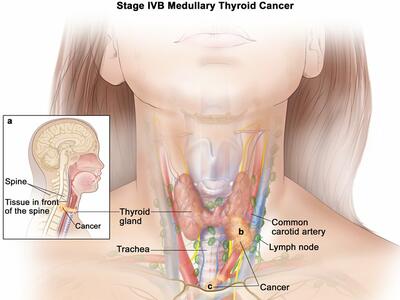
  • Illustration of Stage IVB Medullary Thyroid Cancer. It shows a detailed view of the neck, highlighting the thyroid gland, trachea, and common carotid artery. An inset on the left depicts a side view of the head and neck, with labels for the the spine and tissue in front of the spine as well as an area labeled "Cancer." The image illustrates how the cancer spreads in the neck region.
    • By NCI Staff

    FDA has granted accelerated approval for selpercatinib (Retevmo) to treat certain patients with thyroid cancer or non-small cell lung cancer whose tumors have RET gene alterations. The drug, which works by blocking the activity of RET proteins, was approved based on the results of the LIBRETTO-001 trial.

  • A sick man in a hospital bed.
    • By NCI Staff

    Many advanced cancer patients suffer from chronic nausea and vomiting and there aren’t many good treatments available. But a small study suggests that the drug olanzapine (Zyprexa) may fill that gap.

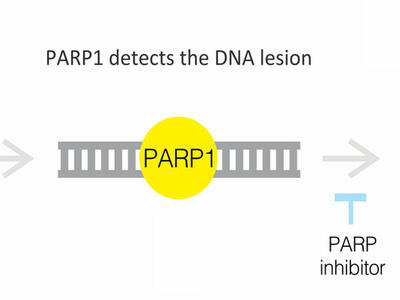
  • Process involving DNA repair through PARP1. It starts with a DNA strand containing a lesion, highlighted in orange. PARP1, a yellow circle, detects this DNA damage. The next step shows PARP1 attached to the DNA, signifying its role in the repair process. Nearby, a label indicates the potential use of a PARP inhibitor, shown in blue, which interferes with this repair mechanism.
    • By NCI Staff

    FDA has approved olaparib (Lynparza) and rucaparib (Rubraca) to treat some men with metastatic prostate cancer. The PARP inhibitors are approved for men whose cancers have stopped responding to hormone treatment and have specific genetic alterations.

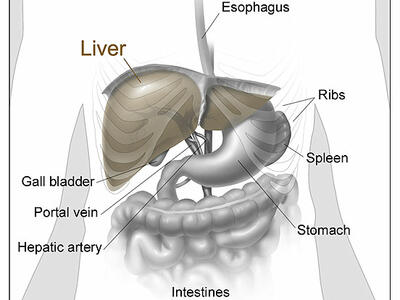
  • Anatomic illustration of the liver and surrounding organs.
    • By NCI Staff

    FDA has approved atezolizumab (Tecentriq) plus bevacizumab (Avastin) as an initial treatment for some people with advanced liver cancer. This is the first approval in 13 years for a treatment that is more effective than the current standard, sorafenib.

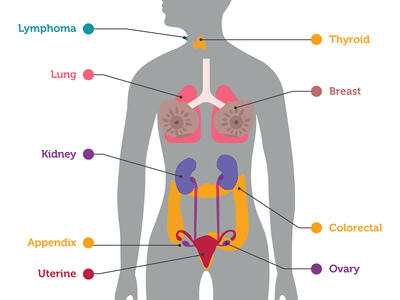
  • An illustration highlighting organs in which cancers were detected by an experimental blood test.
    • By NCI Staff

    A blood test combined with imaging tests detected tumors—some at an early stage—in women with no history of cancer or symptoms, a recent study showed. The test also mistakenly indicated some women had cancer when further testing showed they didn't.

< Older Posts Newer Posts >
Email