
Survivorship & Supportive Care - Cancer Currents Blog
News on research that affect cancer patients and survivors. Topics include managing treatment side effects, fertility preservation, and cancer’s long-term effects.
-

Many women who receive taxane-based chemotherapy to treat breast cancer experience long-term nerve damage, or peripheral neuropathy, data from a large clinical trial show.
-

A drug used to treat several blood cancers, ibrutinib, has been approved by FDA to treat chronic graft-versus-host disease, making it the first approved therapy for this potentially fatal side effect of cancer-related stem cell transplants.
-

Many survivors of early-stage breast cancer prefer that their oncologist handle aspects of routine medical care usually overseen by primary care practitioners, leading to concerns about gaps in care.
-
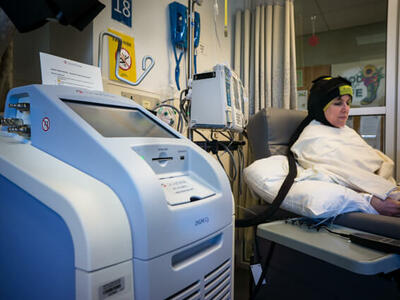
The FDA has cleared a cooling cap—a device designed to reduce hair loss during chemotherapy called the DigniCap Scalp Cooling System—for use by patients with any type of solid tumor.
-

Findings from a new study in mice suggest that a class of targeted cancer drugs may have another use in some younger women being treated for cancer: preserving their fertility.
-

NCI’s Dr. Paul Jacobsen discusses NCI’s Healthcare Delivery Research Program and its role in advancing innovative research to improve the delivery of cancer care.
-

In a clinical trial involving patients with metastatic cancer, administration of zoledronic acid every 12 weeks was as effective at preventing skeletal-related events caused by bone metastases as administration every 4 weeks.
-

The targeted cancer therapy ibrutinib can effectively treat the symptoms of chronic graft-versus-host disease, a common and serious complication of allogeneic stem cell transplants, findings from a small clinical trial show.
-

Researchers have found that duloxetine (Cymbalta®), a drug most commonly used to treat depression, may also reduce joint pain caused by aromatase inhibitors in some women being treated for early-stage breast cancer.
-

Dr. Julia Rowland, director of NCI’s Office of Cancer Survivorship, on the office’s 20th anniversary and efforts to ensure continued progress in survivorship research and improve survivors’ lives.