
NCI and CRUK Take on Cancer’s Toughest Problems
, by Linda Wang
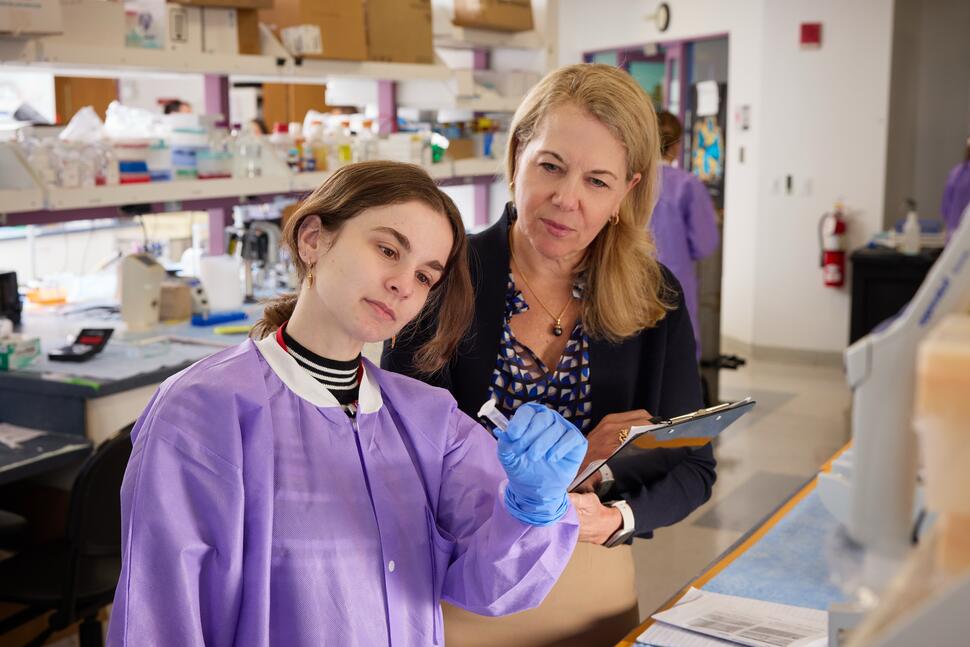
Catherine Bollard of Team NexTGen with a lab member at Children's National Hospital.
Credit: Cancer Grand Challenges
Cancer affects people in every part of the world. Finding better ways to prevent, detect, and treat it will take a global community of researchers working across disciplines and borders.
Decades of research have brought tremendous progress. Yet many fundamental questions remain unanswered. Why do some tumors become aggressive while others do not? What allows cancer to resist treatment or spread to other parts of the body?
Cancer Grand Challenges was created to take on questions of this scale. Co-founded in 2020 by the National Cancer Institute (NCI) and Cancer Research UK (CRUK), this global cancer research initiative focuses on persistent barriers that no single scientist, institution, or country can overcome alone. It brings together international, interdisciplinary teams and gives them the time, resources, and flexibility to pursue bold ideas that could open new paths to cancer prevention, detection, and treatment.
"As two of the largest funders of cancer research in the world, the NCI and CRUK are uniquely positioned to lead this global challenge," said Satish Gopal, M.D., M.P.H., NCI acting deputy director for scientific strategy and development and director of the Center for Global Health.
The program is already generating new insights and changing how researchers approach some of cancer’s toughest problems. It is also investing in its Future Leaders, early-career researchers who gain advanced scientific training, mentorship, and opportunities to build collaborations around the world. These experiences equip them to pursue transformative ideas and become the next generation of leaders in cancer research.
“The U.S. is committed to supporting innovation and marshalling efforts beyond what a single country can do,” Gopal said. “NCI continues to support collaborations that address intractable scientific opportunities that are best tackled by international teams, generating critical new knowledge that ultimately benefits Americans.”
How a Cancer Grand Challenge Takes Shape
Cancer Grand Challenges grew out of earlier efforts to encourage researchers to look at difficult problems in a new way. In 2011, NCI launched its Provocative Questions Initiative to stimulate research in perplexing and underexplored areas identified with help from the U.S. cancer research community. Four years later, CRUK launched its Grand Challenge initiative, assembling large global teams to tackle broad scientific questions.
“For both organizations, the idea was the same: to really try to engage the community to think in novel creative ways about problems whose solutions had eluded us,” said Dinah Singer, Ph.D., emeritus NCI deputy director for scientific strategy and development, who helped establish and guide NCI’s role in the partnership.
In 2020, the two organizations brought those approaches together to create Cancer Grand Challenges. The first teams supported through the NCI-CRUK partnership were announced in 2022, followed by additional teams in 2024 and 2026.
Before each round, the program holds a series of workshops to identify challenges or tough questions that require interdisciplinary teams to tackle. Once the challenges are announced, international teams are invited to propose bold ways to tackle them.
Selection of teams is highly competitive. In the latest round, a record 227 teams submitted brief expressions of interest on how they would tackle this year’s challenges. The Cancer Grand Challenges Scientific Committee narrowed the field to 12 finalists, who developed full applications and took part in in-person interviews. The committee provided their feedback on the interviewed teams, which CRUK and NCI then considered in making a joint funding decision.
Singer says the program’s success depends on both “identifying the right challenge” and “identifying the right teams.”
From Discovery to Treatment
The projects currently underway span the research continuum, from fundamental biology to clinical studies.
Team eDyNAmiC is studying extrachromosomal DNA (ecDNA), small, circular DNA fragments that exist outside the cell’s main chromosomes. Scientists have known about these structures for decades, but newer tools have revealed that ecDNA can carry extra copies of cancer-driving genes, helping some tumors grow aggressively and resist treatment.
“We now understand a lot more about how ecDNA forms and contributes to the development of aggressive cancers,” said Andrew Kurtz, Ph.D., program director in NCI’s Center for Strategic Scientific Initiatives, who co-leads Cancer Grand Challenges. The work, he added, is “beginning to lead to new therapeutic targets.”
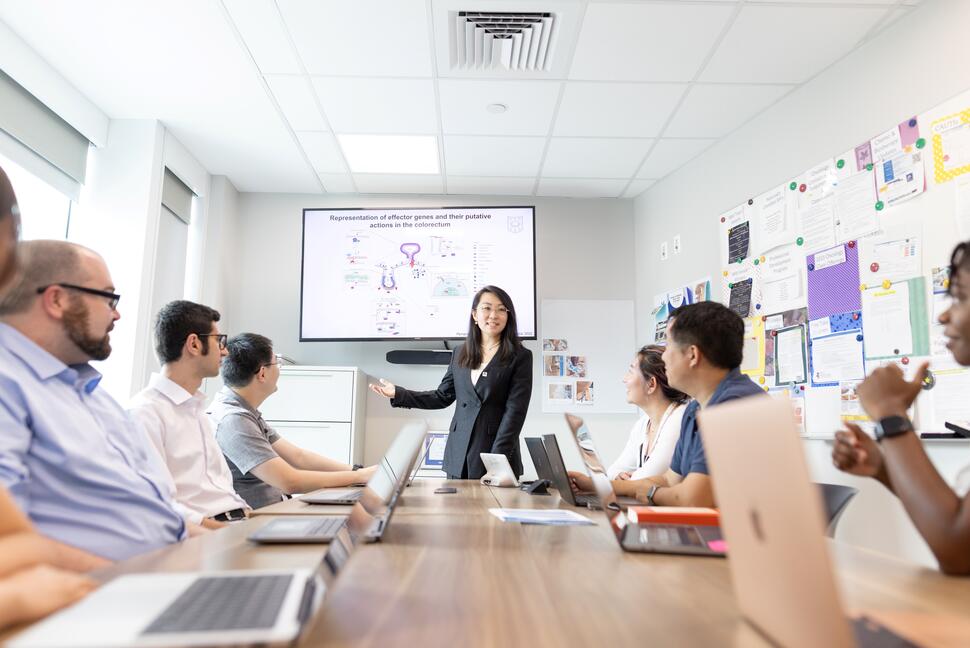
Yin Cao, PROSPECT Co-Team Lead, presents findings to her group.
Credit: Cancer Grand Challenges
Other teams are examining how cancer interacts with the biology of the person in whom it develops. Team PROSPECT, which is investigating the rise of colorectal cancer in people younger than 50, recently reported an association between accelerated biological aging and several early-onset cancers.
Team CANCAN is taking a new look at cancer cachexia, a severe loss of weight and muscle that can accompany cancer. Rather than treating cachexia as a single disease, the team has found that it includes several biologically distinct subtypes, suggesting that interventions need to be tailored to individual patients.
Singer described cachexia as a classic grand challenge: a devastating condition recognized for decades, but one whose molecular and cellular underpinnings remained poorly understood. Answering those foundational questions could eventually open the door to better ways to prevent or treat it, she says.
Team PROMINENT is seeking to understand why many cells carrying cancer-driving mutations remain normal. “What keeps it from becoming a cancer?” Singer asked. Recent work suggests that cells carrying such mutations can remain noncancerous for long periods until additional signals push them toward tumor formation. Understanding the biological “brakes” that hold these cells in check might eventually suggest ways to prevent early lesions, or even micrometastases, from growing.
The portfolio also extends into immunotherapy and clinical research. Team MATCHMAKERS aims to decipher how receptors on T cells recognize cancer-specific targets. By developing tools to predict those matches, the team hopes to lay the groundwork for more precise and personalized immunotherapies.
Immunotherapy has served as one of the most exciting new therapeutic approaches in cancer for more than a decade now, but it hasn’t been as successful for children and young people with solid tumors. Team NexTGen was selected to tackle that challenge in 2020 and has already moved potential treatments into clinic.
In 2026, the team launched three coordinated early-phase trials in the U.S. and U.K. to test engineered T-cell therapies, including CAR T-cell therapies, in children and young people with difficult-to-treat solid tumors. Because these cancers are rare, coordinating trials across countries can help researchers enroll patients and learn from the studies more quickly than any single research center could alone.
The Cancer Grand Challenges portfolio continues to expand. Earlier this year, as leadership for this program transitioned from Singer to Gopal, five new Cancer Grand Challenges teams were announced, with the following four co-funded by NCI:
- Team CAUSE is tracing the chemical damage that leaves characteristic mutation patterns in DNA, with the goal of uncovering previously unknown, and potentially preventable, causes of cancer.
- Team InteroCANCEption is mapping the two-way communication between the nervous system and tumors to explore whether changing neural signals could affect cancer growth or cancer-related symptoms.
- Team ILLUMINE is investigating the cancer “dark proteome,” a largely unexplored collection of proteins made from unknown genetic instructions, to understand their role in cancer and search for new targets for immunotherapy.
- Team REWIRE-CAN is testing a counterintuitive treatment strategy: pushing cancer-promoting signals above the level tumor cells can tolerate, driving the cells into stress and potentially causing them to self-destruct. The team will also explore whether this approach can make resistant colorectal cancers sensitive to treatment again.
“I am incredibly excited to see these new multidisciplinary international teams tackling challenges which are really at the frontiers of current cancer science,” Gopal said. “I look forward to seeing some of their findings eventually having a major impact on how we understand, prevent, and treat cancer around the world.”
Cancer Grand Challenges
Ludmil Alexandrov, who leads Team CAUSE, shares the inspiration behind his research.
Investing in the Next Generation
In addition to supporting cutting-edge research, Cancer Grand Challenges is also investing in early-career researchers who will carry the science forward. Several hundred of these “future leaders” are part of the teams. Along with gaining expertise in advanced cancer science, they learn how to coordinate complex research, exchange ideas across specialties, and build international collaborations. Several have already gone on to establish independent research careers.
“The training opportunity that Cancer Grand Challenges provides for future leaders in cancer research is one of the most exciting things about this program,” Kurtz said.
Patient advocates also have a formal role in Cancer Grand Challenges. Every team includes at least one advocate, who can pose questions of particular interest to patients, help explain the research being conducted to a broader audience, or shape practical aspects of a study, such as consent materials for a clinical trial. Advocates also contribute to discussions that help define future challenges.
Looking Ahead
NCI and Cancer Research UK have completed three joint funding rounds as envisioned in their initial agreement. NCI is currently evaluating these early efforts to determine the next chapter of its partnership with CRUK. But their work is already showing what this co-funding model can make possible.
“My hope is that with programs like Cancer Grand Challenges, we can encourage people to think more broadly and to take greater risks,” Singer said. “The ability to fund amazing science and be able to see it through is very gratifying.”