
Could Functional Precision Medicine Be the New Precision Oncology?
, by Anthony Letai, M.D., Ph.D.
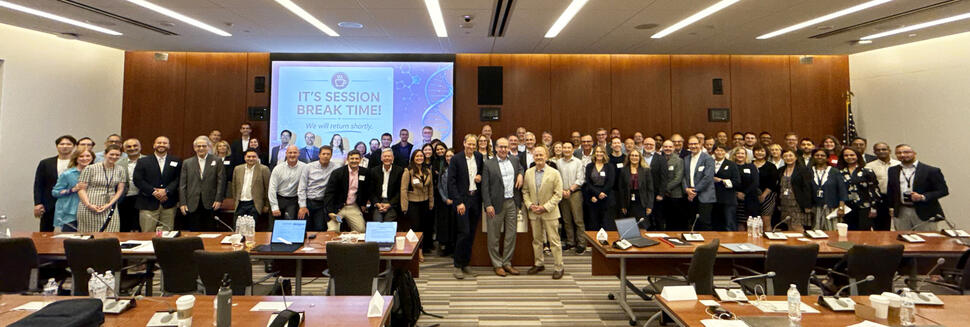
NCI Director Dr. Anthony Letai and in-person attendees of NCI's Precision in Practice: A Functional Medicine Workshop gather for a group photo.
For the last 20 years, precision medicine in cancer has meant finding changes in a patient’s tumor’s DNA, called genetic mutations, so oncologists could target the right treatment to each individual patient. While this genomic approach has led to life-saving breakthroughs, including the discovery of imatinib for chronic myeloid leukemia, only a small number of patients benefit from these mutation-targeting therapies. Indeed, we may be reaching the limit of what genomics alone can accomplish, making the need for a new approach more urgent than ever.
That’s why I’m eager to push us beyond precision medicine. Instead of just identifying the right drug based on the tumor's mutations, the field of functional precision medicine actually tests the patient's own living cancer cells with different therapies to identify which treatment is most effective for that individual patient. Not only that, testing cancer cells this way can provide a companion diagnostic and, when used in research, drive discoveries that more quickly translate into benefits for all people with cancer. In this sense, functional precision medicine offers a simple, common-sense complement to precision medicine.
To understand functional precision medicine, I often point to microbiology. If a person has a bacterial infection, we culture the bacteria, expose it to antibiotics, and measure which ones kill it.
Functional precision medicine applies this same principle to cancer. If you want to know whether a drug will work, why not expose a person’s living cancer cells directly to the therapy and observe what happens? Seeing how cancer cells respond to a drug in real time can help doctors choose the best treatment for an individual more accurately than traditional precision medicine.
My journey in functional precision medicine and the field’s current state
This field is deeply personal to me. Years ago, as a researcher at Dana-Farber, I wanted to know if a new drug compound could help people with chronic lymphocytic leukemia (CLL). I walked down the hall to a colleague, asked for some living leukemia cells from a patient, and put the drug directly on them. We watched, and all the cells died.
That simple lab test paved the clinical path for the U.S. Food and Drug Administration (FDA) approval of venetoclax—a drug that now saves lives of people with CLL every day. Watching a patient recover because of a treatment born in my lab has been the most gratifying moment of my career. As NCI Director, I want to use our national resources to bring this same success to people facing other cancers.
Some doctors might hear about functional precision medicine and think, “Didn’t we try this in the 1980s and 90s?” It’s true—the idea isn’t new. But back then, we had blunt tools and few cancer drugs in our quiver. If a test showed a person’s tumor wouldn’t respond to standard chemotherapy, we had no other drugs to offer. I also believe functional precision medicine was overshadowed by genomics in the early 2000s. With the sequencing of the human genome and the success of gene-targeted drugs like imatinib, oncology understandably focused on finding actionable mutations. As a result, functional testing received far less attention.
Today, everything is different. We have hundreds of FDA-approved drugs, along with powerful new technologies such as single-cell analysis and artificial intelligence. Several of our NCI-Designated Cancer Centers are now conducting feasibility studies and clinical trials using functional precision medicine. Reflecting on this progress, the American Society of Clinical Oncology recently emphasized its support for the advancement of functional precision medicine in cancer care.
But for this approach to help more people, it must move beyond isolated research projects. We need rigorous clinical evidence that demonstrates it works and practical ways to make it easy for physicians to use it in everyday care.
Paving a path for functional precision medicine
To begin this process, in July, NCI convened Precision in Practice: A Functional Medicine Workshop on our Shady Grove campus in Rockville, Maryland. Our goal was to bring together leading minds in functional precision medicine across academia, biotech, pharma, regulators, and advocates. The community shared success stories, identified hurdles to advancing the field, and helped define NCI’s role in moving this area forward.
Over our two days together, three key next steps emerged:
- Saving living tissue. Unlike genetic testing, which can be done on non-living samples, functional testing requires living cells. Today, all biopsied tissue is placed in formalin—a chemical preservative that immediately kills the cancer cells to preserve them for further use. We must partner with ethicists, pathologists, and regulatory agencies to look at our current handling procedures so we can ethically keep a portion of the sample fresh, sterile, and ready for testing for functional precision medicine purposes.
- Standardizing next steps. Because different labs use different methods, we need to establish a common strategy across multiple labs to test a common, shared set of samples for use in testing. This will help us compare and standardize the essential steps of sample handling, such as shipping, storage, and processing times, to ensure every test is reliable and reproducible no matter where the patient is cared for.
- Clearing the way for patients. A major barrier we face is insurance and medical guidelines that do not cover the tests or off-label drug use we recommend, even for patients who have run out of options. We must work with federal partners at the FDA and Centers for Medicare and Medicaid Services, as well as clinical guideline organizations, to build a clear, evidence-based pathway for approval and reimbursement so that all patients can benefit sooner rather than later.
NCI’s role going forward
We do not need to start from scratch to build this future. NCI already has resources that can propel functional precision medicine testing forward. Through our research networks and our Developmental Therapeutics Program and Patient-Derived Models Repository, we offer investigators critical tools at little to no cost, including pre-plated sets of all FDA-approved drugs, validated antibodies, and clinical-grade testing facilities.
We’re also exploring ways to expand our efforts. One possibility is establishing a dedicated center for functional precision medicine at the Frederick National Laboratory to help standardize assays and evaluate new biomarkers. We are already advancing the Standardized Organoid Modeling Center, a project that aims to develop human-based organoids that are reproducible, reliable, and accessible for medical research.
Our immediate task is generating evidence that this technology truly improves lives. Our ultimate goal, five years from now, I hope, is to see functional testing routinely used by oncologists to prescribe effective treatments for their patients who have run out of standard options. If robust clinical studies over the next few years show that functional precision medicine testing extends survival, it could trigger an important or breakthrough shift: Our oncologists, and the pathologists, regulators, and insurers behind the scenes, would have the evidence they need to help integrate functional precision medicine into routine cancer care, offering a new lifeline to the patients who need it most.