
What are thymoma and thymic carcinoma?
Thymoma and thymic carcinoma, also called thymic epithelial tumors (TETs), are two types of rare cancers that can form on a gland called the thymus. The thymus is located above the heart behind the breastbone. It is part of the lymph system and makes white blood cells called lymphocytes that help the body fight infection.
Even though thymoma and thymic carcinoma form in the thymus gland, there are important differences between these cancers:
- Thymoma cells look a lot like the normal cells of the thymus, grow slowly, and rarely spread beyond the thymus. A thymoma may become a thymic carcinoma over time.
- Thymic carcinoma cells do not look like the normal cells of the thymus, grow more quickly, and are more likely to spread to other parts of the body. Thymic carcinoma is more difficult to treat than thymoma.
Thymoma and thymic carcinoma are often found during a chest x-ray done for another reason.
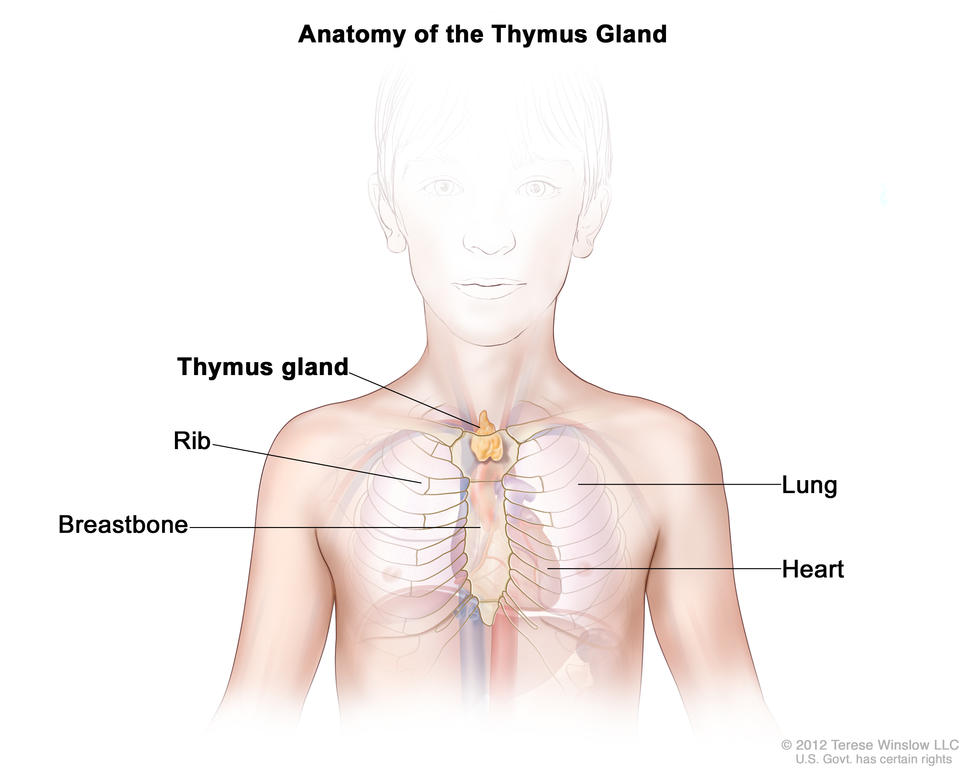
Anatomy of the thymus gland. The thymus gland is a small organ that lies in the upper chest under the breastbone. It makes white blood cells, called lymphocytes, which protect the body against infections.
Credit: © Terese Winslow
Conditions linked with thymoma
Thymoma is linked with autoimmune paraneoplastic diseases, leading to additional symptoms. Autoimmune paraneoplastic diseases are a group of rare disorders that occur when the immune system attacks not only cancer cells but also normal cells. Autoimmune paraneoplastic diseases may occur in people with cancer but are not caused directly by cancer. The most common autoimmune paraneoplastic diseases linked with thymoma include:
- myasthenia gravis (the most common autoimmune paraneoplastic disease linked with thymoma)
- autoimmune pure red cell aplasia
- hypogammaglobulinemia
Other autoimmune paraneoplastic diseases may occur with thymoma and can involve any organ:
Causes and risk factors of childhood thymoma and thymic carcinoma
Childhood thymoma and thymic carcinoma are caused by certain changes to the way the cells in the thymus function, especially how they grow and divide into new cells. Often, the exact cause of these cell changes is unknown. To learn more about how cancer develops, see What Is Cancer?
A risk factor is anything that increases the chance of getting a disease. There are no known risk factors for thymoma or thymic carcinoma.
Symptoms of childhood thymoma and thymic carcinoma
Often, childhood thymoma and thymic carcinoma are found during a chest x-ray done for another health issue. Most people do not have symptoms when first diagnosed with thymoma or thymic carcinoma. When symptoms occur, they may include:
- a cough that doesn’t go away
- shortness of breath
- pain or a tight feeling in the chest
- trouble swallowing
- superior vena cava syndrome (swelling in the face, neck, upper body, or arms)
- hoarseness
- fever
- weight loss
These symptoms may be caused by problems other than cancer. The only way to know is to see your child’s doctor.
Tests to diagnose childhood thymoma and thymic carcinoma
If your child has symptoms that suggest thymoma or thymic carcinoma, the doctor will need to find out if these are due to cancer or another problem. The doctor will ask when the symptoms started and how often your child has been having them. They will also ask about your child’s personal and family medical history and do a physical exam. Depending on these results, they may recommend other tests. If your child is diagnosed with thymoma or thymic carcinoma, the results of these tests will help you and your child’s doctor plan treatment.
The tests used to diagnose thymoma or thymic carcinoma may include:
Chest x-ray
An x-ray is a type of radiation that can go through the body and make pictures. A chest x-ray is one that makes pictures of the organs and bones inside the chest.
CT scan (CAT scan)
A CT scan uses a computer linked to an x-ray machine to make a series of detailed pictures of areas inside the body. The pictures are taken from different angles to create 3-D views of tissues and organs. A dye may be injected into a vein or swallowed to help the organs or tissues show up more clearly. This procedure is also called computed tomography, computerized tomography, or computerized axial tomography. To learn more, see Computed Tomography (CT) Scans and Cancer.
Magnetic resonance imaging (MRI)
MRI uses a magnet, radio waves, and a computer to make a series of detailed pictures of areas inside the body. This procedure is also called nuclear magnetic resonance imaging (NMRI).
PET scan
A PET scan uses a small amount of radioactive sugar (radioactive glucose) that is injected into a vein. The PET scanner rotates around the body and makes a picture of where glucose is being used in the body. Malignant tumor cells show up brighter in the picture because they are more active and take up more glucose than normal cells do.
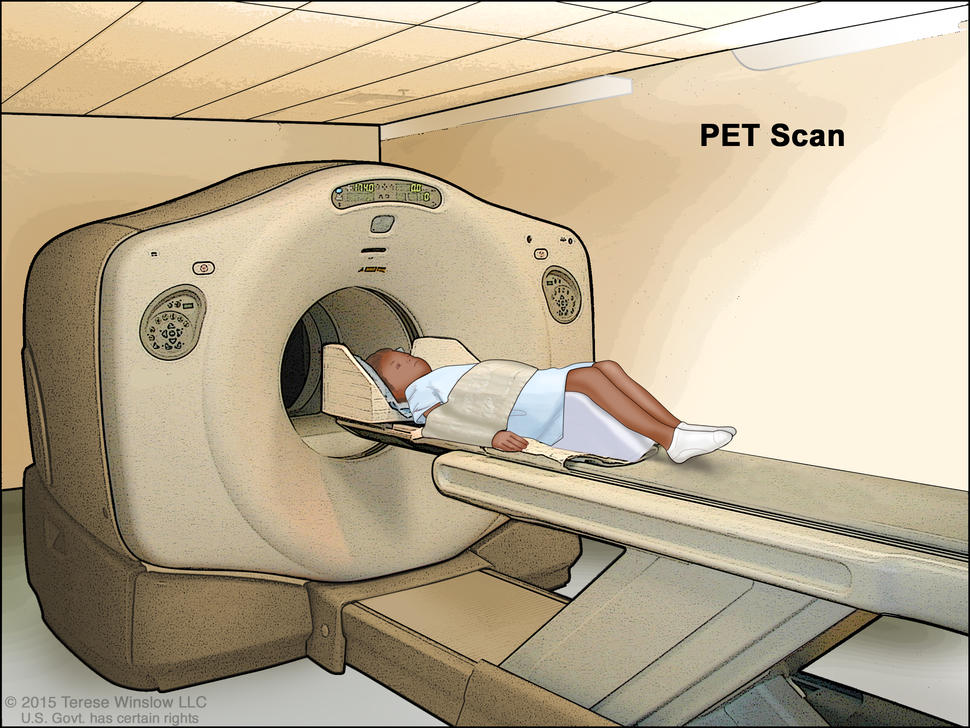
Positron emission tomography (PET) scan. The child lies on a table that slides through the PET scanner. The head rest and white strap help the child lie still. A small amount of radioactive glucose (sugar) is injected into the child's vein, and a scanner makes a picture of where the glucose is being used in the body. Cancer cells show up brighter in the picture because they take up more glucose than normal cells do.
Credit: © Terese Winslow
Biopsy
A biopsy is a procedure in which a sample of tissue is removed from the tumor so that a pathologist can view it under a microscope to check for signs of cancer.
Getting a second opinion
You may want to get a second opinion to confirm your child’s diagnosis and treatment plan. If you seek a second opinion, you will need to get medical test results and reports from the first doctor to share with the second doctor. The second doctor will review the pathology report, slides, and scans. They may agree with the first doctor, suggest changes to the treatment plan, or provide more information about your child’s tumor.
To learn more about choosing a doctor and getting a second opinion, see Finding Cancer Care. You can contact NCI’s Cancer Information Service via chat, email, or phone (both in English and Spanish) for help finding a doctor or hospital that can provide a second opinion. For questions you might want to ask at your child’s appointments, see Questions to Ask Your Doctor About Cancer.
Types of treatment for childhood thymoma and thymic carcinoma
Who treats children with thymoma and thymic carcinoma?
A pediatric oncologist, a doctor who specializes in treating children with cancer, oversees the treatment of thymoma and thymic carcinoma. The pediatric oncologist works with other health care providers who are experts in treating children with thymoma or thymic carcinoma and specialize in certain areas of medicine. Other specialists may include:
- pediatrician
- pediatric surgeon
- radiation oncologist
- pathologist
- pediatric nurse specialist
- social worker
- rehabilitation specialist
- psychologist
- child-life specialist
- fertility specialist
There are different types of treatment for children and adolescents with thymoma or thymic carcinoma. You and your child’s care team will work together to decide treatment. Many factors will be considered, such as your child’s overall health and whether the tumor is newly diagnosed or has come back.
Your child’s treatment plan will include information about the tumor, the goals of treatment, treatment options, and the possible side effects. It will be helpful to talk with your child’s care team before treatment begins about what to expect. For help every step of the way, see our booklet, Children with Cancer: A Guide for Parents.
The following types of treatment may be used:
Surgery
Surgery to remove the cancer is the main treatment for thymoma and thymic carcinoma. However, thymic carcinoma can rarely be completely removed by surgery and is likely to recur (come back) after treatment.
Radiation therapy
Radiation therapy uses high-energy x-rays or other types of radiation to kill cancer cells or keep them from growing. Thymoma and thymic carcinoma are treated with external beam radiation therapy. This type of therapy uses a machine outside the body to send radiation toward the area of the body with cancer. Radiation therapy may be given alone or with other treatments, such as chemotherapy.
To learn more, see External Beam Radiation Therapy for Cancer and Radiation Therapy Side Effects.
Chemotherapy
Chemotherapy (also called chemo) uses drugs to stop the growth of cancer cells. Chemotherapy either kills cancer cells or stops them from dividing. Chemotherapy may be given alone or with other types of treatment.
For thymoma and thymic carcinoma, chemotherapy is injected into a vein. When given this way, the drugs enter the bloodstream and can reach cancer cells throughout the body.
Chemotherapy drugs used alone or in combination to treat thymoma and thymic carcinoma include:
Other chemotherapy drugs not listed here may also be used.
To learn more about how chemotherapy works, how it is given, common side effects, and more, see Chemotherapy to Treat Cancer.
Hormone therapy
Hormone therapy removes hormones or blocks their action, stopping cancer cells from growing. Hormones are substances that are made by glands in the body and flow through the bloodstream. Some hormones can cause certain cancers to grow. If tests show that the cancer cells have places where hormones can attach (receptors), drugs may be used to reduce the production of hormones or block them from working.
Hormone therapy used for thymoma may include octreotide with or without prednisone.
Targeted therapy
Targeted therapy uses drugs or other substances to block the action of specific enzymes, proteins, or other molecules involved in the growth and spread of cancer cells. Sunitinib is used to treat thymoma and thymic carcinoma that has not responded to other treatments.
Learn more about Targeted Therapy to Treat Cancer.
Clinical trials
Joining a clinical trial may be an option. There are different types of clinical trials for childhood cancer. For example, a treatment trial tests new treatments or new ways of using existing treatments. Supportive care and palliative care trials look at ways to improve quality of life, especially for those who have side effects from cancer and its treatment.
You can use the clinical trial search to find NCI-supported cancer clinical trials that are accepting patients. The search allows you to filter trials based on the type of cancer, your child’s age, and where the trials are being done.
To learn more, see Clinical Trials Information for Patients and Caregivers.
Treatment of childhood thymoma
Treatment of newly diagnosed thymoma may include:
- surgery to remove as much of the tumor as possible
- radiation therapy for tumors that cannot be removed by surgery or if some of the tumor remains after surgery
- chemotherapy for tumors that did not respond to other treatments
- hormone therapy (octreotide) for tumors that did not respond to other treatments
- targeted therapy (sunitinib) for tumors that did not respond to other treatments
Treatment of childhood thymic carcinoma
Treatment of newly diagnosed thymic carcinoma may include:
- surgery to remove as much of the tumor as possible
- radiation therapy, for tumors that cannot be removed by surgery or if some of the tumor remains after surgery
- chemotherapy for tumors that did not respond to radiation therapy
- targeted therapy (sunitinib) for tumors that did not respond to other treatments
If the cancer comes back after treatment, your child's doctor will talk with you about what to expect and possible next steps. There might be treatment options that may shrink the cancer or control its growth. If there are no treatments, your child can receive care to control symptoms from cancer so they can be as comfortable as possible.
Prognosis and prognostic factors for childhood thymoma and thymic carcinoma
If your child has been diagnosed with thymoma or thymic carcinoma, you likely have questions about how serious the cancer is and your child’s chances of survival. The likely outcome or course of a disease is called prognosis.
The prognosis depends on:
- whether the cancer is thymoma or thymic carcinoma
- whether the cancer has spread to nearby areas or other parts of the body
- whether the cancer was completely removed by surgery
- whether the cancer is newly diagnosed or has recurred (come back) after treatment
In general, thymoma is associated with a better prognosis than thymic carcinoma. Also, the prognosis is better when the cancer has not spread to other parts of the body. Your child’s cancer care team is in the best position to talk with you about your child’s prognosis.
Side effects and late effects of treatment
Cancer treatments can cause side effects. Which side effects your child might have depends on the type of treatment they receive, the dose, and how their body reacts. Talk with your child's treatment team about which side effects to look for and ways to manage them.
To learn about side effects that begin during treatment for cancer, see Side Effects of Cancer Treatment.
Problems from cancer treatment that begin 6 months or later after treatment and continue for months or years are called late effects. Late effects of cancer treatment may include:
- physical problems
- changes in mood, feelings, thinking, learning, or memory
- second cancers (new types of cancer) or other conditions
Some late effects may be treated or controlled. It is important to talk with your child's doctors about the possible late effects caused by some treatments. To learn more, see Late Effects of Treatment for Childhood Cancer.
Follow-up care
As your child goes through treatment, they will have follow-up tests or check-ups. Some tests that were done to diagnose the cancer may be repeated to see how well the treatment is working. Decisions about whether to continue, change, or stop treatment may be based on the results of these tests.
Some of the tests will continue to be done from time to time after treatment has ended. The results of these tests can show if your child's condition has changed or if the cancer has recurred (come back). To learn more about follow-up tests, see Tests to Diagnose Childhood Thymoma and Thymic Carcinoma.
Coping with your child’s cancer
When your child has cancer, every member of the family needs support. Taking care of yourself during this difficult time is important. Reach out to your child’s treatment team and people in your family and community for support. To learn more, see Support for Families: Childhood Cancer and the booklet Children with Cancer: A Guide for Parents.