
X-linked recessive inheritance
(…. linkt reh-SEH-siv in-HAYR-ih-tunts)
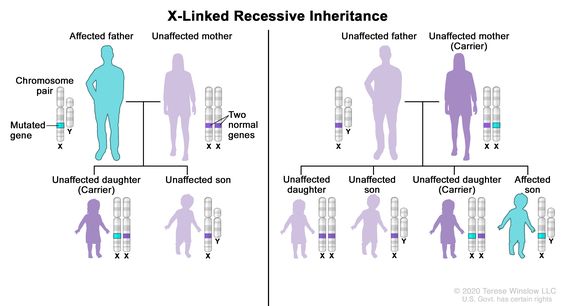
One of the ways a genetic trait or condition caused by a mutated (changed) gene on the X chromosome can be passed down (inherited) from parent to child. In X-linked recessive inheritance, a daughter inherits a single mutated gene on the X chromosome from one of her parents. The X chromosome she inherits from the other parent will usually cancel the effect of the mutation, and she most likely will not have the genetic condition. If she inherits a mutated copy of the gene from both parents, she will be affected with the condition. Fathers cannot pass X-linked recessive conditions to their sons. When a son inherits a mutated gene on the X chromosome from his mother, the genetic condition is more likely to occur. X-linked recessive conditions most often occur in males.
 Enlarge this image in new window
X-linked recessive inheritance is a way a genetic trait or condition can be passed down from parent to child through mutations (changes) in a gene on the X chromosome. In males (who only have one X chromosome), a mutation in the copy of the gene on the single X chromosome causes the condition. Females (who have two X chromosomes) must have a mutation on both X chromosomes in order to be affected with the condition. If only the father or the mother has the mutated X-linked gene, the daughters are usually not affected and are called carriers because one of their X chromosomes has the mutation but the other one is normal. Sons will be affected if they inherit the mutated X-linked gene from their mother. Fathers cannot pass X-linked recessive conditions to their sons.