
cervical dysplasia
(SER-vih-kul dis-PLAY-zhuh)
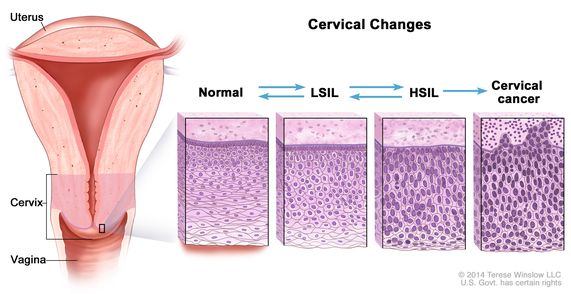
A term used to describe the presence of abnormal cells on the surface of the cervix. Cervical dysplasia is usually caused by certain types of human papillomavirus (HPV) and is found when a Pap test or cervical biopsy is done. It can be mild, moderate, or severe, depending on how abnormal the cells look under a microscope and how much of the cervical tissue is affected. Cervical dysplasia is not cancer but may become cancer and spread to nearby normal tissue. It is sometimes called squamous intraepithelial lesion (SIL) or cervical intraepithelial neoplasia (CIN).
 Enlarge this image in new window
Cervical changes. The cervix is the lower, narrow end of the uterus that forms a canal between the uterus and vagina. Before cancer cells form in tissues of the cervix, the cells of the cervix go through abnormal changes called dysplasia. There are different types of dysplasia. Mild dysplasia, called low-grade intraepithelial lesion (LSIL) is one type. Moderate or severe dysplasia, called high-grade intraepithelial lesion (HSIL) is another type of dysplasia. LSIL and HSIL may or may not become cancer.