
Abemaciclib Approved by FDA for Advanced or Metastatic Breast Cancer
, by NCI Staff
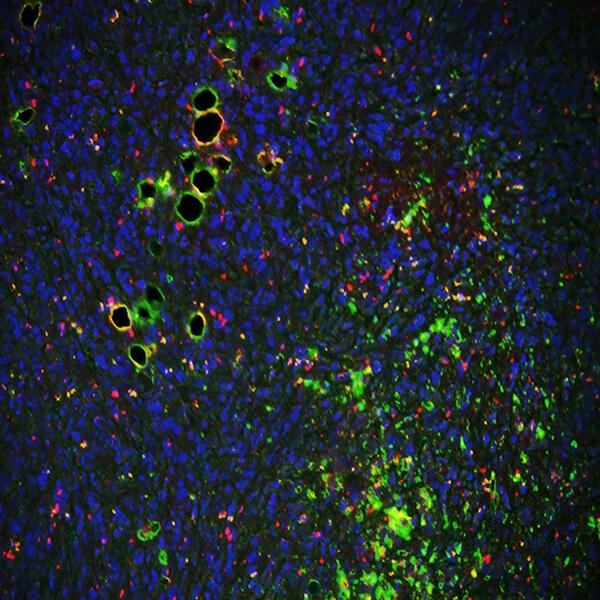
Breast cancer cells (pink, orange, and purple) in the supportive tissue, or stroma (green, red, and yellow), of the tumor microenvironment.
Credit: Credit: National Cancer Institute
On September 28, the Food and Drug Administration (FDA) approved abemaciclib (Verzenio™) for some women with advanced or metastatic breast cancer.
The drug is approved for the treatment of some people with advanced or metastatic hormone receptor (HR)-positive, HER2-negative breast cancer whose disease has progressed after treatment with hormone therapy.
The approval covers two indications for these kinds of breast cancers: for use in combination with the estrogen-blocking drug fulvestrant (Faslodex®) for women whose disease has progressed on hormone therapy, and as a standalone treatment for women and men who previously received hormone therapy and chemotherapy after their cancer had spread to other parts of the body.
First CDK Inhibitor Approved as a Stand-Alone Treatment
Abemaciclib is one of a class of drugs called cyclin-dependent kinase (CDK) inhibitors. These drugs block the activity of two proteins, CDK4 and CDK6, that help to control cell division.
Two other CDK4/6 inhibitors, palbociclib (Ibrance®) and ribociclib (Kisqali®), have been approved for some women with advanced breast cancer.
Although abemaciclib is the third CDK4/6 inhibitor to be approved, it’s the first approved for use as a standalone treatment, said Adam Brufsky, M.D., Ph.D., of the University of Pittsburgh Medical Center.
This class of drugs has been shown to substantially improve how long patients live without their disease getting worse.
“The CDK4/6 inhibitors in general have really changed the natural history of metastatic breast cancer that’s HR-positive,” Dr. Brufsky said. “And I think it’s significant that we now have another CDK4/6 available, and that it can be used alone.”
Abemaciclib Trials: Improved Progression-Free Survival, Response
Abemaciclib’s approvals were based on the results of two clinical trials, both funded by the drug’s manufacturer, Eli Lilly and Company.
The approval for the drug in combination with fulvestrant was based on the results of the phase 3 MONARCH 2 trial. Approximately 670 women were enrolled in the trial and were randomly assigned to receive either fulvestrant with abemaciclib, or fulvestrant with a placebo.
Women in the abemaciclib group had a median progression-free survival of 16.4 months, the trial’s primary endpoint, compared with 9.3 months in the group that received fulvestrant and a placebo.
The approval for standalone use was based on the findings of MONARCH 1, which studied abemaciclib as a standalone treatment. MONARCH 1 was a phase 2 trial of 132 patients, all of whom received the drug. The trial’s primary endpoint was the objective response rate, or the percentage of cancers that responded at least partially to treatment. The objective response rate in MONARCH 1 was 19.7%.
The most common adverse reactions in both trials included diarrhea, neutropenia, nausea, and fatigue.
Of the three CDK4/6 inhibitors now approved, abemaciclib may be the one that binds to CDK4 the best, Dr. Brufsky said. However, despite the clinical effectiveness of the drug, there is a “substantial” chance it will cause severe diarrhea as a side effect, he said, affecting 10% to 15% of patients.
“Diarrhea is the main problem with this drug,” he said. “And why people have it with abemaciclib is unclear.”
It is more likely to cause diarrhea than the other two CDK4/6 inhibitors, he continued. However, he said that the other two are more likely to cause neutropenia.
In the trials, diarrhea was usually managed well with antidiarrheal regimens, and only a small percentage of patients taking abemaciclib had to discontinue the drug because of diarrhea (0.8% and 2.9% in MONARCH 1 and 2, respectively).
The results from the trials, and the fact that the drug is approved for use as a monotherapy, make abemaciclib a good potential alternative for some women with advanced breast cancer who have been through other therapies and need another option, Dr. Brufsky said.