Cancer Currents: An NCI Cancer Research Blog
A blog featuring news and research updates from the National Cancer Institute. Learn more about Cancer Currents.

-
The Cancer Community's Next Steps for the Moonshot Initiative
The National Cancer Moonshot Initiative’s Blue Ribbon Panel is moving quickly to develop recommendations on how to accelerate progress against cancer.
-
Targeted Photoimmunotherapy Approach for Cancer Moves Forward
Two new studies from NCI researchers add to growing evidence of the promise of a novel type of cancer immunotherapy that uses infrared light to activate rapid and selective killing of cancer cells.
-
New Treatment Target Identified for Key Prostate Cancer Driver
Researchers have identified a potential alternative approach to blocking a key molecular driver of an advanced form of prostate cancer, called androgen-independent or castration-resistant prostate cancer.
-
A Shared Commitment for Accelerating Progress with the Cancer Moonshot
At the AACR annual meeting, Vice President Biden spoke about the National Cancer Moonshot Initiative and the critical role the entire research community will play in accelerating progress against cancer.
-
Pembrolizumab Shows Promise in Patients with Rare Form of Skin Cancer
In a small clinical trial, more than half of the patients with an aggressive form of skin cancer called Merkel cell carcinoma responded to the immunotherapy drug pembrolizumab.
-
Vitamin D Deficiency May Promote Spread of Some Breast Cancers
Low vitamin D levels are associated with metastasis in women with breast cancer, suggests a new study.
-
Toward Precision Therapy for Children with Cancer: An Interview with Dr. Javed Khan
NCI’s Dr. Javed Khan discusses a new NCI clinical program and the promise and challenges of genome-guided therapy for children with cancer.
-
Nanoparticle Generator Slips Chemotherapy Past Tumor Cells’ Protective Barriers
Researchers have developed a new injectable nanoparticle-generating technology that can deliver a cancer drug to the nucleus of metastatic breast cancer cells.
-
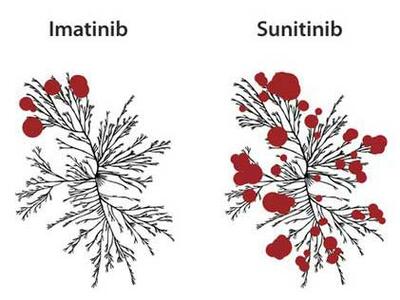
Sunitinib and Sorafenib Ineffective as Adjuvant Therapies for Kidney Cancer
Results from a recent clinical trial show that post-surgical therapy with two anti-angiogenesis drugs does not improve progression-free survival for patients with kidney cancer and may cause serious side effects.
-
Drug Combination Shrinks Duodenal Polyps in People with Familial Adenomatous Polyposis
In a small clinical trial of people with an inherited condition that greatly increases gastrointestinal cancer risk, a two-drug combination shrank precancerous lesions in the duodenum.
-
Blocking Calcium Transfer May Selectively Kill Cancer Cells
A new study shows that blocking the transfer of calcium ions (Ca2+) into mitochondria is toxic to cancer cells and impairs growth of tumors in mice, while sparing normal cells.
-
New Strategy for Treating Advanced Ovarian Cancer Shows Promise in Mice
The use of a protein fragment to stimulate cells in the tumor microenvironment against cancer shows promise in animal models of metastatic ovarian cancer.
-
Crizotinib Approval Expanded for Advanced Lung Cancer
The FDA has approved uses of the targeted therapy crizotinib (Xalkori®) for patients with advanced lung cancer whose tumors have alterations in the ROS1 gene.
-
High-Magnification Microscopy Visualizes Tumor Blood Vessels in Real Time
High-powered intravital microscopy reveals that 50 percent of blood vessels in melanoma tumors do not have any blood flow, according to a new study.
-
Keeping Pace: How New Data Can Affect Ongoing Clinical Trials
Research results sometimes outrace the design of an ongoing clinical trial and the trial has to be recalibrated to include newer treatments, according to NCI’s Dr. Jo Anne Zujewski.
-
Novel Strategy Isolates Immune Cells in the Blood that Recognize Melanoma
NCI scientists have developed a novel strategy for identifying immune cells circulating in the blood that recognize specific proteins on tumor cells, a finding they believe may have potential implications for immune-based therapies.
-
HPV Infections Targeted by Vaccine Decrease in U.S.
Infection with human papillomavirus (HPV) types targeted by the quadrivalent HPV vaccine has declined by nearly two-thirds among teenage girls since HPV vaccination was recommended in the United States.
-
Fueling Basic Discovery: NCI’s Cooperative Human Tissue Network
Quality biospecimens are a foundational resource for cancer research. One of NCI’s longest running biospecimen programs is the Cooperative Human Tissue Network, a resource mainly for basic discovery and early translational research.
-
BRCA Testing Rates High in Young Women with Breast Cancer
Testing for genetic mutations strongly associated with an increased risk of breast cancer has risen dramatically among women younger than age 40 who are diagnosed with the disease, according to a new study.
-
Missed Radiation Therapy Sessions Increase Risk of Cancer Recurrence
Patients who miss radiation therapy sessions during cancer treatment have an increased risk of their disease returning, even if they eventually complete their course of radiation treatment, according to a new study.